What? Two blog entries in a single day? Astounding.
Each semester I teach, it seems that I find myself repeating ideas in different lessons. Enough repetitions and the idea takes on the aura of a theme.
Starting the semester is always interesting because I don't know what themes will bubble to the surface.
We're about at our halfway point in the semester and I believe two themes have arisen:
Play the Hand You're Dealt
This of course is a poker term. Hey, we all want to be in ideal situations. At least some of my students would love have full scholarships to Juilliard with plenty of time to practice every day, good meals to eat, a great circle of friends, inspiring conductors, 8 hours of sleep each night, etc.
Just like in poker, it's hard to lose if you keep getting royal flushes and full houses.
The real question is: how do you respond to a situation that is less than ideal?
I think this is especially relevant in professional orchestras where a young, highly motivated player joins the group and discovers that some of the people around him/her have, shall we say, "lost that spark."
Playing is a Natural Extension of Breathing
So often I need to deal with tension issues in people's playing. I find it interesting that, when someone puts down the horn and just takes a natural, full breath, most of the tension disappears. What is it about the act of picking the horn and looking at music that causes the body to tense up so much? Rhetorical question, really. Obviously these are learned responses that have to be replaced with more effective learned responses.
I like exercises that reinforce the notion that playing the horn isn't so radically different from full breathing.
Here's one idea: try "blowing through" a difficult pattern. In other words, pick up the horn and pretend to play (moving your slide and everything) but simply blow air through the instrument. Make it "musical air" that reflects the phrases you want. I'm guessing you'll find a lot of the tension is gone.
Monday, February 27, 2006
Me and Sasha
As a musician, I love the Olympics. Things have been pretty busy but I managed to watch as much of the games as I could. Having taken auditions, I can begin to relate to the pressure the athletes must feel as they train for so long only to have everything crystalize into one "live or die" moment.
As I watched Sasha Cohan skate her first program, an interesting parallel occured to me, an audition I'd rather forget.
SASHA: Skating a clean first program. Nice jumps. Good confidence.
ME: Good first round. Stuck to my game plan. Played well. (I found out later they almost decided to stop the audition right there).
SASHA: Here comes the press. "Sasha is the leader. Sasha has trouble skating two clean programs in a row. Will Sasha choke?"
ME: The conventional wisdom: he already won a one-year position with the orchestra before. He's the professor at USC. Of course he'll easily win this audition right? In other words, everything to lose, nothing to gain. [Not quite the same as Sasha, I'll admit. Maybe this post should be titled "Me and Irena"]
SASHA: Second program, first jump...she falls. Stumbles on the second jump. Finishes well but it's too late. Now the press hounds will be all over her.
ME: Second round, first note (Mahler 3). I butcher the first note. I have some idea why: I tried to play too loud, I had been messing with lead pipes and a new valve, I was nervous, I didn't warm-up or get focused for the second round. Still, same result: I sent that note to Baghdad with no return address. They should have called in the janitors to mop it up as it lay quivering on the floor. A colleague on the other side of the screen said the conductor's body just went rigid as if some electric shock had been delivered. This was followed by some furious scribbling in his notes. Not a good sign, I believe.
SASHA: Ends up with a silver medal.
ME: I end up losing the audition and having to tell everyone I blew it when I was supposed to coast to victory.
OK, Sasha's a lot prettier and more famous. But, on some level, I can really relate. When the smoke clears, life goes on and we are all older and (hopefully) wiser.
As I watched Sasha Cohan skate her first program, an interesting parallel occured to me, an audition I'd rather forget.
SASHA: Skating a clean first program. Nice jumps. Good confidence.
ME: Good first round. Stuck to my game plan. Played well. (I found out later they almost decided to stop the audition right there).
SASHA: Here comes the press. "Sasha is the leader. Sasha has trouble skating two clean programs in a row. Will Sasha choke?"
ME: The conventional wisdom: he already won a one-year position with the orchestra before. He's the professor at USC. Of course he'll easily win this audition right? In other words, everything to lose, nothing to gain. [Not quite the same as Sasha, I'll admit. Maybe this post should be titled "Me and Irena"]
SASHA: Second program, first jump...she falls. Stumbles on the second jump. Finishes well but it's too late. Now the press hounds will be all over her.
ME: Second round, first note (Mahler 3). I butcher the first note. I have some idea why: I tried to play too loud, I had been messing with lead pipes and a new valve, I was nervous, I didn't warm-up or get focused for the second round. Still, same result: I sent that note to Baghdad with no return address. They should have called in the janitors to mop it up as it lay quivering on the floor. A colleague on the other side of the screen said the conductor's body just went rigid as if some electric shock had been delivered. This was followed by some furious scribbling in his notes. Not a good sign, I believe.
SASHA: Ends up with a silver medal.
ME: I end up losing the audition and having to tell everyone I blew it when I was supposed to coast to victory.
OK, Sasha's a lot prettier and more famous. But, on some level, I can really relate. When the smoke clears, life goes on and we are all older and (hopefully) wiser.

Wednesday, February 22, 2006
Weblog Backlog: Data Dump Needed
Too busy! Many weblog ideas waiting to be posted!
Reaching critical mass! Must dump ideas!
Analogy: rubato like stretching chewing gum. You know, kids stretching chewing gum outside their mouths. How far can you stretch without breaking the gum? Rubato 16th notes: how far can you stretch until they really aren't recognizable as 16th notes any more?
Visual Aids: music has tension and release. How about making a copy of your solo. Use colored highlighting pens to indicate points of tension and release. How about red for the notes of greatest musical tension and green or blue for points of release?
Trombone Placemat: Remember those laminated placemats with things like a map of the U.S. and diagrams of the planets? To get around those bumps on the Manhassett stand (hard to write on), I have an unfolded file folder on the stand to provide a smooth writing surface. It was only a matter of time until I started writing quick notes/illustrations on it. But wait..a lot of the same ideas come up in different lessons. Maybe I should jot down some of my favorites in advance and then have sitting there ready to go. OK, maybe laminating it would be serious overkill.
Renotating: Some licks become strangely easier to play through simple renotation. Take Elegy for Mippy 2. That swing section in the middle would probably be a lot easier to play if it were notated differently. Once I wrote out the second page of the Creston middle movement using flats instead of sharps. Not only was it easier to read, it seemed much easier to play all those high notes.
Time permitting, I'd like to post some of these renotations on the website.
The Trauma of Sharps: Why wait to introduce sharps to beginners? Waiting only makes the experience more traumatic later. I think it might be better to jump right in with sharps at the beginning when everything is new anyway.
System pressure returning to normal.
Reaching critical mass! Must dump ideas!
-------DATA DUMP COMMENCING-----
Analogy: rubato like stretching chewing gum. You know, kids stretching chewing gum outside their mouths. How far can you stretch without breaking the gum? Rubato 16th notes: how far can you stretch until they really aren't recognizable as 16th notes any more?
Visual Aids: music has tension and release. How about making a copy of your solo. Use colored highlighting pens to indicate points of tension and release. How about red for the notes of greatest musical tension and green or blue for points of release?
Trombone Placemat: Remember those laminated placemats with things like a map of the U.S. and diagrams of the planets? To get around those bumps on the Manhassett stand (hard to write on), I have an unfolded file folder on the stand to provide a smooth writing surface. It was only a matter of time until I started writing quick notes/illustrations on it. But wait..a lot of the same ideas come up in different lessons. Maybe I should jot down some of my favorites in advance and then have sitting there ready to go. OK, maybe laminating it would be serious overkill.
Renotating: Some licks become strangely easier to play through simple renotation. Take Elegy for Mippy 2. That swing section in the middle would probably be a lot easier to play if it were notated differently. Once I wrote out the second page of the Creston middle movement using flats instead of sharps. Not only was it easier to read, it seemed much easier to play all those high notes.
Time permitting, I'd like to post some of these renotations on the website.
The Trauma of Sharps: Why wait to introduce sharps to beginners? Waiting only makes the experience more traumatic later. I think it might be better to jump right in with sharps at the beginning when everything is new anyway.
-----DATA DUMP COMPLETE.------
System pressure returning to normal.
Wednesday, February 08, 2006
Hey Cupid (a.k.a. Hey Santa part 2)
OK, so Christmas is over and I never made my second request.
Here's one:
Maybe a special mouthpiece with a little valve at the stem. If you start to use too much pressure, the valve closes.
Actually, hasn't there been an invention like this before (ah, searching through the land of my vague memories)?
Other ways to reduce mouthpiece pressure (the "high blood pressure" of brass playing).
Here's one:
Maybe a special mouthpiece with a little valve at the stem. If you start to use too much pressure, the valve closes.
Actually, hasn't there been an invention like this before (ah, searching through the land of my vague memories)?
Other ways to reduce mouthpiece pressure (the "high blood pressure" of brass playing).
- While playing a medium-high note, slowly take the trombone off the face. Eventually, the note will break up. How much can you lower the pressure before losing the note?
- While holding that same note (or higher?) have a friend stand behind you and, unannounced, gently push the trombone off your face.
- Stand with your back to the wall and play ascending lip slurs. The wall should prevent you from pushing in.
Tuesday, January 24, 2006
Professing, Middle Fingers and Taoism
Students from the music school sometimes see me out in public (like in Sam's club as I'm getting socks). This one student walked by, smiled and said, "Hi, Professor."
It's my seventh year at USC and 10th year teaching college full time and, still, it is disconcerting when someone calls me "professor."
I guess it's nice for my ego. Certainly I've learned a lot and I think I share it well. Still, I've never been comfortable as a big authority figure.
Sometimes my students are surprised when they mention a piece of music I don't know.
I learn from my students. I think that makes me a stronger teacher, not a weaker one.
Here are two new things my students have mentioned:
One of my students shared with me some comments about slide technique from an Alessi master class. As I understood it, Alessi was suggesting that the thumb shouldn't be too flexible. Instead it should be like an extension of the arm.
Another student just visited the Edwards trombone factory to buy a new horn. The factory rep talked about gripping the slide between the thumb and the middle finger (as opposed to the second finger). Apparently there is a tendon that leads through the arm directly to that middle finger. Therefore, one's slide placement should be more consistent.
I never thought much about how to hold the slide. I've always taught: a light grip and keep it comfortable. I even have a section on my bonezone website where I talk about all the "spring hinges" from the shoulder to the tips of the fingers. Hmm, I may have to revise that.
I hope I never stop learning from my students (or from any other source). As soon as I stop growing and learning, I need to get out of this business.
I need to reopen that copy of the Tao te Ching...
Here's one:
Knowing you don't know is wholeness.
It's my seventh year at USC and 10th year teaching college full time and, still, it is disconcerting when someone calls me "professor."
I guess it's nice for my ego. Certainly I've learned a lot and I think I share it well. Still, I've never been comfortable as a big authority figure.
Sometimes my students are surprised when they mention a piece of music I don't know.
I learn from my students. I think that makes me a stronger teacher, not a weaker one.
Here are two new things my students have mentioned:
One of my students shared with me some comments about slide technique from an Alessi master class. As I understood it, Alessi was suggesting that the thumb shouldn't be too flexible. Instead it should be like an extension of the arm.
Another student just visited the Edwards trombone factory to buy a new horn. The factory rep talked about gripping the slide between the thumb and the middle finger (as opposed to the second finger). Apparently there is a tendon that leads through the arm directly to that middle finger. Therefore, one's slide placement should be more consistent.
I never thought much about how to hold the slide. I've always taught: a light grip and keep it comfortable. I even have a section on my bonezone website where I talk about all the "spring hinges" from the shoulder to the tips of the fingers. Hmm, I may have to revise that.
I hope I never stop learning from my students (or from any other source). As soon as I stop growing and learning, I need to get out of this business.
I need to reopen that copy of the Tao te Ching...
Here's one:
Knowing you don't know is wholeness.
Thinking you know is a disease.
Only by recognizing that you have an illness
can you move to seek a cure.
Monday, January 09, 2006
Droning Away
After years of struggle, it appears victory is at hand.
OK, maybe a little too dramatic but it has been years and it has been something of a struggle.
To the point..
Ever since I bought and started using the Bootcamp CD from Tune-Up Systems (http://www.tuneupsystems.com/) I have wanted to make a basic drone CD. Over the years I've tried many solutions with varying degrees of success.
Now, thanks to some freeware on the web, I'm close to a viable tuning CD. (Boring for you, maybe, but satisfying for me).
Here are the links for the freeware..
Wavepad Audio Editor: http://www.nch.com.au/wavepad/
NCH Tone Generator: http://www.nch.com.au/tonegen/index.html
I think they've even updated this software over the stuff I've downloaded and am using. Since you can set the tone generator to any frequency, it only takes some patience (well, a lot of patience) and a pocket calculator.
2:1 octave
3:2 perfect fifth (or multiply the root frequency by 1.5)
5:4 major third (or multiply the root frequency by 1.25)
10:4 major tenth (root times 2.5)
I haven't done the minor chords yet but the following math should work.
6:5 minor third (root times 1.2)
12:5 minor tenth (root times 2.4)
Basically, I set up the frequencies I want, record them in wave pad and then mix them together (an option listed under "edit" in wavepad).
A few other comments:
I preferred triangle waves.
On major chords, I mixed the higher voices in at less then 100% so they wouldn't dominate.
In wavepad, I ultimately decided to include multiple octaves of one tone in a single file.
Also, save the files as .wav format, not .mp3. Much higher quality (sadly, much larger file sizes too).
The end result: something to play along with to ensure you are in tune. In other words, tuning with the ears, not the eyes. A little thing, maybe, but worth it's weight in gold. Here's a brief ten-second example of a major chord:
http://www.bonezone.org/downloads/sound/drones/CMaj.WAV
Soon, I'll at least have a CD for my students to practice with. I'm still not sure what else to do with this project. The files are too large to post on the web. Commercial product? Free zip files?
I do think this is a valuable tool everyone should be using.
OK, maybe a little too dramatic but it has been years and it has been something of a struggle.
To the point..
Ever since I bought and started using the Bootcamp CD from Tune-Up Systems (http://www.tuneupsystems.com/) I have wanted to make a basic drone CD. Over the years I've tried many solutions with varying degrees of success.
Now, thanks to some freeware on the web, I'm close to a viable tuning CD. (Boring for you, maybe, but satisfying for me).
Here are the links for the freeware..
Wavepad Audio Editor: http://www.nch.com.au/wavepad/
NCH Tone Generator: http://www.nch.com.au/tonegen/index.html
I think they've even updated this software over the stuff I've downloaded and am using. Since you can set the tone generator to any frequency, it only takes some patience (well, a lot of patience) and a pocket calculator.
2:1 octave
3:2 perfect fifth (or multiply the root frequency by 1.5)
5:4 major third (or multiply the root frequency by 1.25)
10:4 major tenth (root times 2.5)
I haven't done the minor chords yet but the following math should work.
6:5 minor third (root times 1.2)
12:5 minor tenth (root times 2.4)
Basically, I set up the frequencies I want, record them in wave pad and then mix them together (an option listed under "edit" in wavepad).
A few other comments:
I preferred triangle waves.
On major chords, I mixed the higher voices in at less then 100% so they wouldn't dominate.
In wavepad, I ultimately decided to include multiple octaves of one tone in a single file.
Also, save the files as .wav format, not .mp3. Much higher quality (sadly, much larger file sizes too).
The end result: something to play along with to ensure you are in tune. In other words, tuning with the ears, not the eyes. A little thing, maybe, but worth it's weight in gold. Here's a brief ten-second example of a major chord:
http://www.bonezone.org/downloads/sound/drones/CMaj.WAV
Soon, I'll at least have a CD for my students to practice with. I'm still not sure what else to do with this project. The files are too large to post on the web. Commercial product? Free zip files?
I do think this is a valuable tool everyone should be using.
Sunday, December 11, 2005
Scales? Why? How?
A short post tonight...
Scales: love 'em, hate 'em ..can't live without 'em.
But why, exactly, do we do them?
I think it boils down to two main things..
How well does this translate to new material?
I like to think of a scale as a template.
Instead of one specific pattern, apply a wide variety of patterns to the same set of notes.
Something like this..
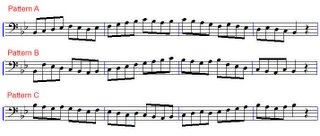
So, by mastering a variety all based on the same scale, you learn the template instead of one pattern.
Thus, when you encounter a new pattern, you can more quickly spot the template and master the new pattern.
Scales: love 'em, hate 'em ..can't live without 'em.
But why, exactly, do we do them?
I think it boils down to two main things..
- Develop the ability to "get around" the horn quickly and well (relaxed, in-tune, good sound...)
- Develop the ability to learn new music more quickly by quickly spotting familiar patterns.
How well does this translate to new material?
I like to think of a scale as a template.
Instead of one specific pattern, apply a wide variety of patterns to the same set of notes.
Something like this..

So, by mastering a variety all based on the same scale, you learn the template instead of one pattern.
Thus, when you encounter a new pattern, you can more quickly spot the template and master the new pattern.
Thursday, December 01, 2005
Hey Santa! (part 1)
My kids are starting on their Christmas lists. Once again a pony will not appear under the tree.
Here's something I'd like for Christmas, a sort of magic box. It should have:
I suppose you could throw in Smart Music studio with lots more useful accompaniments, too.
Here's the kicker: all this has either been done or is easily do-able. I think , if well -marketed, it would sell. But alas, performers are increasingly a niche market. The big sales bucks aren't there to justify the cost. Or are they?
Doubt I'll have see such a box, but maybe Santa has a soft spot in his heart for musicians.
I welcome comments on this one.
Maybe we can start a movement (hey, I can dream can't I?)
Here's something I'd like for Christmas, a sort of magic box. It should have:
- A tuner with an easy to read display
- A metronome
- A digital recorder that records directly to a digital memory (mp3?). This recorder should be able to directly upload to a computer through a USB connection.
- Good speakers.
- A set of oscillators which can send drone pitches through those speakers. Also the oscillators should be able to play intervals and chords in just intonation (similar to the Tune-Up system but programmable to your needs).
- A remote control so you can tape yourself without many trips back and forth to hit the record and playback buttons.
I suppose you could throw in Smart Music studio with lots more useful accompaniments, too.
Here's the kicker: all this has either been done or is easily do-able. I think , if well -marketed, it would sell. But alas, performers are increasingly a niche market. The big sales bucks aren't there to justify the cost. Or are they?
Doubt I'll have see such a box, but maybe Santa has a soft spot in his heart for musicians.
I welcome comments on this one.
Maybe we can start a movement (hey, I can dream can't I?)
Monday, November 21, 2005
Speaking of Concerts and Auditions
Tonight was Fall Trombone Night. I was very happy with the outcome. When things go this well, I feel as if I'm riding a wave.
Congratulations, everyone!
I've also been spending a lot of time going over the ensemble placement audition recordings. Here at USC, auditions are recorded and I receive a CD to review. I go through the whole CD once and then, with the luxury of each selection having its own track, I started at the highest scored lyrical selection (or technical, or sight-reading) and then jump around hearing them not in audition order but in the order I initially scored them.
In other words, I start with the track I scored highest and work my way down. This allows me to hear to selections side by side and make sure the scores are consistent. True, this is time-consuming but I know my students have a lot at stake and I want to make sure I get it right.
All this reminds me of experiences I had auditioning when I was a student. There was one guy in the studio who, as far as we could tell, was mildly autistic (or at least had some kind of developmental disorder). He wasn't the best player in the studio, but when auditions came around, he didn't became even slightly nervous. Thus, he played pretty much exactly the same way whether in the practice room or in the audition.
Other players would have to deal with nerves and sometimes end up not playing us well under pressure as they had practiced.
I think it drove some people nuts to be "stronger" players but unable to prove it in auditions while this guy simply continued on his even keel.
Here's this idea in graph form:
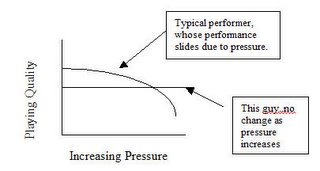
Of course, I have included a third curve which goes up as pressure increases. This kind of player is sometime referred to as a "money player."
Another way to think of it..
There are two skills in music:
The conclusion: you need to have both skills in order to succeed.
Congratulations, everyone!
I've also been spending a lot of time going over the ensemble placement audition recordings. Here at USC, auditions are recorded and I receive a CD to review. I go through the whole CD once and then, with the luxury of each selection having its own track, I started at the highest scored lyrical selection (or technical, or sight-reading) and then jump around hearing them not in audition order but in the order I initially scored them.
In other words, I start with the track I scored highest and work my way down. This allows me to hear to selections side by side and make sure the scores are consistent. True, this is time-consuming but I know my students have a lot at stake and I want to make sure I get it right.
All this reminds me of experiences I had auditioning when I was a student. There was one guy in the studio who, as far as we could tell, was mildly autistic (or at least had some kind of developmental disorder). He wasn't the best player in the studio, but when auditions came around, he didn't became even slightly nervous. Thus, he played pretty much exactly the same way whether in the practice room or in the audition.
Other players would have to deal with nerves and sometimes end up not playing us well under pressure as they had practiced.
I think it drove some people nuts to be "stronger" players but unable to prove it in auditions while this guy simply continued on his even keel.
Here's this idea in graph form:
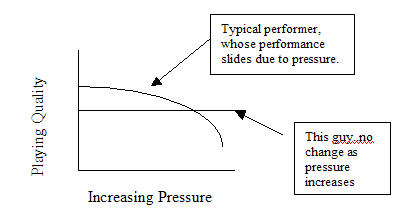
Of course, I have included a third curve which goes up as pressure increases. This kind of player is sometime referred to as a "money player."
Another way to think of it..
There are two skills in music:
- Instrumental skill
- Performing skill
The conclusion: you need to have both skills in order to succeed.
Saturday, November 12, 2005
Koussevitsky, RAM and Perlman
Here's a first. I'm posting this from a public wifi hot spot in Augusta, GA. Very 21st century.
I'm in town doing a concert with the Augusta Symphony. One piece on the program: the Koussevitsky Double Bass Concerto.
Now apparently, the only copies of this concerto are bad manuscript. So our soloist has prepared a Finale edition of score and parts. One problem: mistakes.
For example, trombone parts without any rehearsal letters. (and of course no cues!). So there we are trying to count 66 measures and then come in on one chord.
I'm in town doing a concert with the Augusta Symphony. One piece on the program: the Koussevitsky Double Bass Concerto.
Now apparently, the only copies of this concerto are bad manuscript. So our soloist has prepared a Finale edition of score and parts. One problem: mistakes.
For example, trombone parts without any rehearsal letters. (and of course no cues!). So there we are trying to count 66 measures and then come in on one chord.
Mildly annoying.
Wait, I'm going somewhere with this. At one point, a woodwind principal asks the conductor if he's conducting in 2 or in 4. He expresses mild irritation because it should be obvious. He's right, BUT, that poor musician is already dealing with a mistake-ridden part. I get the impression that dealing with the bad part is occupying so much attention that less is left for other issues.
Come to think of it, uncertainty doesn't exactly help tone quality.
I also bought a laser printer today. I'm looking over the memory specs and decide to pass on the 2 mb model and pay more for the 8 mb model. I'm figuring, more memory, better hendling of print jobs.
Wait, our attention is like that RAM on the printer. Although flexible, we have some kind of limit. If we use up RAM on bad parts, we have less left for other issues.
Years ago, 60 minutes interviewed Itzhak Perlman. He said he practiced scales while watching sports on TV. At the time I was stunned, shocked, horrified (well not really).
But think about it, if the scales is automatic, that frees up memory to focus on phrasing, balance, and other higher level stuff.
I'm not leading up to some grand moral of the story. Draw your own conclusions.
(I hope you liked the hand-dandy color coding. free of charge.)
Wait, I'm going somewhere with this. At one point, a woodwind principal asks the conductor if he's conducting in 2 or in 4. He expresses mild irritation because it should be obvious. He's right, BUT, that poor musician is already dealing with a mistake-ridden part. I get the impression that dealing with the bad part is occupying so much attention that less is left for other issues.
Come to think of it, uncertainty doesn't exactly help tone quality.
I also bought a laser printer today. I'm looking over the memory specs and decide to pass on the 2 mb model and pay more for the 8 mb model. I'm figuring, more memory, better hendling of print jobs.
Wait, our attention is like that RAM on the printer. Although flexible, we have some kind of limit. If we use up RAM on bad parts, we have less left for other issues.
Years ago, 60 minutes interviewed Itzhak Perlman. He said he practiced scales while watching sports on TV. At the time I was stunned, shocked, horrified (well not really).
But think about it, if the scales is automatic, that frees up memory to focus on phrasing, balance, and other higher level stuff.
I'm not leading up to some grand moral of the story. Draw your own conclusions.
(I hope you liked the hand-dandy color coding. free of charge.)
Thursday, November 10, 2005
Adding Post-It Notes to My Blocks
I tried something new in a few lessons today.
You might remember a previous blog entry where I compared Lego MyBlocks to chunks of complicated licks perhaps better performed from memory.
This idea has stuck with me. Here's a new spin...
I could bore you to death waxing on and on about the path from notation to sound concept to results and how most young musicians can't form much of a sound concept and how, in France, beginning music students must sight-sing before they pick up the instrument and blah blah blah. But I won't.
Instead, I'll just say: cool! A new one for my bag of tricks!
(mustn't get stale)
You might remember a previous blog entry where I compared Lego MyBlocks to chunks of complicated licks perhaps better performed from memory.
This idea has stuck with me. Here's a new spin...
- I had the student isolate a tricky passage.
- Then they memorized it.
- Then I had them play it a few times while looking out the window (hey, it was a beautiful day to watch them demolish the Heart of Columbia Hotel out my window).
- THEN, (and here's the cool part) I covered the passage in question with part of a post-it note.
- I asked the student to start somewhere before the passage in question and play through the part they had memorized.
I could bore you to death waxing on and on about the path from notation to sound concept to results and how most young musicians can't form much of a sound concept and how, in France, beginning music students must sight-sing before they pick up the instrument and blah blah blah. But I won't.
Instead, I'll just say: cool! A new one for my bag of tricks!
(mustn't get stale)
Thursday, November 03, 2005
Ding Slurp
OK psychology fans: remember Pavlov and the dogs.
Quick summary: Pavlov serves food and rings a bell. Dogs salivate over the food. Eventually, he rings the bell without any food present but the dogs salivate anyway. I believe this is called a conditioned response.
Stimulus: bell
Response: salivation
This theory is sometimes called the "Ding-Slurp" theory.
Think about a tricky passage..
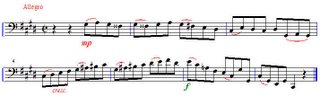
All too easily you can end up with:
Stimulus: Music
Response: Tension
Tension bad, very bad.
How to turn this around? Try looking at the tricky passage but play it in a simple, lyrical style (slow, smooth, totally relaxed). The key is to look at the notes as you play in a relaxed style. You are trying to build this..
Stimulus: Music
Response: Relaxation
It might work. At least it's worth a try.
Quick summary: Pavlov serves food and rings a bell. Dogs salivate over the food. Eventually, he rings the bell without any food present but the dogs salivate anyway. I believe this is called a conditioned response.
Stimulus: bell
Response: salivation
This theory is sometimes called the "Ding-Slurp" theory.
Think about a tricky passage..

All too easily you can end up with:
Stimulus: Music
Response: Tension
Tension bad, very bad.
How to turn this around? Try looking at the tricky passage but play it in a simple, lyrical style (slow, smooth, totally relaxed). The key is to look at the notes as you play in a relaxed style. You are trying to build this..
Stimulus: Music
Response: Relaxation
It might work. At least it's worth a try.
Tuesday, November 01, 2005
Bozza and My Blocks
I am coaching my son's lego league team. If you're curious, here's a link:
http://www.firstlegoleague.org/
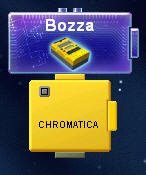
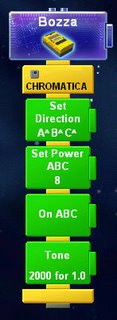
In programming these little robots, we use the Lego Robotics Invention System. Basically, the kids learn to program by connecting blocks on the screen (like, "Forward 10 seconds").
Pretty cool.
You can create custom blocks called "My Blocks." Each block is a "basket" of little commands,
....like a subroutine
One of my students is tackling Bozza's New Orleans, a jazz-influenced chromatic French piece. He sometimes gets hung up on some of the chromatic passages. In the last lesson, we tried the strategy of quickly memorizing chunks of music and working them up without looking at the page.
When I play complicated, chromatic passages, I look at the passage but then essentially play the pattern that I have memorized. I glance at the passage and, hopefully, it evokes my memory of the lick. Instead of focusing on individual notes, I try to automatically play the whole chunk,
...like a subroutine.
Treat complicated licks like those Lego "My Blocks" As you play the piece, hopefully the sight of the lick will trigger a mental subroutine which can be played automatically.
http://www.firstlegoleague.org/
In programming these little robots, we use the Lego Robotics Invention System. Basically, the kids learn to program by connecting blocks on the screen (like, "Forward 10 seconds").
Pretty cool.
You can create custom blocks called "My Blocks." Each block is a "basket" of little commands,
....like a subroutine
One of my students is tackling Bozza's New Orleans, a jazz-influenced chromatic French piece. He sometimes gets hung up on some of the chromatic passages. In the last lesson, we tried the strategy of quickly memorizing chunks of music and working them up without looking at the page.
When I play complicated, chromatic passages, I look at the passage but then essentially play the pattern that I have memorized. I glance at the passage and, hopefully, it evokes my memory of the lick. Instead of focusing on individual notes, I try to automatically play the whole chunk,
...like a subroutine.
Treat complicated licks like those Lego "My Blocks" As you play the piece, hopefully the sight of the lick will trigger a mental subroutine which can be played automatically.


Tuesday, October 25, 2005
Weebles, Randall Cunningham and Headlights
Weebles wobble but they don't fall down...
 Randall Cunningham could get hit and somehow stay on his feet. (Anybody remember that Giants game years ago when he get clobbered .. almost completely upended but came down on his feet to throw a touchdown pass. Still the greatest play I have ever seen.)
No, this isn't that play but you get the idea..

And the headlights, you ask?
you're driving down the road at night and hit a nasty bump. You're annoyed you didn't see it in time to swerve. You think, "Man that was a bad pothole. "
You turn around to look back at the hole instead of where the headlights are pointed.
you're driving down the road at night and hit a nasty bump. You're annoyed you didn't see it in time to swerve. You think, "Man that was a bad pothole. "
You turn around to look back at the hole instead of where the headlights are pointed.
That's when you hit the tree.
Get it?
Monday, October 24, 2005
Speaking of the Devil
I heard recently that Craig Mulcahy, principal trombonist of the Kennedy Center Opera Orchestra, won the second chair in the National Symphony.
Thinking of the Kennedy Center Opera brings back two memories: one good, one bad.
First the good:
Years age, I was hired as a freelancer to play some offstage brass licks during a production of Boito's Mephistopholes. Samuel Ramey sang the role of the devil. In one big scene, the devil has his big aria (his triumphant moment). Ramey leaps onto a table (shirtless) and belts out this incredibly resonant sound. Every night, the offstage brass guys would immediately stop chatting and simply listen to Ramey's incredible sound. Since the guy was shirtless, you could see that he was totally relaxed.
It was amazing to hear that much sound come from any human body with so little effort.
I'll never forget it!
Now the bad:
At some points during this opera, multiple brass choirs spread out through the hall play "trumpet calls" back and forth. Sometimes, two trumpets, far apart must perfectly match pure fifths and octaves. Here's the kicker: when we played, we could only hear ourselves, *not* the other ensemble!
Tell me this: how do you tune to someone you can't hear?
Of all the times I've seen trumpet players plop tuners on a stand during the gig (a pet peeve of mine) this was the only time it was really called for. They didn't do it, though.
Not a happy ending: things didn't sound too good and the pit orchestra players were annoyed with us.
This raises a vexing puzzle: one of the pit trumpet players kept telling us: "Remember, the pitch drops when you're farther away!"
Wait, think about that.
But think about it: a trumpet bell vibrates at 440 cycles per second and those little compressions of the air start traveling at the speed of sound towards you. If that trumpet player holds the note for a second, we've got 440 compressions flying through the air. You'll hear a note lasting for a second. If, in fact, they arrive at a frequency of 438 cycles per second, where did those other compressions go.
Hmmm...
Thinking of the Kennedy Center Opera brings back two memories: one good, one bad.
First the good:
Years age, I was hired as a freelancer to play some offstage brass licks during a production of Boito's Mephistopholes. Samuel Ramey sang the role of the devil. In one big scene, the devil has his big aria (his triumphant moment). Ramey leaps onto a table (shirtless) and belts out this incredibly resonant sound. Every night, the offstage brass guys would immediately stop chatting and simply listen to Ramey's incredible sound. Since the guy was shirtless, you could see that he was totally relaxed.
It was amazing to hear that much sound come from any human body with so little effort.
I'll never forget it!
Now the bad:
At some points during this opera, multiple brass choirs spread out through the hall play "trumpet calls" back and forth. Sometimes, two trumpets, far apart must perfectly match pure fifths and octaves. Here's the kicker: when we played, we could only hear ourselves, *not* the other ensemble!
Tell me this: how do you tune to someone you can't hear?
Of all the times I've seen trumpet players plop tuners on a stand during the gig (a pet peeve of mine) this was the only time it was really called for. They didn't do it, though.
Not a happy ending: things didn't sound too good and the pit orchestra players were annoyed with us.
This raises a vexing puzzle: one of the pit trumpet players kept telling us: "Remember, the pitch drops when you're farther away!"
Wait, think about that.
WARNING:
TECHNICAL DISCUSSION APPROACHING.
DO NOT READ THIS AND OPERATE HEAVY MACHINERY
I'm not talking about the doppler effect. I'm talking someone standing still 50 yards away from you. When they play a note into their tuner, will it be in tune on your tuner as well? I've heard many professional players insist it will be flat when it gets to you. TECHNICAL DISCUSSION APPROACHING.
DO NOT READ THIS AND OPERATE HEAVY MACHINERY
But think about it: a trumpet bell vibrates at 440 cycles per second and those little compressions of the air start traveling at the speed of sound towards you. If that trumpet player holds the note for a second, we've got 440 compressions flying through the air. You'll hear a note lasting for a second. If, in fact, they arrive at a frequency of 438 cycles per second, where did those other compressions go.
Hmmm...
Tuesday, October 18, 2005
Here's Lookin' at Ya, Fonzy
Here are some random strands that seem to weave together:
Masterclass Monday ... several bone chamber groups play through pieces. I had them play the same passage either pointing out or pointing at each other. What a difference.
Recent lessons ... I find some students chronically pointing down and under the stand as they play. The thing is, when they point out, they seem to sound better and they also *look* better.
Years ago in Baltimore ... I heard two horn recitals a few days apart, one a student, one a pro. The pro didn't have the best night. The thing was I went in with an expectation: "Here's a great player struggling a bit." Compare that to the student recital: "Here's a student who I am expecting to struggle."
Cincinnati Symphony Concerts ... Back when Marshall Carson was bass trombonist in the section, he used to sit off to the side of his stand and get his bell out. Tony Chipurn (who I knew could play with a lot of power), wouldn't point out with his bell. Way up in the nosebleed seats, I could hear Marshall clearly but not the rest of the section.
My Air Force Band days ... On tour, we were reminded to look our best: haircuts, uniform, posture. The saying, as I recall it, "People hear with their eyes."
I hated that saying but I gotta admit, there's some truth. How you look and behave affects expectations. It's very hard to listen with no pre-disposition. If you pick up visual clues that the performer is confident and poised, you tend to hear them differently.
So, what does all this mean?...
Stand tall, point your bell out there. It does really affect the projection of your sound *and* it affects others' perceptions of you.
What about that Fonzy part?
OK, I'm saying it helps to stand tall and look relaxed in performance. But what if you are nervous? What if you're a wreck?
Imagine you are in a high school play based on Happy Days. You have to play a "Fonzy" character. Back stage, you're nervous. But you need to saunter on stage and convince others you're the cool guy. Obvious, you're an actor.
Can you apply this to a trombone performance? Should you be an actor? Is that false, or is it a strategy?
One last thing: how you look may not only affect the perception of others; is there a chance that being a bit of an actor might affect your self-perception?
Whoa.
Masterclass Monday ... several bone chamber groups play through pieces. I had them play the same passage either pointing out or pointing at each other. What a difference.
Recent lessons ... I find some students chronically pointing down and under the stand as they play. The thing is, when they point out, they seem to sound better and they also *look* better.
Years ago in Baltimore ... I heard two horn recitals a few days apart, one a student, one a pro. The pro didn't have the best night. The thing was I went in with an expectation: "Here's a great player struggling a bit." Compare that to the student recital: "Here's a student who I am expecting to struggle."
Cincinnati Symphony Concerts ... Back when Marshall Carson was bass trombonist in the section, he used to sit off to the side of his stand and get his bell out. Tony Chipurn (who I knew could play with a lot of power), wouldn't point out with his bell. Way up in the nosebleed seats, I could hear Marshall clearly but not the rest of the section.
My Air Force Band days ... On tour, we were reminded to look our best: haircuts, uniform, posture. The saying, as I recall it, "People hear with their eyes."
I hated that saying but I gotta admit, there's some truth. How you look and behave affects expectations. It's very hard to listen with no pre-disposition. If you pick up visual clues that the performer is confident and poised, you tend to hear them differently.
So, what does all this mean?...
Stand tall, point your bell out there. It does really affect the projection of your sound *and* it affects others' perceptions of you.
What about that Fonzy part?
OK, I'm saying it helps to stand tall and look relaxed in performance. But what if you are nervous? What if you're a wreck?
Imagine you are in a high school play based on Happy Days. You have to play a "Fonzy" character. Back stage, you're nervous. But you need to saunter on stage and convince others you're the cool guy. Obvious, you're an actor.
Can you apply this to a trombone performance? Should you be an actor? Is that false, or is it a strategy?
One last thing: how you look may not only affect the perception of others; is there a chance that being a bit of an actor might affect your self-perception?
Whoa.
Thursday, October 13, 2005
Formulas, formulas
You may know this one (not original):
In other words, your performance is your potential (the best you can possibly play) minus all the stuff that holds you back.
Let me expand this ...
P - I = R
Potential minus interference equals result.In other words, your performance is your potential (the best you can possibly play) minus all the stuff that holds you back.
Let me expand this ...
P=SC + F
"SC" stands for sound concept. You're about to play a piece...do really know exactly how you want it to sound? (Be honest, have you marked in the breaths, decided on nuances like vibrato, degree of attack, etc.).
"F" stands for fundamentals. Assuming that you really know what you want the piece to sound like, do you have the command over your instrument to produce the exact result you hear in your head? Do you end up playing mezzo piano because you can't control your tone at piano? Do you resort to "wah" attacks because you can't "ping" the notes cleanly?
"D" stands for distraction. Anything that takes your mind off the task at hand. There are two types of distraction: external and internal. If a comet crashes through the roof during your performance, you might not play as well as planned. Internal distractions are any thoughts other than the phrase at hand. Thoughts like:
"Man, I hope I don't blow this."
"Wow, this is going really well."
"I wonder what the listeners think of me."
I like to think of nervousness as simply a matter of attention focus. If you are immersed in the phrase of the moment, it's hard to be nervous because you are focused away from yourself.
What does this all mean?
Well, maybe it can simplify things. If these formulas work, there are only four things you need to focus on:
Sound Concept
Fundamentals
Tension
Distraction
What else is there.
"F" stands for fundamentals. Assuming that you really know what you want the piece to sound like, do you have the command over your instrument to produce the exact result you hear in your head? Do you end up playing mezzo piano because you can't control your tone at piano? Do you resort to "wah" attacks because you can't "ping" the notes cleanly?
I=T+D
"T" stands for tension. If you allow your body to tense up in a performance, the fundamentals won't work to bring forward your sound concept. Relaxation is crucial."D" stands for distraction. Anything that takes your mind off the task at hand. There are two types of distraction: external and internal. If a comet crashes through the roof during your performance, you might not play as well as planned. Internal distractions are any thoughts other than the phrase at hand. Thoughts like:
"Man, I hope I don't blow this."
"Wow, this is going really well."
"I wonder what the listeners think of me."
I like to think of nervousness as simply a matter of attention focus. If you are immersed in the phrase of the moment, it's hard to be nervous because you are focused away from yourself.
What does this all mean?
Well, maybe it can simplify things. If these formulas work, there are only four things you need to focus on:
Sound Concept
Fundamentals
Tension
Distraction
What else is there.
(Sound Concept+Fundamentals) - (Tension+Distaction) = Result
Ouch, too much math for a trombone brain.
Ouch, too much math for a trombone brain.
Wednesday, October 12, 2005
Amnesia and the Invisible Soloist
Last Monday I gave my faculty recital. How did it go?
I think it went pretty well because I can't remember it too well. I've noticed this before. Here's what happens (I think)…
On one end: the composer. On the other end: the audience.
Your job? Disappear.
My favorite compliment isn't, "Gee, you played great." It's, "I really loved that piece."
The amnesia part? If I'm not self-aware while performing, I'm less likely to remember how it went.
The bad moments? I remember them all too well ….
Monday, October 10, 2005
Broken Tuning Slides, Stagnant Water and Anna Kournikova
Three thoughts from lessons today...
"Hey my tuning slide is broken!"
Ever notice a student play their tuning note, adjust the tuning slide, play the note again and see no change in the tuner?
I love the looks on their faces.
Ah, the power of inner hearing: if the inner ear wants to repeat the same note as before, it automatically directs the lip to bend the note to the same pitch as before, overcoming the power of the tuning slide. If you tune to a tuner and find yourself out of whack, you should *hear* a different pitch in your head as well as adjust your tuning slide.
Stagnant Water and Long Notes
Ever been hiking? If you needed to drink from a stream, would you choose the moving water or the water that is just sitting there?
(OK, I'm hoping the answer here is pretty obvious).
Long notes are like that. Don't let them become stagnant. They should always feel as if they are moving somewhere (either building or decaying).
Dinner with Anna
A student seemed to scrambling through a lyrical piece. I got the impression he wasn't really savoring the notes, just moving on to the next thing.
I asked him, "Who's the most beautiful woman in the world?" His immediate reply, "Anna Kournikova." I said, "So imagine you're having dinner with Anna Kournikova. Just for fun, let's assume that she is really fascinated with you in every way but will have to leave as soon as the meal is over. Would you want to rush through dinner or take your time? "
(OK, I'm hoping the answer here is pretty obvious)
"OK, imagine that this etude is your dinner with Anna. I'm guessing you're going to want to take your time and savor every moment for what it's worth."
Sexist maybe but well, it seemed to help ....
Thursday, October 06, 2005
Air, BASF and turtles
You know that BASF commercial? It goes something like..
"We don't make the things you buy. We make the things you buy better."
Air is like that.
It won't make your high range, but it'll make it better.
It won't make your articulation, but it'll make it better.
It won't make your tone, but .... you get the idea.
Have you ever heard that story about the anthropologist interviewing the tribal elder who insisted that the earth sits on the back of turtle. The anthropologist asks, "What is the turtle sitting on?" The elder replies, "Another turtle."
The anthropologist asks, "What's that turtle sitting on?"
The elder smiles, answering, "You can't fool me. It's turtles all the way down."
So, if your tone rests on your air, what does your air rely on?
Probably relaxation and posture. What does that rely on?
Probably habits and attitude. Below that?
Turtles?
"We don't make the things you buy. We make the things you buy better."
Air is like that.
It won't make your high range, but it'll make it better.
It won't make your articulation, but it'll make it better.
It won't make your tone, but .... you get the idea.
Have you ever heard that story about the anthropologist interviewing the tribal elder who insisted that the earth sits on the back of turtle. The anthropologist asks, "What is the turtle sitting on?" The elder replies, "Another turtle."
The anthropologist asks, "What's that turtle sitting on?"
The elder smiles, answering, "You can't fool me. It's turtles all the way down."
So, if your tone rests on your air, what does your air rely on?
Probably relaxation and posture. What does that rely on?
Probably habits and attitude. Below that?
Turtles?
Subscribe to:
Posts (Atom)