Showing posts with label technique. Show all posts

Wednesday, October 19, 2011

Icebergs, Dentists and ....Ramjack?


As I work with a student, I often find some little problem on the surface.
Sometimes that "little problem" is like the tip of the iceberg.

It's like finding a something on the surface of a tooth. As you drill down, you may find that the problem goes deeper than expected.
Maybe the attacks aren't very clean on Hungarian March.
Then you drill deeper...
  • and you find that the slide movement is sloppy
  • and there isn't really much air behind the attacks
And you drill deeper...
  • and you find that even major scales don't have an accurate slide
  • and there is a lot of tension inhibiting the breathing.

Cancel all my appointments, Mildred, this one's going to take a while.


It reminds me of new students who come in all ready to move on to the next super advanced piece. In their minds, they've built this wonderful 5-story "trombone building" and they think we will be moving on the add on the 6th and 7th stories.

Fundamentals? BORING

Instead, I'm more like the building inspector, heading down into the basement with my trusty flashlight. "Well, lookey here at this foundation. I'm afraid this isn't up to code. We could throw on that 6th story but the whole structure is becoming unstable."


Hmmm, maybe long tones are like the RamJack of trombone.


Wednesday, October 21, 2009

The Lips Don't Care...

So here's a saying that has been forming in my mind. Let me know what you think...


The lips don't care about the tongue.
They only care about air.

The horn doesn't care about the lips.
It only cares about vibration.

The audience doesn't care about the horn.
They only care about sound.


Perhaps it then follows that you should...

Focus more on: Air, Vibration, Sound

Focus less on: tongue, lips, horn

Monday, October 27, 2008

A Little Valve Thing...

Has anybody out there ever played Ewazen's Colchester Fantasy?
In the slow movement, you find this forte septuplet that calls for some serious faking.

I tried using my old "valve wiggle" trick....just keep blowing while you press/release the valve as quickly as possible. You can create some cool effects.

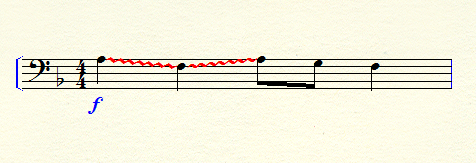
Then I thought it through a little more carefully and realized that by "articulating" with the valve, you could accurately play this lick.

Here it is (I'm working from memory here but you get the idea):


Play it fast without tonguing.

This reminds me of a Baltimore Opera gig I did years ago where we ran across this fast E major scale that was effectively unplayable on slide trombone.

It went something like this...


Through kidding around, we discovered that, if you just stayed in 2nd position and employed a healthy valve wiggle, you could simulate the run really well. In fact, when we tried it together, we both burst out laughing because it sounded like we had actually played it correctly.

Wednesday, March 07, 2007

Goofy Vibrato

Time to head on down to Orlando with the kids. So I guess a Disney spin is appropriate.


Here's a trick I've been using in some lessons. Buzz sustained notes with a ridiculously wide vibrato...one might say a Goofy Vibrato.

I think this helps in a few ways:
  1. It helps you develop your normal vibrato.
  2. It helps you find the center of the note.
  3. It strengthens the embouchure.
    Why? The embouchure corners must work harder to maintain the pitch when everything is shaking around.

Make sure that, as you buzz with that wide vibrato, you don't lose the center of the pitch. Also, make sure the air continues to flow.
You can also try goofy vibrato on the trombone (stay relaxed, keep the air moving!)

Tuesday, March 06, 2007

DGD? DDG?

How to triple tongue?

You can use Da-Ga-Da Da-Ga-Da etc.

or..

Da-Da-Ga Da-Da-Ga

Most of students cling to the first way and, having already learned it, are naturally reluctant to change.

Does it matter?

Well, why do we use the Ga syllable at all? To give the tip of the tongue a chance to reset.
Doesn't it logically follow that that weakest note is the second of the two "Da's"?

Usually when playing a string of triplets, don't we want to put a slight accent on the beginning of each triplet? If so, Da-Ga-Da Da-Ga-Da puts you at a disadvantage.

For my money, Da-Da-Ga is the way to go. This puts the weakest note in the middle.

Of course there are those purists who use...Da-Ga-Da Ga-Da-Ga (starting every other triplet with Ga).

Well, maybe for you but for me that's just too weird.

Friday, March 02, 2007

Bone Frogger

Sorry..long time since my last post. Other projects have gotten in the way.

Here's one way to think of practicing, it's a little like playing frogger...


Not the first part (with the cars) but the second with the lily pads. Well, at least sort of...

Suppose you're learning a new technique like......double tonguing. You can think of each stage of the learning process as a lily pad. You hop from lily pad to the next.
Like this:


Start with something natural, like saying "da-ga-da-ga" quickly.
Now blow air against your hand using the same syllables.
Now buzz it on your mouthpiece.
Now play it on one note on your horn.
Now play it with moving notes.

If you get stuck on any one lily pad, simply jump back to the lily pad before. If that doesn't work, jump back again.


Just don't tense up and fall in the water.

Wednesday, January 17, 2007

A good one to center things...

Here's a pattern I've been playing lately. It really seems to help me focus and center, mentally.
I play this pattern through the circle of fifths, usually with a metronome on.

One practice note: when I'm playing the eighth note version, I strive to keep my slide movement quick and accurate. Another way to look at this: even when playing the eighth notes, I want my slide movements in between the notes to be as quick as if I were playing the fast version.

Monday, December 18, 2006

It's not Easy Bein' GGGGGGGreen

And now for a trip down memory lane ...
In a previous post, I talked about my spectacular solo debut on "Young MacDonald had a Farm"

Fast forward to my junior high days and a glowing chance to be cool playing in the jazz band. Along comes that Kermit ballad, "It's Not Easy Bein' Green." Big trombone feature and it starts on a G.

Here's the catch: that note was bit of a problem for me. All on its own it wanted to split into two octaves.
"Oh great, now I have to stand up and play a solo starting on my worst note."

(I survived)

I still remember my "angry F-sharp" practice session while working on my master's in Cincinnati. After a lesson with Tony Chipurn in which I couldn't buy a clean attack on an F-sharp, I sequestered myself in a practice room and proceeded to play F-sharp over and over for about a half hour.

Finally, one of my friends knocked on the door, "Hey man, are you alright?"

Fast forward to the present day. Now, I've seen a lot of students and I gotta say, there's something about G and F-sharp (4th partial). I have one student who went through an embouchure change and sure enough those were the notes that gave him fits. Another student was recently playing Hungarian March in preparation for a professional audition. When I got nit-picky about clean attacks, guess which note was the culprit time and again. You guessed it: the G. (best intoned like "Da Bears")

This can't be chance. Is it the acoustics of the horn? Is it a slight embouchure shift? Is it just a big psyche-out? Well I think it's more than just that.

Without any prompting from me, my students succeed in struggling just a bit more on these pesky little notes.

Time for new lyrics?
"It's not that easy playin' G.
Havin' to spend each day pounding away on F-sharp, too
When I think it could be nicer playin' A or F or E-flat
Or somethin' much more stable like that.

etc. etc.

Monday, December 11, 2006

Gap or Overlap?

I remember Tino.

Tino was this talented, charismatic, annoying, endearing trumpet player I once went to school with. We were in a brass quintet together. It seemed like every fast piece we played, Tino would say, "Guys we need to take that faster, it's right on my break." I would joke that Tino had a great double tongue ... at a metronome range of, say, 136-144. Everything else: on the break.

I'm not blessed with a fast single tongue. Thus I had to learn to double tongue at lower speeds than my friends. I think this has become an advantage.

Where am I going with all this? LEARN TO DOUBLE TONGUE SLOWLY

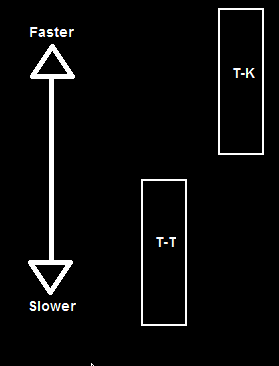
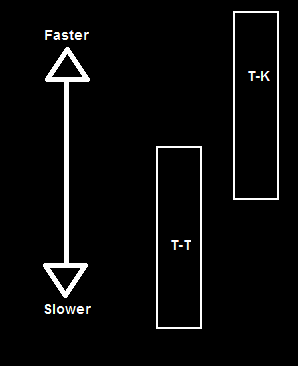
Instead of a gap (too fast for single tongue and too slow for double tongue)...

...have an overlap:

In other words, have a range of tempos where you can comfortably single tongue or double tongue.

Choice is power.

Saturday, November 11, 2006

Gliss-O-Rama

Ahh, I remember it well....my first solo performance!

It was an elementary school band concert...a stirring rendition of "Young MacDonald Had a Farm" as I recall.

At one point, right after the familiar refrain, "Young MacDonald had a farm..." the usual E-I-E-I-O was replaced by a lovely trombone gliss (faithfully notated below)


In his wisdom, our band director had me stand to deliver this stirring cadenza.
(In all fairness, the solo happened twice..Howard Danner played it the first time)

I believe I am scarred for life.

It's just like those early conversations...
"Oh, what instrument do you play?"
"The Trombone."
"Oh [pause] [twinkle forms in the eye..arm raises up] beee-reeer-rup"
[you know, that sound made by the average witty joe on the street imitating a trombone gliss].
"...sigh..{ah, such incisive wit, such comedic brilliance}"

I guess all these years I've had something of an anti-glissando bias.

But hey, I'm growing. This semester in teaching, I've rediscovered the pedagogical power of this trombone cliche. A number of my students have really benefited from doing loud glissandos (at last something possibly more annoying than that alto sax in the next room).

In honor of this therapeutic re-discovery, I've added another flow exercise to the basic daily routine on the BoneZone website. Click here for it (a .pdf file will download).

Of course in a recent lesson, as a student and I roared unabashedly through some high glisses, I looked over at the window in my door.

Looking in were a mother and her toddler, apparently enjoying the zoo animals inside.

"...sigh.."

Tuesday, October 24, 2006

Back to the Big Four: F, C, T, D

Seems I've trod this ground before but it bears repeating.
Here are the big four...
F
Fundamentals
  • Do you have a resonant, centered tone in different registers?
  • Can you play in tune with yourself and others?
  • Can you hear the notes in your head before you play them?
  • Can you keep a steady tempo?
  • Can you subdivide correctly within that tempo?
  • Can you begin the notes cleanly?
  • Can you control all these elements as you play.. high and low? ...loud and soft? ...fast and slow?
C
Concept
  • Do you know exactly what the piece should sound like?
  • Do you know where you are going to breathe?
  • Do you know where to crescendo? ...whether to use vibrato? ...how much accent to use?
  • Do you know exactly what slide positions you're going to use?
  • Have you heard multiple recordings of the piece?
  • If a solo, do you know the piano part well?
  • If an excerpt, do you know the piece as a whole?
  • Do you know the meanings of all the terms?
  • Can you close your eyes and hear the precise sound of someone really "nailing it?"
T
Tension
  • Are you aware when tension builds in your body?
  • Is your posture well-balanced?
  • Is your playing a natural extension of relaxed breathing?
  • Is your tongue relaxed? Your throat? Your shoulders?
D
Distraction
  • Are you so focused on the music that you don't notice what is going on around you?
  • Have you quieted any "inner conversations" about your playing, good or bad?
  • Are you " in the moment?"
  • Do you "disappear into the music" as you play?

I'm sure I missed a few but this seems to be a pretty good list.

Back to ye old performance equation...
P - I = R
Potential minus interference equals result.
Potential = (Fundamentals + Concept)
Interference = (Tension + Distraction)

Hope this checklist helps.

Saturday, August 26, 2006

And Away WE Go!

Happy New Year!

No, it's not January but in the academic world everything is beginning so this may as well be the new year.

I've caught grief from some of my students for not keeping active with this blog over the summer. Sorry. Summer is a time not only to recharge my batteries a bit but to work on those projects that end up gobbling up a lot of time.

The two big projects: continuing to transcribe and edit my own collection of selected etudes ( currently 200 - 300 pages of material), and working on another book, Pattern Building, to accompany my book of Lip Slurs.

Ultimately I plan for these books to be a 3-part (or possibly 4-part) collection of books. Here's the plan:


Underlying everything are the fundamentals (Bone Basics): warm-up patterns, simple tunes, basic articulation exercises, maybe some specialized exercises (like building the high register).
These are exercises which are not progressive. They will be basic "bread and butter" stuff. Many sketches for this book are already done.

The Lip Slurs are pretty much self-explanatory. I'm mostly happy with the book and other people seem to like them. If you're curious, here's a link.

Pattern Building is the latest (and hopefully the final) incarnation in my search for a way to teach scales and arpeggios (Ouch, so many previous tries that just haven't worked). Yes, I know a lot these kinds books are already available but I haven't seen anything that really does what I'm looking for. This book is basically the mixture of scale/arp patterns and rhythm patterns. Any given section of the book, for example, presents a melodic pattern (scale or arp based) to be played from memory in all keys and a collection of related rhythms (almost like flashcards). What follows are 24 "mini etudes," most 8-12 measures long , which are connected to the given melodic and rhythmic patterns.

Why do we learn scales? Not only to develop general technique but to develop instincts that let us rapidly read/learn music. Thus, a complete scale/arp plan needs to have both memory work and reading work. Rhythm patterns aren't really different, the goal is a kind of "instant recognition" ... see the rhythm and instinctively know what it is supposed to sound like.

All this is very similar to learning to read words. One starts sounding out words and eventually moves on to instant recognition.

If the book succeeds, I hope my students will develop much stronger reading skills.

We'll see how it goes.

Sunday, December 11, 2005

Scales? Why? How?

A short post tonight...
Scales: love 'em, hate 'em ..can't live without 'em.
But why, exactly, do we do them?

I think it boils down to two main things..
  1. Develop the ability to "get around" the horn quickly and well (relaxed, in-tune, good sound...)
  2. Develop the ability to learn new music more quickly by quickly spotting familiar patterns.
Most people stick with a limited number of patterns.
How well does this translate to new material?

I like to think of a scale as a template.
Instead of one specific pattern, apply a wide variety of patterns to the same set of notes.
Something like this..


So, by mastering a variety all based on the same scale, you learn the template instead of one pattern.

Thus, when you encounter a new pattern, you can more quickly spot the template and master the new pattern.

Saturday, November 12, 2005

Koussevitsky, RAM and Perlman

Here's a first. I'm posting this from a public wifi hot spot in Augusta, GA. Very 21st century.
I'm in town doing a concert with the Augusta Symphony. One piece on the program: the Koussevitsky Double Bass Concerto.

Now apparently, the only copies of this concerto are bad manuscript. So our soloist has prepared a Finale edition of score and parts. One problem: mistakes.

For example, trombone parts without any rehearsal letters. (and of course no cues!). So there we are trying to count 66 measures and then come in on one chord.

Mildly annoying.

Wait, I'm going somewhere with this. At one point, a woodwind principal asks the conductor if he's conducting in 2 or in 4. He expresses mild irritation because it should be obvious. He's right, BUT, that poor musician is already dealing with a mistake-ridden part. I get the impression that dealing with the bad part is occupying so much attention that less is left for other issues.

Come to think of it, uncertainty doesn't exactly help tone quality.

I also bought a laser printer today. I'm looking over the memory specs and decide to pass on the 2 mb model and pay more for the 8 mb model. I'm figuring, more memory, better hendling of print jobs.

Wait, our attention is like that RAM on the printer. Although flexible, we have some kind of limit. If we use up RAM on bad parts, we have less left for other issues.

Years ago, 60 minutes interviewed Itzhak Perlman. He said he practiced scales while watching sports on TV. At the time I was stunned, shocked, horrified (well not really).

But think about it, if the scales is automatic, that frees up memory to focus on phrasing, balance, and other higher level stuff.

I'm not leading up to some grand moral of the story. Draw your own conclusions.

(I hope you liked the hand-dandy color coding. free of charge.)

Thursday, November 10, 2005

Adding Post-It Notes to My Blocks

I tried something new in a few lessons today.

You might remember a previous blog entry where I compared Lego MyBlocks to chunks of complicated licks perhaps better performed from memory.

This idea has stuck with me. Here's a new spin...
  1. I had the student isolate a tricky passage.
  2. Then they memorized it.
  3. Then I had them play it a few times while looking out the window (hey, it was a beautiful day to watch them demolish the Heart of Columbia Hotel out my window).
  4. THEN, (and here's the cool part) I covered the passage in question with part of a post-it note.
  5. I asked the student to start somewhere before the passage in question and play through the part they had memorized.
In each case, they found it was easier to play the tricky passage when they couldn't see it!

I could bore you to death waxing on and on about the path from notation to sound concept to results and how most young musicians can't form much of a sound concept and how, in France, beginning music students must sight-sing before they pick up the instrument and blah blah blah. But I won't.

Instead, I'll just say: cool! A new one for my bag of tricks!
(mustn't get stale)

Tuesday, November 01, 2005

Bozza and My Blocks

I am coaching my son's lego league team. If you're curious, here's a link:
http://www.firstlegoleague.org/

In programming these little robots, we use the Lego Robotics Invention System. Basically, the kids learn to program by connecting blocks on the screen (like, "Forward 10 seconds").
Pretty cool.

You can create custom blocks called "My Blocks." Each block is a "basket" of little commands,

....like a subroutine

One of my students is tackling Bozza's New Orleans, a jazz-influenced chromatic French piece. He sometimes gets hung up on some of the chromatic passages. In the last lesson, we tried the strategy of quickly memorizing chunks of music and working them up without looking at the page.

When I play complicated, chromatic passages, I look at the passage but then essentially play the pattern that I have memorized. I glance at the passage and, hopefully, it evokes my memory of the lick. Instead of focusing on individual notes, I try to automatically play the whole chunk,

...like a subroutine.

Treat complicated licks like those Lego "My Blocks" As you play the piece, hopefully the sight of the lick will trigger a mental subroutine which can be played automatically.