Out with the old. In with the new.
In preparation for my warm-up session at the International Trombone Festival, I have revised and expanded my warm-up routine.
The old: Basic 4 Warm-Up
The new: Basic 6 Warm-Up
As you might guess, the first four are basically the same (except this revised version gives more choices). The additional two are: long tones and simple tunes.
The routine takes 20-40 minutes.
I also have a version for younger players that takes about 12 minutes.
Don't have time? The routine is in "triage" order.
In other words, I might not get through all six if I'm warming up right before a rehearsal but I'll still start at the beginning and go as far as I can.
Happy practicing!
Showing posts with label warming up. Show all posts
Showing posts with label warming up. Show all posts
Thursday, June 10, 2010
Monday, November 16, 2009
Out with the old and in with the new...The Basic 4 Warm-Up
I've pulled down my old warm-up materials from the website and replaced them with this.
Daily Routine Menu
Daily Building Block Routine
Well, the routine menu is going to overlap too much with the book I will be writing this Spring. The idea still works but I need to revise material and put it into a more cohesive form.
So....
I wanted something short and sweet. (yes, I was tempted to write "short and suite")
Something to get you (and me) off the ground a little more quickly (like, 12 minutes)
- Wind/Sound
- Flow
- Lip Slurs
- Scales

Monday, June 22, 2009
New(er) Building Blocks
Summer months...not much to blog about at the moment.
I have been working quite a bit on my third book and am almost done with a demo version. This one weighs in around 120 pages. I'm quite excited about it.
This morning, I took some time to write out some of the tweaks I've made to the "Building Block" warm-up routine this past year. They include some extensions (faster, higher, louder, softer)that I've been in the habit of adding on as I practice.
You can find the newest version here.
I have been working quite a bit on my third book and am almost done with a demo version. This one weighs in around 120 pages. I'm quite excited about it.
This morning, I took some time to write out some of the tweaks I've made to the "Building Block" warm-up routine this past year. They include some extensions (faster, higher, louder, softer)that I've been in the habit of adding on as I practice.
You can find the newest version here.
Wednesday, January 16, 2008
After all this time, you're posting about WHAT??
Everybody needs a hobby.
I don't collect baseball cards or build ships in a bottle. I do, however seem to have an unnatural obsession with warm-up routines.
I guess it is like trying to play the perfect game of golf. I enjoy tweaking and tweaking, trying to find the perfect compact little routine.
And so (ta-da!) here is my latest effort, the Daily Building Block Routine.
Inevitably, I use it for a while and then find ways to improve it and move on.
Oh well, at least this new routine doesn't really violate that whole daily routine menu that I posted last Fall.
If you're interested, you can download the whole thing and give it a spin.
Now that I've gotten this out of my system, maybe I'll start blogging again!
Oh yeah, I've got to figure another BoneWeek fanfare.
I don't collect baseball cards or build ships in a bottle. I do, however seem to have an unnatural obsession with warm-up routines.
I guess it is like trying to play the perfect game of golf. I enjoy tweaking and tweaking, trying to find the perfect compact little routine.
And so (ta-da!) here is my latest effort, the Daily Building Block Routine.
Inevitably, I use it for a while and then find ways to improve it and move on.
Oh well, at least this new routine doesn't really violate that whole daily routine menu that I posted last Fall.
If you're interested, you can download the whole thing and give it a spin.
Now that I've gotten this out of my system, maybe I'll start blogging again!
Oh yeah, I've got to figure another BoneWeek fanfare.
Wednesday, August 15, 2007
Daily Routines...What's on the Menu?

I have made big revisions to the Daily Routine portion of my website.
You can find 13 new pages of materials available for free download (.pdf files).
Here's the basic idea:
The Daily Routine "Menu" is like a restaurant menu with an appetizer, three courses and dessert. Pick and choose from each course according to your needs.
You don't need to get through the whole menu in a single practice session. Material in the later courses, for example, might be better served later in your practice day.
Bon appetite
Wednesday, August 01, 2007
Alessi Seminar Notes, Day 3 (part 1)...Aim and Fire
Please note:
These entries from the Alessi Seminar are not a literal transcript. I took written notes and then typed them up. I have made every effort to be accurate but, as you might expect, each blog entry is a meager substitute for actually being there.
Remember that many of the things Mr. Alessi says in these masterclasses are in the context of addressing the needs of a particular student and should not be seen as universal mandates to be mindlessly followed.
If you are serious about pursuing musical excellence on the trombone, there is no substitute for actually attending one of Mr. Alessi's seminars. You'll be glad you did.
The day began for the participants with a group warm-up led by Peter Ellefson. He generously gave us handout for not one but three warm-ups. He commented that he likes to update his warm-up every few years and that one shouldn't play the exact thing year after year (although it does work for some). Click on the link above and you can see these warm-ups, I blieve. Once again, I wasn't writing notes at the time but I do have a few recollections:
Pete recommended two books: The Brass Player's Cookbook and Also Sprach Arnold Jacobs.
When breathing, he recommended that you "keep the jar open" at the end of the inhalation. In other words, don't close off your throat.
He talked about the "4-1 disease" When playing a passing tone between 4th and 1st, many players play a convenient halfway position between second and third.
He included a wonderful exercise for playing extremely soft and stressed the importance of playing your very softest every day.
He spoke highly of an out-of-print book, "55 Phrasing Studies" by Jaroslav Cimera.
Lastly he threw in a very nice thought, "In order to be a quality musician, you have to be a quality human being."
The warm-up was followed, once again by a masterclass with Joe. We began the session with a moment of silence in memory of Milt Stevens.
The performers were:
Stephen Lange - Creston Fantasy
Jared Lantzy - Schnyder Concerto for Bass Trombone
Ben Perrier - Arrows of Time, Mvt 2
Quartet (Dishman, Abissi, Johnson, Brady) - Debussy Trois Chansons
Orchestra Section: Mahler, Symphony No. 2
Here are some notes:
Alternate positions present a trade-off between tone/pitch and facility.
When playing fast passages, don't worry about those little intonation adjustments (B-flat in sharp 5th and so on).
If you want to learn something quickly ... you can learn it twice as fast if you write in the positions, even the obvious ones
When demonstrating triple tonguing, I noticed he was using the T-T-K syllable pattern.
"Go for the gold, don't go for the silver."
In phrasing, your should try to earmark certain notes that you're going to go for.
When taking a breath, try to color the note before. "Think about what you're leaving in the hall"
You have to take risks. He commented that he is more impressed by someone who takes a chance even if they mess up rather than someone who only plays it safe.
Get used to placing the stand lower so the audience can see you. Don't have the stand blocking you. Also, don't let page turns distract from the music.
He suggested that we should play off to the side of the stand not right behind it.
He suggested that you should point your bell so that you're "bisecting the hall" In other words, straight out into the middle of the hall.
Many players need to move the air more slowly.
"The way you breathe affects the way you blow. It's a mirror." He demonstrated a breath with throat tension to show the sound of a bad breath. He again reminded us that the best breath is just like a sigh.
He pointed out that when you create friction or make a sound as you breathe in, you're closing off the throat.
On the old T.V. sets, you would use a dial...uhf, vhf, and you had to dial it in. In a similar way you have to dial in the note to find a sweet spot on notes.
If a new thing feels awkward, that may be good (he used an analogy of golfers who change their grip.)
"When you introduce the melody, let the melody speak for itself. You don't have to add a lot to it."
He used an interesting analogy concerning alternate positions: It's like going home and everything has changed in your neighborhood.
As you taper off the note, taper off the vibrato, ending with a straight tone.
A good practice technique for the high range is to play the passage down an octave and get it to sound the way you want. Then take it back up the octave.
"The higher the passage, the more you have to breathe deeper."
"Deep breathing does not mean making this sound (he demonstrated a somewhat noisy Darth Vader-like breath), I think that's a misconception."
For tonguing the high B-flat, he used the syllable "tee"
He also repeated (many times throughout the day) "Aim and Fire" as advice for hitting a high note.
All good quartets should try this exercise: close your eyes, then start and release together by listening to the first player.
He told a great story about Phil Myers (principal horn of the NYPO). Myers always wants to know is going on in everyone else's part. He takes the time to re-write each first horn part in Finale, adding complete cues for the other instrument parts. "When he walks into rehearsal, he is more prepared than anyone."
That's all for the morning masterclass. More to come ....
Monday, July 30, 2007
Alessi Seminar Notes, Day 2 (part 1)..The Warm-Up
Please note:
These entries from the Alessi Seminar are not a literal transcript. I took written notes and then typed them up. I have made every effort to be accurate but, as you might expect, each blog entry is a meager substitute for actually being there.
Remember that many of the things Mr. Alessi says in these masterclasses are in the context of addressing the needs of a particular student and should not be seen as universal mandates to be mindlessly followed.
If you are serious about pursuing musical excellence on the trombone, there is no substitute for actually attending one of Mr. Alessi's seminars. You'll be glad you did.
Today at the seminar, things really got cranking. The participants had a group warm-up led by Mr. Alessi followed by the first masterclass lasting about 3 1/2 hours. For me the afternoon filled up with rehearsals and sectionals. The day ended with Mr. Alessi's recital.
The Warm-Up Session
Joe led us through some of his ideas for warming up and maintenance. We also received an 8-page handout of exercises. I wasn't able to take notes during the warm-up itself but here are some recollections.
Breathing:
Joe showed us a breathing exercise which involved touching the toes and then straightening up and lifting the arms over the head as you breathe in.
He made an interesting analogy: air in playing is like pouring gasoline into a funnel. From your lungs you have this ample supply of air but you don't want to pour more into the funnel (lips/mouthpiece) than your lips can handle.
He also commented on how so many trombonists make the mistake of "hammering" away in their warm-up rather than working towards a relaxed, beautiful sound. Don't hammer.
The first exercise was a descending arpeggio buzzed on the mouthpiece ranging from middle B-flat down the pedal B-flat. (then the arpeggio is to be done in lower and lower keys).
A couple points about this: he advised us to scoop into the first note. Also he wanted the arpeggio to be somewhat glissy, not slotting into each note.
The second exercise, played very freely on the trombone, was basically a mixture of sustained notes and legato tonguing. The main purpose here was to find the pitch center.
During the 6th exercise, a slow, legato passage of expanding intervals he spoke of the importance of pitch accuracy and consistency. Here he made an interesting observation..
In any audition, only about 2% of the candidates stand any chance of being hired.
One of the major reasons so many candidates aren't worthy of serious consideration is faulty intonation.
Another reminder as we progressed: don't force or strain. Just get a nice relaxed, beautiful tone.
Incidentally, quite a few of the exercises were lip slur patterns.
Exercise #10 focused on slurring over wider intervals. He spoke of the importance of an even sound without favoring certain registers.
Exercise #13 consisted of a bold two-octave tongued arpeggio (B-flat to B-flat for starters) followed by a descending legato chromatic scale. Joe talked about the importance of mastering the chromatic scale starting on any note for true mastery of slide technique. Exercises 16 and 17 also focused on the chromatic scale both in triplets and 16th's.
At many points in the masterclass, he spoke about the importance of breathing well. As he described it a great breath is just like a sigh. He gave the analogy of losing something and then finding it after some searching. When you finally see it, you might heave a sigh of relief. This, he says, is the perfect breath.
He also introduced a different technique for breathing. Basically, he recommends that you maintain contact with the mouthpiece at the center and breathe in through the corners of the mouth by "stretching out" the corners a bit. He returned to this idea a couple times during the masterclass. Another phrase he used was, "Plug it in first and then breathe"
He stressed that this was an important concept to learn and that, once mastered, should really help with consistency and accuracy.
During the masterclass, I wrote down quite a few notes which I'd like to share with you. Check out the next blog for this...
Saturday, November 11, 2006
Gliss-O-Rama
Ahh, I remember it well....my first solo performance!
It was an elementary school band concert...a stirring rendition of "Young MacDonald Had a Farm" as I recall.
At one point, right after the familiar refrain, "Young MacDonald had a farm..." the usual E-I-E-I-O was replaced by a lovely trombone gliss (faithfully notated below)
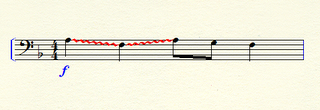
In his wisdom, our band director had me stand to deliver this stirring cadenza.
(In all fairness, the solo happened twice..Howard Danner played it the first time)
I believe I am scarred for life.
It's just like those early conversations...
"Oh, what instrument do you play?"
"The Trombone."
"Oh [pause] [twinkle forms in the eye..arm raises up] beee-reeer-rup"
[you know, that sound made by the average witty joe on the street imitating a trombone gliss].
"...sigh..{ah, such incisive wit, such comedic brilliance}"
I guess all these years I've had something of an anti-glissando bias.
But hey, I'm growing. This semester in teaching, I've rediscovered the pedagogical power of this trombone cliche. A number of my students have really benefited from doing loud glissandos (at last something possibly more annoying than that alto sax in the next room).
In honor of this therapeutic re-discovery, I've added another flow exercise to the basic daily routine on the BoneZone website. Click here for it (a .pdf file will download).
Of course in a recent lesson, as a student and I roared unabashedly through some high glisses, I looked over at the window in my door.
Looking in were a mother and her toddler, apparently enjoying the zoo animals inside.
"...sigh.."
It was an elementary school band concert...a stirring rendition of "Young MacDonald Had a Farm" as I recall.
At one point, right after the familiar refrain, "Young MacDonald had a farm..." the usual E-I-E-I-O was replaced by a lovely trombone gliss (faithfully notated below)
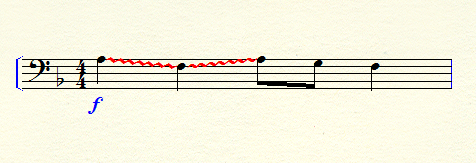
In his wisdom, our band director had me stand to deliver this stirring cadenza.
(In all fairness, the solo happened twice..Howard Danner played it the first time)
I believe I am scarred for life.
It's just like those early conversations...
"Oh, what instrument do you play?"
"The Trombone."
"Oh [pause] [twinkle forms in the eye..arm raises up] beee-reeer-rup"
[you know, that sound made by the average witty joe on the street imitating a trombone gliss].
"...sigh..{ah, such incisive wit, such comedic brilliance}"
I guess all these years I've had something of an anti-glissando bias.
But hey, I'm growing. This semester in teaching, I've rediscovered the pedagogical power of this trombone cliche. A number of my students have really benefited from doing loud glissandos (at last something possibly more annoying than that alto sax in the next room).
In honor of this therapeutic re-discovery, I've added another flow exercise to the basic daily routine on the BoneZone website. Click here for it (a .pdf file will download).
Of course in a recent lesson, as a student and I roared unabashedly through some high glisses, I looked over at the window in my door.
Looking in were a mother and her toddler, apparently enjoying the zoo animals inside.
"...sigh.."
Subscribe to:
Posts (Atom)