Showing posts with label tuning. Show all posts

Wednesday, September 14, 2011

The Tuner Flip (and a deep metronome question)


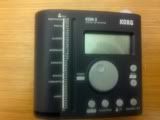
Here's a photo from my studio. Basically, it's my Korg CA tuner attached to a filing cabinet using 3M Dual Lock.

The picture isn't wrong, it's on its side.
Why?
In return, I might ask, "Who decided that Right=Sharp and Left=Flat?" When you stop to think about it, doesn't, "Up=Sharp and Down=Flat" make more sense?
It does to me.

The *initial* reason I did this was twofold:
  1. These tuners have a rounded edge and, when placed on a music stand, tend to slip.
  2. On the opposite wall of my studio, I have a mirror which I often look at while practicing. I can see the tuner in the reflection. The whole left/right thing was messing with my head but, even in a mirror, up it still up.
So, those were the initial reasons but it got me to thinking...up and down really do make more sense.

OK, while I talking about these little electronic "truth boxes" I have another question.
This actually came up years ago while I was working on my dissertation.

I noticed that all these different metronomes, used the same tempo markings for the same Italian terms. Once upon a time, somebody out there decided that "Larghetto" would range from 60-66 bpm....but who?
At least at that time, I found that every metronome was the same.
But, I couldn't find the source...who decided this? How is that everyone seemed to be conforming to this standard.


Deep questions....I shall lay awake at night.
(I hope the answer isn't long and dull. Can we blame it on aliens? Dibs on the movie rights)


Thursday, March 20, 2008

Accepting Dissonance to Find Consonance

Here's an idea that came up in a lesson a while back...

A student was playing along with the drone, working on locking in pitch. He was close but not right on the money. He seemed reluctant to make larger adjustments (I see this a lot).

I got him to purposely bend farther out of tune and just listen to the beats. Once he had "permission" to play the note out of tune, he seemed to relax and hear the pitch in a more non-judgmental way. In other words, he was simply hearing his intonation without any extra moral connotations.

Sure enough, he quickly "locked in" the tuning.

That's when I noted,

"Maybe you have to accept dissonance in order to find consonance."

Maybe that could a be life lesson as well.


Friday, November 30, 2007

Why is this so hard?

Here's a simple little tuning exercise that's not as easy as it looks...


Some players, once they own that trigger, begin to believe that all positions beyond 4th are alien territory. Thus a simple gliss to 6th seems to give trouble.

After finding 6th, you would think it a simple matter to gliss back to 5th accurately. Nope!

I think there are several reasons for this..
1. When we do our beloved Remington long tones, we are always measuring out from 1st position. Accurately "measuring out" is something we do a lot, but "measuring in" is something we don't practice. Maybe we should do that famous Remington pattern inverted.


2. (disclaimer, this is pretty speculative, I may have it wrong)
Beyond 4th position, the elbow begins to have to extend beyond a right angle and seems to be less accurate.

Anyway, try those glisses out with a tuner (look first, then listen), see what you think.

Tuesday, November 13, 2007

Letting Bruckner Bark

Here's an entry from today's trombone master class.

We did an orchestral excerpt class focusing on the finale to Bruckner's 8th symphony.
Here's that opening passage:


Everybody starts fortissimo on an F-sharp out there in that treacherous 5th position.

Perhaps you've heard that, if it is in tune, a note will sound louder.

Why? How?

Sound waves can either reinforce each other or cancel each other out..


Here's a picture of two waves that are slightly out-of-sync.
Of course, if they were out of tune, you would see the peaks of one wave closer together than the other so this picture isn't perfect but hopefully you get the idea.

Here's the thing: when out of phase, the waves partially cancel each other out. Here's a great link explaining this concept.

In fact, I once saw a dog wearing collar that used active noise cancellation to cancel out the bark.
Something like this:


So, if I understand it, the collar has a microphone that records the bark and a speaker that plays it back out of phase, canceling the original sound.

Of course, we don't want to use noise cancellation in Bruckner!

Play it in tune and it will not only sound louder, it actually will be louder.

Wednesday, November 07, 2007

13 Good Minutes

On my website you can find drone tone files.
12 files, each 65 seconds, droning on pure perfect fifths

(3:2 ratio, top note raised 2 cents, all that jazz)

Played back to back, the files last 13 minutes.

Put them on your ipod and spend those 13 minutes playing along with the drones, making things up as you go. Long tones, melodies, lip slurs. Just play beautifully and listen carefully.

Here's a link to the drones..

Here's a link to a summary of pitch adjustments needed for certain intervals.

Tuesday, November 06, 2007

The E-flat "Re-education camp" (Gulag)?


Oh that pesky E-flat.

sharp, sharp, sharp.

Play it sharp often enough and it starts to sound right.

How could that tuner be right? It sounds so wrong!

Maybe we should spend some time playing it flat on purpose.

Actually, I've heard of a trumpet teacher who made his freshman play F (on a B-flat trumpet) using it 1st and 3rd valves. This would be like playing the E-flat in regular 6th position...nice and flat.

After a semester of this, perhaps the ear is retrained?

Maybe trombonists need to spend a similar period of time in an E-flat "gulag," or "re-education camp" playing the note flat to retrain the ear.

Perhaps as the camp commandant reviews the trombone prisoners during their "re-education" they could play the "Ruffles and Flourishes" fanfare with the E-flats getting lower and lower.

Like this

(ouch)


Wednesday, August 08, 2007

Alessi Seminar Notes, Day 9, ...the Last Day

Please note:

These entries from the Alessi Seminar are not a literal transcript. I took written notes and then typed them up. I have made every effort to be accurate but, as you might expect, each blog entry is a meager substitute for actually being there.

Remember that many of the things Mr. Alessi says in these masterclasses are in the context of addressing the needs of a particular student and should not be seen as universal mandates to be mindlessly followed.

If you are serious about pursuing musical excellence on the trombone, there is no substitute for actually attending one of Mr. Alessi's seminars. You'll be glad you did.


On this final day of the Alessi seminar, we had the usual morning warm-up (it was my turn to do the warm-up for the participants), the last masterclass and, in the evening, a great party at an area restaurant.

I should note that I have been describing the schedule for the participants. Each afternoon the auditors had masterclasses running, I believe, from 2:30-5:00. These classes were run by Pete Ellefson
Although I didn't attend any of Pete's classes (hey, I need to practice sometime!) I spoke to a number of auditors and they said he did a great job!

This morning's schedule was:
Adam Johnson - Jongen Aria and Polonaise (2nd half)
Daniel Brady - excerpts
An auditor - Mahler's 3rd
An auditor - Rota Concerto
A final chat with Mr. Alessi

Here are my notes:
  • When you perform, don't put the stand in front of you. "The audience wants to see you, not the stand."
  • For a rapid dotted-eighth, sixteenth rhythms, he again suggested pulling the tongue further back in the mouth.
  • He talked about the importance of focusing your practice both on the technical side and the musical side. "You have to pay homage to each one and then they become one." He doesn't believe that, if you only focus on musicality, the technique will come.
  • "I think that air flow and relaxation comes from good musical decisions."
  • He talked about the need to perform more than just the orchestral repertoire. "Where do we get to express ourselves in the literature? Maybe once every three years."
  • He talked about trombonists being "a little bit lazy" in not getting together often enough to work with pianists. It really bothers him to hear any trombonist play out of tune with the piano.
  • He reminded the student to always keep things interesting, dynamically.
The Creation
  • After the student's momentary false start, he said "Once you commit yourself to that first note, it has to come out." (no matter what it sounds like)
  • At one point, he asked the student, "Would you vote for that?" (in an audition) Later, after the student had made a few adjustments he commented that he would have voted for that last performance in a professional audition.
  • Don't ever play tentative. Just go for it.
  • If you get nervous and start to hear those voices in your head, "replace the voices with musical things." Start thinking about the tune and then just start playing. He demonstrated by singing a passage then breathing and playing in time.
  • For the rests in this excerpt, he advised the student to breathe through the whole rest, not just at the very end.
Fountains of Rome
  • Be sure to start your breath early enough so you are ready to fire on time.
  • He used the phrase "always three to one" to describe beat groupings:


  • He suggested that, in this excerpt, perhaps the breathing should not be symmetrical and predictable.
  • To improve intonation consistency, he suggested playing this excerpt (and others) very slowly at least once a day to "sweep the area for pitch."
  • He cited a quote from virtuoso violinist Itzhak Perlman, "The slower you practice, the faster you progress. The faster you practice, the slower you progress."
  • Concerning how many breaths to take in these sostenuto passages he advised, "You have to be a magician and figure what you need and what you don't need."
  • Don't lose time on the half notes in an effort to "make them as big as a house."
  • All these details, (especially rhythm and intonation) separate the 2% from the other 98%.
  • Concerning an early breath taken in the passage shown above, he said, "When you get to the main event, why would you want to breathe after that first note?" He pointed out this was the time to show off your stuff.
  • Regarding your sheet music, he advised us to save everything we ever play. Then, in the future, you can take the music back out and restart where you left off.
  • Don't be late after taking breaths. The time has to be solid when you come up to breathe.
  • Concerning the process of fixing an out-of-tune passage by identifying a problem note he said, "What's the main culprit? Find it."
  • Concerning keeping the low brass section rhythmically tight in one section he advised placing the sixteenth note directly on the downbeat:


  • Get an ipod and make a collection of the orchestral repertoire. Get three of four versions of the same piece. "It's kind of a monumental task but start with one piece and build from there."
  • He noted that a lot of bass trombonists don't bother to learn the score. They just know the excerpt passage.

Mahler 3
  • He noted that this is a tricky solo to play. "With this solo, you have to go for it but not go out of control."
  • Make sure the air doesn't get too fast. He recommended, "A nice big sound, nothing more than that." He also advised, "Don't blow yourself out of the pocket."
  • Building on this idea further he advised us to retain our good sound. He pointed out, "There's a slot where every note goes. Are you in that slot?"
  • He talked about remaining calm even though the music can become very intense, even threatening. He advised us to separate ourselves from the music somewhat so we don't become too involved and lose control.
  • As a demonstration of relaxed air, he held up the student's hand and blew warm air against it.
  • In describing the ideal attack, he raised the analogy of a stereo system already playing music with the speakers turned off. You flick the speaker switch on and you get "immediate sound."
  • He also advised that the notes should "sound like bricks" and not become distorted.
  • He doesn't feel that alternate positions have much value here. "Go for the best possible sound, not convenience."
  • In playing loud, he said, "Less, sometimes, is more." He gave an analogy of great golfers and their effortless approach.
  • He also suggested that one might practice this excerpt in the manner of a Bordogni etude noting that, "we forget that these things are melodies."
  • For younger players, he suggested not starting out trying to play too loudly and then add volume over time rather than trying to hammer away at it.
  • He demonstrated the excerpt, observing, "You see, I'm using a lot less energy than you but it's twice as big."
  • He broke one passage down into its component intervals stressing the importance of correctly hearing these intervals.
  • He noted that a lot of young players tend to play sharp. He cited two possible causes: blowing too fast and measuring off the bell with the finger.
  • For younger players, he said that now is your chance to get the notes in tune. Then it will sound bigger later.
  • When going to the low A, you're not supposed to increase your air speed. Decrease it.
  • In trying to get the student not to move the bell around so much he suggested, "try to make your amplifier more consistent."
  • "Things sound better when it feels easier. There's a direct correlation."
  • In not crossing that fine line between exciting and out-of-control, he suggested the "2% solution." I believe he meant playing a loud passage 2% softer. Just back off a bit.
  • When you see the music get exciting, don't lose control. He used the phrase, "fortissimo with some intelligence."
  • Peter Ellefson observed from the audience that, as he watched the waveform of the audio software recording the masterclass, it was possible to actually see the difference in tone between Mr. Alessi's tone and the student's. Pete also noted that more effort doesn't necessarily translate into more sound.
  • Joe advised that student to "take a snapshot and ask yourself, 'Is this best sound I can play with?' "
(end of Mahler coaching)

  • Concerning tongue placement in the high range, he noted that, the higher you go in the scale, the more tongue placement is important.
  • He pointed out that, as a general rule, when you play louder, use less tongue. The opposite is true for playing softer.
At the end Mr. Alessi came out to sit in the audience and field more questions. He had many more stories to tell and wonderful pieces of advice but I opted not to take notes at this point.

I guess you just had to be there.

This is the end of my written notes for the Alessi seminar.

A Final Comment:

I would like to thank Mr. Alessi for conducting this seminar. I was consistently impressed not only by his spectacular playing but his consistent work ethic and clear commitment to helping each student.

I had heard stories of Mr. Alessi's intensity and was quite nervous about playing for him for the first time. As one former student put it, "He sets the same expectations for you that he sets for himself." Throughout the week, I found him not only intense but very positive. When a student played well, he was quick to praise them. On many occasions, he would say something like, "That was perfect," or "Very nice playing." You knew that this wasn't hollow praise of the "atta- boy" variety. If he praised you, you had earned it.

If something wasn't up to standard, he wasn't going to let it slide. But I never found any of his criticisms throughout the week to be anything less than fair and professional. If his own playing wasn't up to his personal standards he would try again and sometimes apologized to the audience if he didn't feel he was playing well enough. (I should have such bad days!)

Mr. Alessi was consistently hard-working, polite, highly focused and completely sincere in his efforts to help everyone who attended this seminar. This set a tone of mutual respect and professionalism that made the seminar a very positive learning experience for everyone involved.

As Pete Ellefson put it at the beginning, some students say they can't afford to attend this seminar. He added that, if you are serious about making it as professional musician on the trombone, you can't afford not to.

I agree.


Tuesday, August 07, 2007

Alessi Seminar Notes, Day 8.."Jaw Droppers"

Please note:

These entries from the Alessi Seminar are not a literal transcript. I took written notes and then typed them up. I have made every effort to be accurate but, as you might expect, each blog entry is a meager substitute for actually being there.

Remember that many of the things Mr. Alessi says in these masterclasses are in the context of addressing the needs of a particular student and should not be seen as universal mandates to be mindlessly followed.

If you are serious about pursuing musical excellence on the trombone, there is no substitute for actually attending one of Mr. Alessi's seminars. You'll be glad you did.

Today began with the usual warm-up sessions (ours was led by Paul Compton) followed by trombone choir rehearsals. After lunch, we boarded buses and traveled to St. Paul's Lutheran Church for our second concert which consisted of soloists, chamber groups and both trombone choirs.

In the evening, Joe gave another masterclass. The performers were:

me - a maestoso etude followed by Mahler's 3rd
Casey Thomas - Castereded Fantasie Concertante
Miguel Rivera - Morales Fantasy for Trombone and Piano
Josh Bynum - excerpts


Once again, I don't have notes to share from my own coaching. Here the notes I wrote down from the remainder:
  • Joe discussed the problem of excessive tension in slide technique. He suggested that, sometimes, you need to just let go. Just play it.
  • He noted that many times he tells his students to do something and they tend to overdo it, going too far with a suggestion.
  • He gave the analogy of great athletes and how they stay so loose.
  • He referred again to the idea of a "dead man's float" (floating in pool, completely relaxed) as he discussed staying relaxed in a performance.
  • He suggested, "Try to wean yourself from the music." Don't be so dependent on the music as you perform. For a demonstration, he moved the music stand farther and farther from the student. "I think that's a good test as you learn a piece. Do you have to be so dependent on the music?"
  • In faster passages, relax the slide more. Don't try to stop the slide in each position. "It becomes more of a glide." He demonstrated, playing a repeating chromatic scale at faster and faster tempos to show how the slide action becomes smoother as you speed up.
  • To free yourself up while tonguing rapidly, let the tongue come back. Don't try to spit out every note. "Start thinking 'dah' "
  • When killing time with colleagues from the NYPO, they chat about everything and sometimes talk shop. His colleague Phil Smith (Principal Trumpet) likes to use the term "the gully" to describe that spot on the roof of the mouth where one should place the tongue when tonguing rapidly.
  • Some passages you should know so well that you can wake up in the middle of the night and play them. While the student was playing a challenging, fast passage, he also suggested that one should make phrases out of the notes.
  • He demonstrated a scale exercise he likes to do, suggesting that we do this every day with the metronome:


  • When a student played a rhythm that wasn't accurate, he said, "You cannot lie about rhythm." He gave the analogy of someone who cheats on their golf score.
  • He praised the UNM Wind Ensemble Conductor, Eric Rombach Kendell, because he makes his students sing their parts. He then gave a short demonstration singing and conducting in strict time.
  • He talked about playing a Bordogni vocalises in 5 ways:
  1. As is
  2. Tenor Clef
  3. An Octave Down
  4. An Octave Up
  5. In Tenor Clef Down Two Octaves
  • He began one vocalise and expected the student to be able to play along with him from memory.
  • He pointed out that, in particular, there were two Bordogni etudes that everyone should have memorized and be be able to play in those five ways without using the music. This, I believe was the one, he was playing with the student:


In a humorous moment, after playing the first etude with the student, he asked audience to sing the other Bordogni every trombone player should know. Sure enough, we all started singing:


  • In talking about high range he said, "The higher you go, the sweeter you play. That's my motto."
  • He suggested that a good way to develop the high range was to get a fake book and start learning some of the standard jazz ballads. Be able to play them in the high range.
  • He observed that, when he goes into the high range, it's easier if he eases off a bit. "Let the note go up there by itself." He also said, "I almost try less."

Although I have been trying not to interject my own opinions into this blog, I do want to point out that, as he was making these comments, he was demonstrating some of the most beautiful, effortless high playing I have ever heard. I think it's fair to say that a lot of jaws were dropping.

  • Concerning long practice sessions, he said, "You can play ten hours a day but I don't think it's going to do you any good." He went on to note that he doesn't get his endurance from playing ten hours a day.
  • As you descend into the low register, be sure to maintain an embouchure. There should be no air escaping.
  • If you rely on single tonguing for too long, the tongue is going to get tired. He sometimes will alternate between single and double tonguing.
  • He gave another demonstration of tonguing while accenting the KAH syllable (tah-KAH). He pointed out that if you really want to develop strong double tonguing, you need to practice it very slowly. He also pointed that you can practice it while walking down the street.
  • He pointed out that, at faster tempos, the syllables "da-da-ga" worked better (than "ta-ta-ka")


Mozart Requiem

  • In the opening figure, he talked about 'air management' suggesting that one option was to go a little faster.
  • Many people have the problem of using a different tempo for half notes and the quarter notes.
  • Concerning intonation, he said that you have to microtune. Every partial is in a different place.
  • On the legato arpeggios (beginning on low B-flat) he advised the student to let the last note of each arpeggio relax a bit. I believe he meant to not clip those notes off.
  • He advised the fourth position D as passing tone in the legato lines to avoid 'sawing.' He demonstrated repeatedly jumping back and forth between first and third positions as a sawing motion.
  • At one point, Joe and the student played through the excerpt together for pitch. This was a common practice with many of the excerpts presented at the seminar. With other students, he would sometimes play along playing from one of the section parts from memory.
  • With this excerpt, the pitch has to be right on. You just have to listen more.


Hungarian March

  • On the ascending quarter notes, he suggested starting with the trigger B instead of 7th position for better intonation.
  • To help with timing, he had the audience sing the opening tuba arpeggio right before the big run. After we did it, he joked, "You guys are late."
  • Since he had already worked on this excerpt with the student in a private lesson, he had the student recall some of the concepts presented in the lesson:
  • Joe had suggested "symmetrical breathing," meaning taking breaths in the same places rhythmically.
  • In the ending of the excerpt, he had suggested using the D in the alternate 4th position.
  • On the opening scale, Joe had noted that most people tend to use too much tongue and not enough air.


The Ride

  • He praised the student for playing the excerpts from memory.
  • He noted that, when playing this excerpt, he hears rhythms from the piece in his head. He sang the rhythm pattern of the accompaniment and one of the singer's lines.
  • He suggested these slide position choices for the opening of the ride (the minor version):


Someone asked if, in a live hall, would he bring down the pitch of the last A-sharp (given that it is effectively the third of a major chord). He said that he would bring it down a bit.

He suggested a sequence for working out this excerpt with respect to intonation.

First, play the long notes (beat 2 and 3 of each measure):


Next, practice the excerpt without the dotted rhythm, using straight eighth notes:


Or, if this is giving you trouble, you could practice it this way:


He suggested also practicing the excerpts using subdivisions:


As a demonstration, he had the student play the original excerpt while he played the subdivided version.

Another practice technique was to isolate portions beginning at each 16th note.


Concerning breathing, he suggested two-bar phrases.


That's all for now.

Thursday, August 02, 2007

Alessi Seminar Notes, Day 4 (part 2) ... Singing in the Fast Lane

Please note:

These entries from the Alessi Seminar are not a literal transcript. I took written notes and then typed them up. I have made every effort to be accurate but, as you might expect, each blog entry is a meager substitute for actually being there.

Remember that many of the things Mr. Alessi says in these masterclasses are in the context of addressing the needs of a particular student and should not be seen as universal mandates to be mindlessly followed.

If you are serious about pursuing musical excellence on the trombone, there is no substitute for actually attending one of Mr. Alessi's seminars. You'll be glad you did.

The evening master class featured the following:

Adam Johnson - Jongen Aria and Polonaise
Daniel Brady - Vaughn Williams Tuba Concerto
Quartet (me, Josh Bynum, Sam Schlosser, Casey Thomas) - Apon, First Quartet
Orchestra Section - (Lange, Abissi, Rodriquez, Bremer and tuba, of course) -
Nielsen Great Symphony, Smetena The Moldau, Respighi Fountains of Rome

A lecture and Q&A session with Mr. Alessi.

Here are some observations. As before, I wasn't able to hear Danial Brady's performance and couldn't take notes when our quartet was playing.

  • When you have a repetitive figure, do something different on each repetition.
  • When sitting, place the stand so the slide isn't under the stand.
  • Joe held the student's fingers as if he were holding a trombone slide and then moved his hand to demonstrate a smoother slide action.
  • He described jaw vibrato as looking like a fish. Later he humorously that perhaps you could go out and buy a fish to help with jaw vibrato.
  • How to practice vibrato. I'm not completely sure I got this right but I think he said: practice undulating your jaw with a clear rhythmic pulse. (he demonstrates starting with quarters and then eighths and so on). Do a "mini-crescendo" on the quarters and eighths. When he gets to triplets, he starts undulating the jaw. By the time he gets to 16ths, it's just the jaw.
  • The most out-of-tune notes are the F and A-flat partials. (I believe he means the 6th and 7th partials. He would refer to partials by note name rather than number.
  • On syncopated passages he warned against the beat counting getting into the sound. He demonstrated, swelling the sound on each downbeat.
  • "We carry around this bag of silly stuff" In other words, we all have these bad habits that tend to stick around.
  • He again warned against "flaring" on the trombone. (A flare, is a sudden swelling in volume as a note is sustained, often as one is about to lead to another note. )
  • "If you want to show beauty, let it resound through the hall. Don't rush."
  • "Try to play in a simpler way."

Mr. Alessi finished the masterclass with a lecture and a question and answer session.

He began by reminding us that "Rhythm controls everything."

He told a great story about his early career and auditioning. What follows is a paraphrase, not a verbatim quote. I'll try to be as accurate as I can. Any other people who heard the lecture can correct me if I got something wrong:


He spoke about the time he began to get serious about winning auditions. After early success with the San Francisco Ballet while he was in high school (once he even asked the personnel manager if he could be excused to attend his prom) he described himself as "spoiled," believing that it would be easy to win the next audition.

He took a number of auditions in which he was not successful. In New Orleans, 120 people showed up. They had everyone warm-up in this big room. "The sound was like a nightmare, like a B-52." He went on to list a number of other auditions which were not successful.

Then he decided to get serious about winning an audition. He started recording myself. "That's when I discovered about rhythm and pitch." He observed that, if you go to a disco, you'll hear a strong beat (he demonstrate thumping a rhythm on the stage). He pointed out that you need that kind of strong internal rhythm. He demonstrates singing "Stars and Stripes" with perfect rhythm. He recalled that his father drilled that into him, tapping a pencil on the stand. He suggested that we all need to connect to something familiar (in other words, familiar music that has a clear pulse).

"At Juilliard, I make my students sing in lessons." He asked if you can't sing convincingly, how can you play convincingly. He recommended that we should conduct and sing. He feels that this kind of practice, without the instrument, is not done enough.

"For the brief time I was in Montreal (preparing for the New York Philharmonic audition), every day I would go down to the hall with my tape recorder and work on my rhythm."

He pointed out that preparation is the most important. Absolutely be prepared for anything you're going to do...an audition, a recital, whatever.

Concerning pitch:

He began by reminding us that, first, we have to understand the pitfalls, to understand the pitch tendencies of our instruments. He observed that, all around the world, he has to tell people the same notes are out of tune. He asks the audience, "Do you know why?" After a number of failed attempts at an answer, he provided the answer, "Finger on the bell."

He shared that another problem with pitch is that there's not enough singing that goes on. We don't sing enough. "I grew up in a house where everyone was singing."

He also suggested playing duets with yourself. Tape one part and then play with it.

He described the ideal pitch as being like "a train going down the track."

I raised my hand and got a chance to ask one of my "deep questions:" "When you play alone, should you temper notes like you do when you are playing chords in a section.

He thought for a moment and then replied that this question ran the danger of becoming paralysis by analysis. He pointed out that when he's playing, he just wants to sing and make it in tune. He doesn't want to analyze it that much.

He went on to point out that, if you have one note in a passage, like a D, that keeps coming back again and again, you need to return to the same note. Sometimes, he draws brackets in his music connecting pitches so he can make them in tune.

Going on...

He reminded us that if you're in high school or college, now is the best time to practice. When you get out, you're going to have to make living and that will cut into your practice time.

He recommended that, every day, you should visit the standard books: Arban, Schlossberg, Remington. In other words, visit the fundamentals every day.

"There's no point in practicing when you're not focused." 45 minutes is a good amount of time. While resting, he used to practice the piano. After visiting the studies, he recommended that we practice etudes. He mentioned playing Bordogni vocalises in 4 registers and Blazhevich etudes. He suggested we might follow etudes with work on solos and excerpts.

He recalled that the most fun he had listening to repertoire was when he was very young, maybe 13. His father had albums he would listen to. He got the Chicago Symphony excerpt record and would dream of doing that. He observed how now Jay Friedman calls him and wants to get together to play golf. "I never imagined when I was looking at those record covers that that would happen someday. It's like a dream come true."

He stressed the importance of learning the repertoire. The best way to do that now is iTunes. "Put all your favorite things on an ipod and listen all the time. "

When he was in San Francisco and Philadelphia, he would go to orchestra concerts every single week. "We were enthusiastic." After the concert was over, he would always go backstage and congratulate the section.

About jazz:

"I'm listening more and more and finding out what jazz players do rhythmically." Recently Robin Eubanks called him and wanted to get together to play. "That's the great thing about New York, there are all these great players." He told a story of how he and Robin Eubanks got together and played along with the Aebersold accompaniments. He quoted Eubanks, "Jazz is like a language. You have to learn the language." For Christmas he received the Columbia JJ Johnson collection and keeps it in his car. "I love JJ Johnson. That is pure jazz." He observed that he would like to start transcribing solos.

He feels that practicing jazz does help his playing, especially in the brass quintet. On a recent NYPO brass quintet tour, they played a number of pop tunes. He shared with us that Phil Smith loved playing the Johnson Rag. When he got back, he couldn't get it out of his head.

With respect to recital programming, he said the he looks for a great opener. He also shared that you don't want a recital to be too long, especially a trombone recital. He recommend an optimal length of 1 1/2 to 1 3/4 hours.


About finding time to practice in a busy schedule:
Every year, he takes time to clean up his studio. During the year, rushing to and from gigs, he doesn't have time to put his music away. So once a year, he resets, puts everything away and gets organized.
Every piece he's doing, he puts into a blue bound folder which he carries with him. He noted tht sometimes he is carrying around several of these blue folders in his case. This way he has the music available to practice whenever there is time. "Being organized with your music is important." He pointed out that orchestra tours are a great time to practice because there's so much downtime. He pointed that sometimes they all are fighting over good spaces in which to practice while on the road.
He ended with a great quote (I hope I got it right)

"It's just sing, sing, sing, sing, sing. That's life in the fast lane."

Wednesday, August 01, 2007

Alessi Seminar Notes, Day 3 (part 2) ... Attack and Response

Please note:

These entries from the Alessi Seminar are not a literal transcript. I took written notes and then typed them up. I have made every effort to be accurate but, as you might expect, each blog entry is a meager substitute for actually being there.

Remember that many of the things Mr. Alessi says in these masterclasses are in the context of addressing the needs of a particular student and should not be seen as universal mandates to be mindlessly followed.

If you are serious about pursuing musical excellence on the trombone, there is no substitute for actually attending one of Mr. Alessi's seminars. You'll be glad you did.


Tuesday evening was another masterclass. The performers:

Nathan Dishman - Stojowski Fantasie

Sam Schlosser - Tomasi Concerto

me - Arrows of Time, Mvt 1 (and the beginning of mvt. 2)

Quartet (Sprott, Perrier, Rodriguez, Lantzy) - Ewazen Myths and Legends

Orchestra Section - Strauss Alpine Symphony and Bruckner 8


Since this was my turn to perform, I missed Sam's Tomasi.

Here are some comments:

  • You have to maintain a core to your sound as you decrescendo.
  • It is good to buzz in front of a mirror with a visualizer rim.

During one of the participant's sessions, Joe went into some very detailed embouchure analysis. I think it best not to include comments here because they were specific to the needs of this individual

These next comments were concerning my performance of Arrows. He had some nice things to say but, of course, his best gift to me was to dive right into some of my bad habits and point them out. This was great for me because I had been unaware of the some of these habits.

Here were some of his comments (as best I can remember them)

  • Point straight out into the hall. You don't need to make eye contact with the pianist. They can see you and will follow you.
  • In trying to be musical, don't flare individual notes. Think of the bigger phrase, the larger "architecture of the phrase."
  • The pedal D at the end of the first movement might not be such a great idea. It' better to just play the trigger D in the written octave.
  • If you're playing with a great sound, stay within that sound. Don't get outside of that good sound.
  • "You're like Popeye, you don't know your own strength" Don't play like a bull in a china shop.
  • Even at the peak of the phrase, always keep a singing sound. Don't let it get too intense.

He also had some very nice things to say but I don't think it's appropriate to go repeating that stuff here.

Moving on...

  • He observed that the trombone quartet can be a vehicle to help your playing because you have to listen.
  • He has mentioned many times throughout the seminar how much he loves playing in trombone quartet...one of his favorite things. He strongly emphasized the importance of getting your students to play in quartets.
  • In tuning the orchestra section, he advocates this procedure :

Tuba with bass trombone

Tuba with second trombone

Tuba with first trombone

(or similar if there are four bones in the section)

  • When playing slow chorales, clearly subdivide in your mind.
  • If you go to an audition and you're asked to lead the section, don't over-conduct.
  • "When you play soft, try to relax. The worst thing you can do is to tense up."
  • To improve rhythm, he is a big fan of a technique known as "attack and response"
  • He told a story about how, during juries, Warren Deck's tuba students always played with such impeccable rhythm. He asked Warren how they did this and Warren described this technique.
    Basically, he demonstrated by singing different passages and, during any sustained notes, snapping his fingers exactly in the time of the subdivision.
    He described those sustained notes as "dead spots" during which rhythmic accuracy can falter. By snapping the fingers, you maintain a clear sense of pulse and subdivision.


That's all for now.

Thursday, March 22, 2007

Deep Question #2: "Just Alone?"

Here's my second deep question for the Alessi seminar.

Should you play with just intonation when playing alone?

It seems trombonists agree (as they should) that the third of a major chord should be lowered.
For example the D in this chord:


...or the G-sharp in this chord:


But what if you're playing an audition round alone and you run across this passage:


...or the G-sharp in this passage:


Will it sound better with just intonation or equal temperament?

A few thoughts:
  • I suppose in a room with a big echo, you would be harmonizing with yourself, thus just intonation.
  • To what extent do the other instruments follow these concepts of just intonation? Do the strings do this? The oboe? The trumpets? They may be on the committee.
  • If you believe in just intonation all the way, what do you when playing with piano accompaniment?

Here's a link to deep question #1 "Slide vibrato"

Here's a link to a summary of intonation adjustments on the BoneZone website.

Tuesday, October 31, 2006

A beautiful day outside .... for drone rounds?

Ever have a lick that you play over and over, getting stuck repeatedly?

Try memorizing it.

My office has a window.
I sometimes have students "flash memorize" a measure or two and then look out the window and play the lick a few times from memory while "paying attention" to some detail out the window.
When they return to the printed page, the passage hopefully has been transformed into a kind of icon which evokes the memory of the lick.

A little bit like the My Blocks I talked about a year ago.


This whole business of "paying attention" is interesting. A while back, Itzhak Perlman was interviewed by Mike Wallace. He mentioned practicing scales while watching sports on TV with the sound turned off.
Hmm: watching TV while practicing?

So perhaps the scales are on an "autopilot" level so higher level thinking can be directed to other issues..phrasing, the conductor, etc.


Reminds me of a 1987 movie, "Broadcast News." One scene shows the anchor smoothly delivering the news while the producer speaks to him through his earpiece.
Hmm: speaking while listening?


If you haven't done so, check out the drones on my website. Get together with a friend and try this:
The first person begins a simple theme and the second follows in the manner of a round.
Nothing too complex. Maybe something like this:


Player #2 has a tricky job of both playing and listening. Really keeps you on your toes.

Monday, January 09, 2006

Droning Away

After years of struggle, it appears victory is at hand.
OK, maybe a little too dramatic but it has been years and it has been something of a struggle.

To the point..
Ever since I bought and started using the Bootcamp CD from Tune-Up Systems (http://www.tuneupsystems.com/) I have wanted to make a basic drone CD. Over the years I've tried many solutions with varying degrees of success.
Now, thanks to some freeware on the web, I'm close to a viable tuning CD. (Boring for you, maybe, but satisfying for me).
Here are the links for the freeware..
Wavepad Audio Editor: http://www.nch.com.au/wavepad/
NCH Tone Generator: http://www.nch.com.au/tonegen/index.html

I think they've even updated this software over the stuff I've downloaded and am using. Since you can set the tone generator to any frequency, it only takes some patience (well, a lot of patience) and a pocket calculator.
2:1 octave
3:2 perfect fifth (or multiply the root frequency by 1.5)
5:4 major third (or multiply the root frequency by 1.25)
10:4 major tenth (root times 2.5)
I haven't done the minor chords yet but the following math should work.
6:5 minor third (root times 1.2)
12:5 minor tenth (root times 2.4)

Basically, I set up the frequencies I want, record them in wave pad and then mix them together (an option listed under "edit" in wavepad).
A few other comments:
I preferred triangle waves.
On major chords, I mixed the higher voices in at less then 100% so they wouldn't dominate.
In wavepad, I ultimately decided to include multiple octaves of one tone in a single file.
Also, save the files as .wav format, not .mp3. Much higher quality (sadly, much larger file sizes too).

The end result: something to play along with to ensure you are in tune. In other words, tuning with the ears, not the eyes. A little thing, maybe, but worth it's weight in gold. Here's a brief ten-second example of a major chord:
http://www.bonezone.org/downloads/sound/drones/CMaj.WAV

Soon, I'll at least have a CD for my students to practice with. I'm still not sure what else to do with this project. The files are too large to post on the web. Commercial product? Free zip files?

I do think this is a valuable tool everyone should be using.

Monday, October 24, 2005

Speaking of the Devil

I heard recently that Craig Mulcahy, principal trombonist of the Kennedy Center Opera Orchestra, won the second chair in the National Symphony.
Thinking of the Kennedy Center Opera brings back two memories: one good, one bad.

First the good:
Years age, I was hired as a freelancer to play some offstage brass licks during a production of Boito's Mephistopholes. Samuel Ramey sang the role of the devil. In one big scene, the devil has his big aria (his triumphant moment). Ramey leaps onto a table (shirtless) and belts out this incredibly resonant sound. Every night, the offstage brass guys would immediately stop chatting and simply listen to Ramey's incredible sound. Since the guy was shirtless, you could see that he was totally relaxed.
It was amazing to hear that much sound come from any human body with so little effort.
I'll never forget it!

Now the bad:
At some points during this opera, multiple brass choirs spread out through the hall play "trumpet calls" back and forth. Sometimes, two trumpets, far apart must perfectly match pure fifths and octaves. Here's the kicker: when we played, we could only hear ourselves, *not* the other ensemble!

Tell me this: how do you tune to someone you can't hear?

Of all the times I've seen trumpet players plop tuners on a stand during the gig (a pet peeve of mine) this was the only time it was really called for. They didn't do it, though.
Not a happy ending: things didn't sound too good and the pit orchestra players were annoyed with us.

This raises a vexing puzzle: one of the pit trumpet players kept telling us: "Remember, the pitch drops when you're farther away!"

Wait, think about that.

WARNING:
TECHNICAL DISCUSSION APPROACHING.
DO NOT READ THIS AND OPERATE HEAVY MACHINERY
I'm not talking about the doppler effect. I'm talking someone standing still 50 yards away from you. When they play a note into their tuner, will it be in tune on your tuner as well? I've heard many professional players insist it will be flat when it gets to you.
But think about it: a trumpet bell vibrates at 440 cycles per second and those little compressions of the air start traveling at the speed of sound towards you. If that trumpet player holds the note for a second, we've got 440 compressions flying through the air. You'll hear a note lasting for a second. If, in fact, they arrive at a frequency of 438 cycles per second, where did those other compressions go.
Hmmm...