One of my students emailed this news story to me.
...reflect on this when you think you've got it tough.
ABC News: Blind, Wheelchair-Bound Student Doesn't Fail to Inspire
Saturday, November 11, 2006
Gliss-O-Rama
Ahh, I remember it well....my first solo performance!
It was an elementary school band concert...a stirring rendition of "Young MacDonald Had a Farm" as I recall.
At one point, right after the familiar refrain, "Young MacDonald had a farm..." the usual E-I-E-I-O was replaced by a lovely trombone gliss (faithfully notated below)
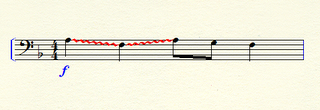
In his wisdom, our band director had me stand to deliver this stirring cadenza.
(In all fairness, the solo happened twice..Howard Danner played it the first time)
I believe I am scarred for life.
It's just like those early conversations...
"Oh, what instrument do you play?"
"The Trombone."
"Oh [pause] [twinkle forms in the eye..arm raises up] beee-reeer-rup"
[you know, that sound made by the average witty joe on the street imitating a trombone gliss].
"...sigh..{ah, such incisive wit, such comedic brilliance}"
I guess all these years I've had something of an anti-glissando bias.
But hey, I'm growing. This semester in teaching, I've rediscovered the pedagogical power of this trombone cliche. A number of my students have really benefited from doing loud glissandos (at last something possibly more annoying than that alto sax in the next room).
In honor of this therapeutic re-discovery, I've added another flow exercise to the basic daily routine on the BoneZone website. Click here for it (a .pdf file will download).
Of course in a recent lesson, as a student and I roared unabashedly through some high glisses, I looked over at the window in my door.
Looking in were a mother and her toddler, apparently enjoying the zoo animals inside.
"...sigh.."
It was an elementary school band concert...a stirring rendition of "Young MacDonald Had a Farm" as I recall.
At one point, right after the familiar refrain, "Young MacDonald had a farm..." the usual E-I-E-I-O was replaced by a lovely trombone gliss (faithfully notated below)
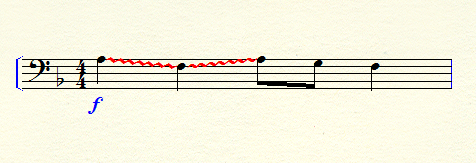
In his wisdom, our band director had me stand to deliver this stirring cadenza.
(In all fairness, the solo happened twice..Howard Danner played it the first time)
I believe I am scarred for life.
It's just like those early conversations...
"Oh, what instrument do you play?"
"The Trombone."
"Oh [pause] [twinkle forms in the eye..arm raises up] beee-reeer-rup"
[you know, that sound made by the average witty joe on the street imitating a trombone gliss].
"...sigh..{ah, such incisive wit, such comedic brilliance}"
I guess all these years I've had something of an anti-glissando bias.
But hey, I'm growing. This semester in teaching, I've rediscovered the pedagogical power of this trombone cliche. A number of my students have really benefited from doing loud glissandos (at last something possibly more annoying than that alto sax in the next room).
In honor of this therapeutic re-discovery, I've added another flow exercise to the basic daily routine on the BoneZone website. Click here for it (a .pdf file will download).
Of course in a recent lesson, as a student and I roared unabashedly through some high glisses, I looked over at the window in my door.
Looking in were a mother and her toddler, apparently enjoying the zoo animals inside.
"...sigh.."

Thursday, November 09, 2006
A "Killer App" for Aspiring Orchestral Players
In the software world, there is the term, "killer app." A killer app is that piece of software that blows away everything else.
Like lots of teachers, I've talked about the importance of studying excerpts in their context. How many trombonists have labored away on those notes without any idea of how the excerpt sounds in context?
Better yet, trombonists should be able to hear different renditions of the same selection.
Before, this meant repeated trips to the music library (assuming of course they had more than one or two recordings) or spending a small fortune in CD's.
I've even heard of one trombonist who joined one of those record clubs (and had his friends and family join as well) so he could get multiple recordings. I know of another who worked in a music library and quietly borrowed and burned hundreds of recordings to expand his library.
But for most of us this is all a logistical and financial nightmare.
Wouldn't it be nice if someone out there could compile a bunch of recordings of the excerpted passages and place them side by side along with the printed music.
Well someone *has* done it!
I don't who Seth T. Vatt is but I'm here to declare this website as possibly the best resource I have ever seen (at least if you are in the business of seriously studying orchestral excerpts).
Seth's website tromboneexcerpts.org is such a jaw-dropping stroke of genius that I think somebody should give him an award! I imagine a time not too long from now when a young, serious student will come here to study already having carefully listened to multiple recordings of all the major excerpts. It will never occur to them how difficult this used to be!
It's almost too easy.
Some purists may object, saying that record companies and orchestras are being cheated out of rightful profits. Well, last time I checked, most young trombone hopefuls aren't brimming over with extra cash to spend on recordings!
And frankly, this is such an obvious idea that I say shame on the recording industry for not producing excerpt compilation CD's for all the major instruments (if not for the profit, then as a public service to future musicians....or is everything driven by the accountants these days)
Hooray for Seth Vatt.
(I just hope nobody forces down this wonderful website.
Hmm. maybe I should quickly snag these sound files before everything vanishes)
Like lots of teachers, I've talked about the importance of studying excerpts in their context. How many trombonists have labored away on those notes without any idea of how the excerpt sounds in context?
Better yet, trombonists should be able to hear different renditions of the same selection.
Before, this meant repeated trips to the music library (assuming of course they had more than one or two recordings) or spending a small fortune in CD's.
I've even heard of one trombonist who joined one of those record clubs (and had his friends and family join as well) so he could get multiple recordings. I know of another who worked in a music library and quietly borrowed and burned hundreds of recordings to expand his library.
But for most of us this is all a logistical and financial nightmare.
Wouldn't it be nice if someone out there could compile a bunch of recordings of the excerpted passages and place them side by side along with the printed music.
Well someone *has* done it!
I don't who Seth T. Vatt is but I'm here to declare this website as possibly the best resource I have ever seen (at least if you are in the business of seriously studying orchestral excerpts).
Seth's website tromboneexcerpts.org is such a jaw-dropping stroke of genius that I think somebody should give him an award! I imagine a time not too long from now when a young, serious student will come here to study already having carefully listened to multiple recordings of all the major excerpts. It will never occur to them how difficult this used to be!
It's almost too easy.
Some purists may object, saying that record companies and orchestras are being cheated out of rightful profits. Well, last time I checked, most young trombone hopefuls aren't brimming over with extra cash to spend on recordings!
And frankly, this is such an obvious idea that I say shame on the recording industry for not producing excerpt compilation CD's for all the major instruments (if not for the profit, then as a public service to future musicians....or is everything driven by the accountants these days)
Hooray for Seth Vatt.
(I just hope nobody forces down this wonderful website.
Hmm. maybe I should quickly snag these sound files before everything vanishes)
Tuesday, November 07, 2006
Happy Fun Time
Here's an addition to the BoneZone website that's just for fun. I've actually been thinking about doing this for years.
Auditions tend to be stressful times for the candidates. Here's some cynical fun to pass the time,
the Happy Fun puzzle page.
It includes a maze, a word search and (my favorite) a crossword puzzle.
(You definitely need to be versed in trombone excerpts to solve the crossword puzzle.)
Auditions tend to be stressful times for the candidates. Here's some cynical fun to pass the time,
the Happy Fun puzzle page.
It includes a maze, a word search and (my favorite) a crossword puzzle.
(You definitely need to be versed in trombone excerpts to solve the crossword puzzle.)
Saturday, November 04, 2006
Warts and All
I've added 6 new live performance mp3's to my website.
Not perfect...actually kind of tough to just throw them up there for anyone to listen to, warts and all.
Yikes, maybe I should just take it all down. Naah. I'll just be happy about the good stuff and let the chips fall where they may.
Also this gives me a chance to let people hear a new piece I've written..
Not perfect...actually kind of tough to just throw them up there for anyone to listen to, warts and all.
Especially when I know how picky some of my students are.
Especially when I know how picky I get in lessons.
Especially these days when a professional CD can be edited to such clean perfection.
Especially when I know how picky I get in lessons.
Especially these days when a professional CD can be edited to such clean perfection.
Yikes, maybe I should just take it all down. Naah. I'll just be happy about the good stuff and let the chips fall where they may.
Also this gives me a chance to let people hear a new piece I've written..
4 Impromptus for Low Bone Alone.
Tuesday, October 31, 2006
Aaaahh....I've been pedaled !!!
Another Halloween. Out walking the usual trick-or-treat route with my kids. Of course, there's the usual smattering of older kids who have put in the minimal costume effort in order to score some candy.
Around 8, we shut down our sugar operation..lights off, etc. I'm putting the kids to bed when, around 9 the doorbell rings. Oh great, here we go again with the late trick-or-treaters.
Little did I know.... (insert evil "mu-ha-ha-ha" here).
What possesses some of my students to hop in a car, drive 40 minutes out to my house just so life can imitate art...
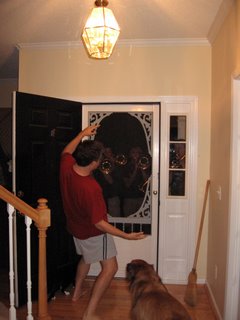
Yeah, this is a Peterson Project moment.
I should have figured what was up when one of my students calls to ask me my address "for some college applications."
College applications? On Halloween? Will???
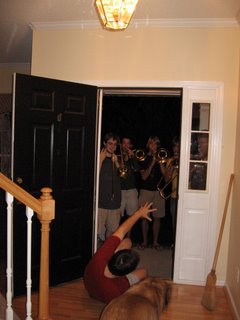
So gullible I am.
I wonder if I can sue mapquest?
Around 8, we shut down our sugar operation..lights off, etc. I'm putting the kids to bed when, around 9 the doorbell rings. Oh great, here we go again with the late trick-or-treaters.
Little did I know.... (insert evil "mu-ha-ha-ha" here).
What possesses some of my students to hop in a car, drive 40 minutes out to my house just so life can imitate art...

Yeah, this is a Peterson Project moment.
I should have figured what was up when one of my students calls to ask me my address "for some college applications."
College applications? On Halloween? Will???

So gullible I am.
I wonder if I can sue mapquest?
A beautiful day outside .... for drone rounds?
Ever have a lick that you play over and over, getting stuck repeatedly?
Try memorizing it.
My office has a window.
I sometimes have students "flash memorize" a measure or two and then look out the window and play the lick a few times from memory while "paying attention" to some detail out the window.
When they return to the printed page, the passage hopefully has been transformed into a kind of icon which evokes the memory of the lick.
A little bit like the My Blocks I talked about a year ago.

This whole business of "paying attention" is interesting. A while back, Itzhak Perlman was interviewed by Mike Wallace. He mentioned practicing scales while watching sports on TV with the sound turned off.
Hmm: watching TV while practicing?
So perhaps the scales are on an "autopilot" level so higher level thinking can be directed to other issues..phrasing, the conductor, etc.

Reminds me of a 1987 movie, "Broadcast News." One scene shows the anchor smoothly delivering the news while the producer speaks to him through his earpiece.
Hmm: speaking while listening?
If you haven't done so, check out the drones on my website. Get together with a friend and try this:
The first person begins a simple theme and the second follows in the manner of a round.
Nothing too complex. Maybe something like this:

Player #2 has a tricky job of both playing and listening. Really keeps you on your toes.
Monday, October 30, 2006
A Good Link: The Peterson Project
My students mentioned this website to me. A Houston freelancer who is making some great short films. Fun site ...
Peterson Project
Peterson Project
Saturday, October 28, 2006
Tuning, Squacking and that Singer Stuff
I used to teach at Kinhaven Music School. Still, I believe, just about the nicest place I've ever been. Here's a memory I'd like to share...
As I walked around the camp, I could easily hear musical sounds wafting from practice rooms. As I listened to the violin teachers practicing, here's what struck me: how often they stopped to tune so the instrument would "ring."
A friend of mine once switched from trombone to violin. She made the most interesting comment, "I love the violin. It talks to you. It tells you when it's out of tune."
Think of Jay Friedman's comment that he might describe himself as a "professional seeker of resonance."
Another sound floating across the Kinhaven grounds came from the reed room where the oboes would practice. I noticed how often they would interrupt their practicing, remove their reeds and start squacking and whittling. As I understand it, they were seeking that resonant squack..that perfect reed.
We have a lip reed. How often do we stop to buzz in the middle of our practice sessions, looking to maintain that perfect buzz.
Even singers seem to spend a lot of time singing those descending glisses. Let me guess....seeking resonance?
Stopping often to tune ... to seek resonance. Finding that sweet spot where the instrument really rings.
How often do we trombonists do this?
How often do we just try to muscle the horn?
Observe the pusuit of excellence on other instruments.
Adopt the best habits
Teachers are all around you
As I walked around the camp, I could easily hear musical sounds wafting from practice rooms. As I listened to the violin teachers practicing, here's what struck me: how often they stopped to tune so the instrument would "ring."
A friend of mine once switched from trombone to violin. She made the most interesting comment, "I love the violin. It talks to you. It tells you when it's out of tune."
Think of Jay Friedman's comment that he might describe himself as a "professional seeker of resonance."
Another sound floating across the Kinhaven grounds came from the reed room where the oboes would practice. I noticed how often they would interrupt their practicing, remove their reeds and start squacking and whittling. As I understand it, they were seeking that resonant squack..that perfect reed.
We have a lip reed. How often do we stop to buzz in the middle of our practice sessions, looking to maintain that perfect buzz.
Even singers seem to spend a lot of time singing those descending glisses. Let me guess....seeking resonance?
Stopping often to tune ... to seek resonance. Finding that sweet spot where the instrument really rings.
How often do we trombonists do this?
How often do we just try to muscle the horn?
Observe the pusuit of excellence on other instruments.
Adopt the best habits
Teachers are all around you
Tuesday, October 24, 2006
Back to the Big Four: F, C, T, D
Seems I've trod this ground before but it bears repeating.
Here are the big four...
F
Fundamentals
Concept
Tension
Distraction
I'm sure I missed a few but this seems to be a pretty good list.
Back to ye old performance equation...
P - I = R
Potential minus interference equals result.
Potential = (Fundamentals + Concept)
Interference = (Tension + Distraction)
Hope this checklist helps.
Here are the big four...
F
Fundamentals
- Do you have a resonant, centered tone in different registers?
- Can you play in tune with yourself and others?
- Can you hear the notes in your head before you play them?
- Can you keep a steady tempo?
- Can you subdivide correctly within that tempo?
- Can you begin the notes cleanly?
- Can you control all these elements as you play.. high and low? ...loud and soft? ...fast and slow?
Concept
- Do you know exactly what the piece should sound like?
- Do you know where you are going to breathe?
- Do you know where to crescendo? ...whether to use vibrato? ...how much accent to use?
- Do you know exactly what slide positions you're going to use?
- Have you heard multiple recordings of the piece?
- If a solo, do you know the piano part well?
- If an excerpt, do you know the piece as a whole?
- Do you know the meanings of all the terms?
- Can you close your eyes and hear the precise sound of someone really "nailing it?"
Tension
- Are you aware when tension builds in your body?
- Is your posture well-balanced?
- Is your playing a natural extension of relaxed breathing?
- Is your tongue relaxed? Your throat? Your shoulders?
Distraction
- Are you so focused on the music that you don't notice what is going on around you?
- Have you quieted any "inner conversations" about your playing, good or bad?
- Are you " in the moment?"
- Do you "disappear into the music" as you play?
I'm sure I missed a few but this seems to be a pretty good list.
Back to ye old performance equation...
P - I = R
Potential minus interference equals result.
Potential = (Fundamentals + Concept)
Interference = (Tension + Distraction)
Hope this checklist helps.
Tuesday, October 17, 2006
Dive Stupid
Recitals coming up this week and next. Pressure.
Think of audition pressure. Having to nail Bolero. Tough, yes?
Think of the olympic diving competition coming up in China. Think of those divers who are probably training right now in order to represent their country on the world stage. A quick google search yielded this article from the Chinese People's Daily.

So, you step up on the platform and, in the next second or two, years of training will either result in a perfect dive and national celebrations...
or
the slightest misalignment will lead to failure and national disgrace
(or at least disappointment).
Now that's pressure!
I once heard an interview with a U.S. Olympic diver. She said,
"They teach us to dive stupid."
(That's "dive stupid" not "dive, stupid."
A fairly important comma for the poor
reporter's feelings, don't you think?)
In other words, when everything is on the line,
turn the brain off and let the training take over.
Now that's good advice!
Think of audition pressure. Having to nail Bolero. Tough, yes?
Think of the olympic diving competition coming up in China. Think of those divers who are probably training right now in order to represent their country on the world stage. A quick google search yielded this article from the Chinese People's Daily.

So, you step up on the platform and, in the next second or two, years of training will either result in a perfect dive and national celebrations...
or
the slightest misalignment will lead to failure and national disgrace
(or at least disappointment).
Now that's pressure!
I once heard an interview with a U.S. Olympic diver. She said,
"They teach us to dive stupid."
(That's "dive stupid" not "dive, stupid."
A fairly important comma for the poor
reporter's feelings, don't you think?)
In other words, when everything is on the line,
turn the brain off and let the training take over.
Now that's good advice!
Saturday, October 14, 2006
Eric and the Tree People ...
In a recent lesson I was working with a student on the last movement of Eric Ewazen's Sonata. One or two passages didn't have quite the right feel. After some fancy finger work with with Dr. Beat, I was able to have the metronome continue with only one click every measure (beat volume up, all others down).
It seemed the feeling of the piece changed before our eyes. Same tempo but, by feeling the larger beat, the music seemed to flow better.
Choosing on which level to experience the beat is an expressive tool that we sometimes overlook. When one thinks in quarter notes, it is more likely the music have a different quality than when one thinks in half notes or even whole notes.
Is this my imagination??
It seemed the feeling of the piece changed before our eyes. Same tempo but, by feeling the larger beat, the music seemed to flow better.
Choosing on which level to experience the beat is an expressive tool that we sometimes overlook. When one thinks in quarter notes, it is more likely the music have a different quality than when one thinks in half notes or even whole notes.
Is this my imagination??
DISSERTATION ALERT:
Have subjects learn and play the same passage at the same tempo but one group is thinking in quarters while another thinks in halves and another in whole notes. Have others listen to recordings of these performers. Can they discern a difference?END DISSERTATION ALERT (Resume normal blogging)
I was trying to think of some story to go along with Ewazen's music. The opening passage (of the third movement) feels like people rejoicing on the ground. Later passages take on a more peaceful quality almost like angels floating above all this commotion.
No, angels aren't quite right. Druids? Monks? Who experiences time on a slower scale than humans? How about trees? That might work...oh yes, what about those tree people (Ents) in Lord of the Rings? They would probably prefer to hear the Ewazen Sonata on the whole note level.
Squirrels on the other hand ....
Of course if you really want to stretch your time scale out, consider some of the concepts thrown out in Greg Bear's creepy book Vitals.
What about choosing a time scale of subdivision other than for the obvious practice utility of rhythmic accuracy? Well, when encountering a slow excerpt like St. Saens 3 or Schumann 3 (or even the opening of Mahler 3 [what's with all these big "3" excerpts] ) I find I play better when thinking 8th notes. It seems to keep the air from becoming stagnant.
Who knows, maybe I'm just giving Self 1 something to do so it doesn't get in the way.
I was trying to think of some story to go along with Ewazen's music. The opening passage (of the third movement) feels like people rejoicing on the ground. Later passages take on a more peaceful quality almost like angels floating above all this commotion.
No, angels aren't quite right. Druids? Monks? Who experiences time on a slower scale than humans? How about trees? That might work...oh yes, what about those tree people (Ents) in Lord of the Rings? They would probably prefer to hear the Ewazen Sonata on the whole note level.
Squirrels on the other hand ....
Of course if you really want to stretch your time scale out, consider some of the concepts thrown out in Greg Bear's creepy book Vitals.
What about choosing a time scale of subdivision other than for the obvious practice utility of rhythmic accuracy? Well, when encountering a slow excerpt like St. Saens 3 or Schumann 3 (or even the opening of Mahler 3 [what's with all these big "3" excerpts] ) I find I play better when thinking 8th notes. It seems to keep the air from becoming stagnant.
Who knows, maybe I'm just giving Self 1 something to do so it doesn't get in the way.
Monday, October 09, 2006
Just in Case...
Alright, time for a gripe.
I did Shostakovitch 7th this past weekend. I'm not sure but I think we managed to save Leningrad again. So there I am at the rehearsal break and I look around me at all these trumpets, trombones and especially horns left sitting out while their owners have walked away. Most amazing to me are the horns which are usually left laying on chairs.
Why do otherwise sensible professional musicians spend thousands of dollars on fine musical instruments only to leave them laying out during rehearsal break? In my career, I have witnessed two incidents where a french horn was accidentally knocked off a chair and another in which a music stand was knocked into a french horn. I've also seen a trumpet knocked off its stand by a less-than-graceful basoonist. A few weeks ago, I nearly knocked horn off its chair but managed to grab it before it hit the floor. Of course I apologized profusely but inside I was thinking, "Why on earth do just leave a $9,000 instrument laying on a chair on a crowded stage???" Yes musicians do make an extra effort to not crush each other's instruments but, hey, mistakes happen.
I, for one, have a personal rule for rehearsals: If I'm not holding it, it's in the case.
The worst offenders by far are the double basses who place their instruments in the most likely path of travel by people entering and exiting the stage. Are they trying to build a bass barricade? Do they look around and say, "Hmm, where will people need to walk? Oh yes, I'll lay my instrument right there."
Should I crack a pun about rehearsal "break" not being a literal term? Naah, too corny.
And don't get me started about my students who travel up and down the elevators and the stairwells with their instruments unprotected (sometimes struggling to get through doorways carrying their trombone and case separately).
grumble, grumble, grumble...
I did Shostakovitch 7th this past weekend. I'm not sure but I think we managed to save Leningrad again. So there I am at the rehearsal break and I look around me at all these trumpets, trombones and especially horns left sitting out while their owners have walked away. Most amazing to me are the horns which are usually left laying on chairs.
Why do otherwise sensible professional musicians spend thousands of dollars on fine musical instruments only to leave them laying out during rehearsal break? In my career, I have witnessed two incidents where a french horn was accidentally knocked off a chair and another in which a music stand was knocked into a french horn. I've also seen a trumpet knocked off its stand by a less-than-graceful basoonist. A few weeks ago, I nearly knocked horn off its chair but managed to grab it before it hit the floor. Of course I apologized profusely but inside I was thinking, "Why on earth do just leave a $9,000 instrument laying on a chair on a crowded stage???" Yes musicians do make an extra effort to not crush each other's instruments but, hey, mistakes happen.
I, for one, have a personal rule for rehearsals: If I'm not holding it, it's in the case.
The worst offenders by far are the double basses who place their instruments in the most likely path of travel by people entering and exiting the stage. Are they trying to build a bass barricade? Do they look around and say, "Hmm, where will people need to walk? Oh yes, I'll lay my instrument right there."
Should I crack a pun about rehearsal "break" not being a literal term? Naah, too corny.
And don't get me started about my students who travel up and down the elevators and the stairwells with their instruments unprotected (sometimes struggling to get through doorways carrying their trombone and case separately).
grumble, grumble, grumble...
Friday, October 06, 2006
Me and Gilderoy
First of all, for anyone who's actually reading this, sorry that my posts have come to a standstill. There's a reason which I'll get to in a moment.
I had an interesting chat at the end of a private student's lesson Wednesday. She had bought my clef studies book and I was thinking about recommending the lip slurs book as well. She related her mother's comment, "Oh those professors just want you to go out and buy all their books so that can get their name out there." She meant it in good humor but it brought up a valid point.
Thus far I have two books and am working on at least two more. If I succeed, this could create a situation where a student coming to study with me would need to buy 4 (count them, "four") of my books.
This reminds me of Gilderoy Lockhart from the Harry Potter series. Gilderoy was on a blatant ego trip about himself and his books. Am I?
I hope not. So, why do I write these things?
Some of it comes from years of frustration: I've been teaching quite a few private students since about 1990 and I'm always looking for the right tool for the job. I tried the Blazhevich clef studies (and the Fink and the Uber and the Sauer). Maybe I'm just too picky but none of these quite did the trick so I wrote my own.
Some of it comes from creative drive. You know, when a little kid is proud of a picture he has drawn and wants mom and dad to like it. I'm proud of these two books and want other people to like them. I love being creative and I love teaching. These books combine the two and are extremely satisfying to write.
Some of it comes from wanting to build a better mousetrap. Just like the satisfaction in solving a crossword puzzle, I find it intriguing to look at a problem (the flawed materials we end up using) and see if I can come up with a better solution. I just can't help tinkering.
Ultimately, I feel like the stuff I write is "out there" waiting to come in for a landing. I look at the etudes I've written and I don't feel like I was the one who wrote them.
Oh yes, why no posts lately? I'm trying to write a new set of pieces for either bass or low tenor trombone: 4 Impromptus for Low Bone Alone. I'm performing them in two weeks so I guess I'd better finish. Here's the kicker: I have already submitted the program info complete with movement titles even the music isn't finished. The second through 4th impromptus are done but the first one is still giving me fits. I can see how it starts and how it ends but haven't connected the dots yet. So, that is eating up brain power and time later at night when I might normally do a blog entry.
I had an interesting chat at the end of a private student's lesson Wednesday. She had bought my clef studies book and I was thinking about recommending the lip slurs book as well. She related her mother's comment, "Oh those professors just want you to go out and buy all their books so that can get their name out there." She meant it in good humor but it brought up a valid point.
Thus far I have two books and am working on at least two more. If I succeed, this could create a situation where a student coming to study with me would need to buy 4 (count them, "four") of my books.
This reminds me of Gilderoy Lockhart from the Harry Potter series. Gilderoy was on a blatant ego trip about himself and his books. Am I?
I hope not. So, why do I write these things?
Some of it comes from years of frustration: I've been teaching quite a few private students since about 1990 and I'm always looking for the right tool for the job. I tried the Blazhevich clef studies (and the Fink and the Uber and the Sauer). Maybe I'm just too picky but none of these quite did the trick so I wrote my own.
Some of it comes from creative drive. You know, when a little kid is proud of a picture he has drawn and wants mom and dad to like it. I'm proud of these two books and want other people to like them. I love being creative and I love teaching. These books combine the two and are extremely satisfying to write.
Some of it comes from wanting to build a better mousetrap. Just like the satisfaction in solving a crossword puzzle, I find it intriguing to look at a problem (the flawed materials we end up using) and see if I can come up with a better solution. I just can't help tinkering.
Ultimately, I feel like the stuff I write is "out there" waiting to come in for a landing. I look at the etudes I've written and I don't feel like I was the one who wrote them.
Oh yes, why no posts lately? I'm trying to write a new set of pieces for either bass or low tenor trombone: 4 Impromptus for Low Bone Alone. I'm performing them in two weeks so I guess I'd better finish. Here's the kicker: I have already submitted the program info complete with movement titles even the music isn't finished. The second through 4th impromptus are done but the first one is still giving me fits. I can see how it starts and how it ends but haven't connected the dots yet. So, that is eating up brain power and time later at night when I might normally do a blog entry.
Wednesday, September 13, 2006
Akeelah and the Bee
Recently, I saw a very inspirational film, Akeelah and the Bee. I strongly recommend it!!!
Here's the movie's website.
There is a wonderful quote that appears in this movie...
Here's the movie's website.
There is a wonderful quote that appears in this movie...
Our deepest fear is not that we are inadequate.
Our deepest fear is that we are powerful beyond measure.
It is our light, not our darkness, that most frightens us.
We ask ourselves, who am I to be brilliant, gorgeous,
talented and fabulous.
Actually, who are you not to be?
You are a child of God.
Your playing small doesn't serve the world.
There's nothing enlightened about shrinking so that other
people won't feel insecure around you.
We were born to make manifest the glory of
God that is within us.
It's not just in some of us -- it's in everyone.
And as we let our own light shine,
we unconsciously give other people
permission to do the same.
As we are liberated from our own fear,
our presence automatically liberates others
-Marianne Williamson
BA-UM
While doing my undergrad work at the Hartt School of Music, I played in the Hartt Jazz Band whose director was Al Lepak (also the percussion teacher).
Whenever the trumpets and trombones fell apart on some complex rhythm, Al would simply look up, unlit cigar in his mouth and say in that gravelly voice, "Guys, guys, it's ba-um"
Ba - pick-up
Um - downbeat
Of course his other saying was "Guys, guys, it's um-ba"
It still amazes me how this simple advice worked instantly to fix our counting errors.
Extending this idea a bit .....
I seem to perceive rhythm differently than some of my students and (maybe) most people. I see most rhythms as pick-ups to downbeats (BA-UM or maybe BA-BA-BA-UM, etc)
Think of the excerpt from La Gazza Ladra:
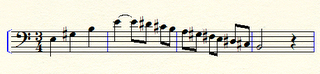
A common rhythmic error is to leave the top note early, thus starting the run too soon.
Instead of perceiving the beginning of that run as "1&2&BA", I think of it as "BA-BA-BA-UM"
Over time, I've learned to know the "feel" of three pickups to a downbeat.
In other words:
You can count a rhythm by relating it to
what precedes
or to what follows
For what it's worth, it worked like a charm in one lesson today.
PS Just like Tabuteau numbers if you're familiar with them.
Whenever the trumpets and trombones fell apart on some complex rhythm, Al would simply look up, unlit cigar in his mouth and say in that gravelly voice, "Guys, guys, it's ba-um"
Ba - pick-up
Um - downbeat
Of course his other saying was "Guys, guys, it's um-ba"
It still amazes me how this simple advice worked instantly to fix our counting errors.
Extending this idea a bit .....
I seem to perceive rhythm differently than some of my students and (maybe) most people. I see most rhythms as pick-ups to downbeats (BA-UM or maybe BA-BA-BA-UM, etc)
Think of the excerpt from La Gazza Ladra:
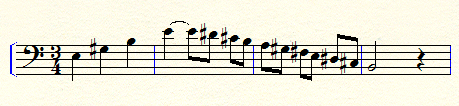
A common rhythmic error is to leave the top note early, thus starting the run too soon.
Instead of perceiving the beginning of that run as "1&2&BA", I think of it as "BA-BA-BA-UM"
Over time, I've learned to know the "feel" of three pickups to a downbeat.
In other words:
You can count a rhythm by relating it to
what precedes
or to what follows
For what it's worth, it worked like a charm in one lesson today.
PS Just like Tabuteau numbers if you're familiar with them.
Tuesday, August 29, 2006
Two Types of People
Here's a favorite saying. I use it often...
There are two types of people..
Those who pursue success
and
Those who avoid failure.
Those who pursue success
and
Those who avoid failure.
Monday, August 28, 2006
UBOT!!
After a summer of being able to blissfully ignore my "to-do" list, classes have begun and the maelstrom of details and deadlines has started.
Alas, we have come to rely on our electronic.computer.software.helpers to accomplish our deeds.
Lately it seems some of my helpers are out to get me...
And thus, I have a new term:
UBOT
Unproductive Because Of Technology
(a.k.a. "Where did that last hour go???")
I do have some "star" programs that have chugged away reliably and thus deserve credit:
The PBOT list:
Not really a trombone posting but, regardless of our specialty, we all increasingly rely on these machines to achieve our goals.
Alas, we have come to rely on our electronic.computer.software.helpers to accomplish our deeds.
Lately it seems some of my helpers are out to get me...
- I'm about to post my syllabus on the website when Adobe Acrobat (which has worked faithfully for years) suddenly locks up my computer.
- iCal dropped a bunch of of recital hall reservations creating double bookings
- MS Word crashes about once each work session (I've learned to hit Ctrl-S after about every sentence)
- I get 20 - 30 spams a day (Boy, no matter how many times I give them my my social security number they still say my credit union account needs updating).
- Just as I'm about to really get something done on the computer, Windows announces everything must stop for an update, (or McAfee).
- When I plug in my iPod for an update it takes about 5 minutes for iTunes to open and begin the update
- Even my login to blogger.com got messed up for a while.
And thus, I have a new term:
UBOT
Unproductive Because Of Technology
(a.k.a. "Where did that last hour go???")
I do have some "star" programs that have chugged away reliably and thus deserve credit:
The PBOT list:
- Finale 2006. Just got it and love it. Never crashes.
- Dreamweaver MX. I use it for BoneZone. Fantastic. So good I can't see why I need to ever update the software.
- Eudora. Trusty, simple, it does the gig although I don't venture into spam filtering (yet).
- Palm Desktop. Synchs beautifully with the Palm Pilot. The desktop app. is missing some features I'd love to see but, hey, it works day in day out. However, thumbs down to the "Documents to Go" app that synchs MS Word docs with the PDA.
- CGoban (from Java). My addiction is playing the game of GO online. The applet from the Kiseido Go Server is a faithful friend. http://kgs.kiseido.com/
Not really a trombone posting but, regardless of our specialty, we all increasingly rely on these machines to achieve our goals.
Saturday, August 26, 2006
And Away WE Go!
Happy New Year!
No, it's not January but in the academic world everything is beginning so this may as well be the new year.
I've caught grief from some of my students for not keeping active with this blog over the summer. Sorry. Summer is a time not only to recharge my batteries a bit but to work on those projects that end up gobbling up a lot of time.
The two big projects: continuing to transcribe and edit my own collection of selected etudes ( currently 200 - 300 pages of material), and working on another book, Pattern Building, to accompany my book of Lip Slurs.
Ultimately I plan for these books to be a 3-part (or possibly 4-part) collection of books. Here's the plan:
Underlying everything are the fundamentals (Bone Basics): warm-up patterns, simple tunes, basic articulation exercises, maybe some specialized exercises (like building the high register).
These are exercises which are not progressive. They will be basic "bread and butter" stuff. Many sketches for this book are already done.
The Lip Slurs are pretty much self-explanatory. I'm mostly happy with the book and other people seem to like them. If you're curious, here's a link.
Pattern Building is the latest (and hopefully the final) incarnation in my search for a way to teach scales and arpeggios (Ouch, so many previous tries that just haven't worked). Yes, I know a lot these kinds books are already available but I haven't seen anything that really does what I'm looking for. This book is basically the mixture of scale/arp patterns and rhythm patterns. Any given section of the book, for example, presents a melodic pattern (scale or arp based) to be played from memory in all keys and a collection of related rhythms (almost like flashcards). What follows are 24 "mini etudes," most 8-12 measures long , which are connected to the given melodic and rhythmic patterns.
Why do we learn scales? Not only to develop general technique but to develop instincts that let us rapidly read/learn music. Thus, a complete scale/arp plan needs to have both memory work and reading work. Rhythm patterns aren't really different, the goal is a kind of "instant recognition" ... see the rhythm and instinctively know what it is supposed to sound like.
All this is very similar to learning to read words. One starts sounding out words and eventually moves on to instant recognition.
If the book succeeds, I hope my students will develop much stronger reading skills.
We'll see how it goes.
No, it's not January but in the academic world everything is beginning so this may as well be the new year.
I've caught grief from some of my students for not keeping active with this blog over the summer. Sorry. Summer is a time not only to recharge my batteries a bit but to work on those projects that end up gobbling up a lot of time.
The two big projects: continuing to transcribe and edit my own collection of selected etudes ( currently 200 - 300 pages of material), and working on another book, Pattern Building, to accompany my book of Lip Slurs.
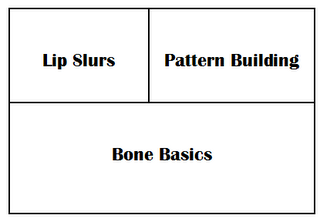
Ultimately I plan for these books to be a 3-part (or possibly 4-part) collection of books. Here's the plan:

Underlying everything are the fundamentals (Bone Basics): warm-up patterns, simple tunes, basic articulation exercises, maybe some specialized exercises (like building the high register).
These are exercises which are not progressive. They will be basic "bread and butter" stuff. Many sketches for this book are already done.
The Lip Slurs are pretty much self-explanatory. I'm mostly happy with the book and other people seem to like them. If you're curious, here's a link.
Pattern Building is the latest (and hopefully the final) incarnation in my search for a way to teach scales and arpeggios (Ouch, so many previous tries that just haven't worked). Yes, I know a lot these kinds books are already available but I haven't seen anything that really does what I'm looking for. This book is basically the mixture of scale/arp patterns and rhythm patterns. Any given section of the book, for example, presents a melodic pattern (scale or arp based) to be played from memory in all keys and a collection of related rhythms (almost like flashcards). What follows are 24 "mini etudes," most 8-12 measures long , which are connected to the given melodic and rhythmic patterns.
Why do we learn scales? Not only to develop general technique but to develop instincts that let us rapidly read/learn music. Thus, a complete scale/arp plan needs to have both memory work and reading work. Rhythm patterns aren't really different, the goal is a kind of "instant recognition" ... see the rhythm and instinctively know what it is supposed to sound like.
All this is very similar to learning to read words. One starts sounding out words and eventually moves on to instant recognition.
If the book succeeds, I hope my students will develop much stronger reading skills.
We'll see how it goes.
Wednesday, June 21, 2006
Grunts and Moans
I'm doing less teaching over the summer but I do see a few private students.
So often, freshman students arrive with bad habits so deeply ingrained that it takes months or years to turn things around. That's why I like to work with younger students and try to instill good habits earlier in the process.
Here's the big one I'm noticing this summer (not that I haven't seen it before!):
So often, freshman students arrive with bad habits so deeply ingrained that it takes months or years to turn things around. That's why I like to work with younger students and try to instill good habits earlier in the process.
Here's the big one I'm noticing this summer (not that I haven't seen it before!):
THROAT TENSION
Especially when students go to attack notes, I so often hear a little grunting sound as the throat tenses (often for the attack). In more severe cases, you can actually hear a soft humming or moaning sound along with the playing.
I've even held up a recorder microphone close to a student's throat to help them hear these sounds. Sometimes the effect is kind of spooky, like the ghost of someone's grandfather is humming along with the music.
Remember, the vocal chords help to keep food out of the lungs. But, as they close, this also prevents air from coming out of the lungs.
Some things to think about it:
Especially when students go to attack notes, I so often hear a little grunting sound as the throat tenses (often for the attack). In more severe cases, you can actually hear a soft humming or moaning sound along with the playing.
I've even held up a recorder microphone close to a student's throat to help them hear these sounds. Sometimes the effect is kind of spooky, like the ghost of someone's grandfather is humming along with the music.
Remember, the vocal chords help to keep food out of the lungs. But, as they close, this also prevents air from coming out of the lungs.
Some things to think about it:
- Higher notes seem to cause more trouble.
- Tricky music makes things worse.
- You need to notice it in order to fix it. Have a friend stand nearby and listen for those throat sounds.
- As your throat relaxes, you might notice your sound getting bigger and notes speaking more easily.
- When notes don't speak, I often hear a very significant grunt (makes sense, really..less air going to the lips makes "air balls" much easier)
A relaxed throat is an open throat.
Subscribe to:
Posts (Atom)