The Burning River Brass Ensemble has some concerts coming up in the southeast. If their live concerts sound anything like their recordings, this is not an event to be missed!
I frequently play some of the recordings in lessons to help demonstrate sound concept to my students. Including the first movement, "Of Knights and Castles" by Raymond Premru. It includes one of the cleanest trombone scales I've ever heard. I sometimes refer to it as"the perfect scale." You'll know it when you hear it.
They'll be in Beaufort, SC on Feb. 25th and then head over to Georgia.
Here's a link to their schedule on their website
Wednesday, January 31, 2007
Tuesday, January 30, 2007
Getting back on my feet again....
I'm posting this from my new laptop computer. Excitement? Not really.
I already owned a laptop: a new one.
Somebody stole it last Friday and I've been a little off my game ever since.
I hope to be posting again soon.
I already owned a laptop: a new one.
Somebody stole it last Friday and I've been a little off my game ever since.
I hope to be posting again soon.

Wednesday, January 24, 2007
Two trombone performances worth checking out..
For those of you in the area, here are two trombone events coming up:
Feb 1 Wycliffe Gordon performs with the Augusta Ballet.
http://www.augustaballet.org/performance-winter.html
Mar. 10 Scott Hartman plays the Rota concerto with the Spartanburg Philharmonic (his wife is the music director)
http://www.spartanburgphilharmonic.org/Calendar/Concert_06-07/index.htm#exotic
Feb 1 Wycliffe Gordon performs with the Augusta Ballet.
http://www.augustaballet.org/performance-winter.html
Mar. 10 Scott Hartman plays the Rota concerto with the Spartanburg Philharmonic (his wife is the music director)
http://www.spartanburgphilharmonic.org/Calendar/Concert_06-07/index.htm#exotic
Carl Fontana clip (in case you haven't seen it)
No posts lately sorry. I had a recital in Georgia last night and have been preparing a big non-musical event this Friday.
Still, here's a wonderful clip my student have shared with me. In case you haven't seen it yet, it's great not only hearing Carl play but also *seeing* how effortlessly he produces these stellar lines.
Amazing.
Still, here's a wonderful clip my student have shared with me. In case you haven't seen it yet, it's great not only hearing Carl play but also *seeing* how effortlessly he produces these stellar lines.
Amazing.
Wednesday, January 17, 2007
A good one to center things...
Here's a pattern I've been playing lately. It really seems to help me focus and center, mentally.
I play this pattern through the circle of fifths, usually with a metronome on.
One practice note: when I'm playing the eighth note version, I strive to keep my slide movement quick and accurate. Another way to look at this: even when playing the eighth notes, I want my slide movements in between the notes to be as quick as if I were playing the fast version.
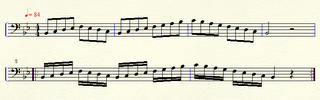
I play this pattern through the circle of fifths, usually with a metronome on.
One practice note: when I'm playing the eighth note version, I strive to keep my slide movement quick and accurate. Another way to look at this: even when playing the eighth notes, I want my slide movements in between the notes to be as quick as if I were playing the fast version.

Tuesday, January 16, 2007
The most important beat ....
....is the one you don't play.
(But you'd better be playing it in your head!)
Here's one of those rhythms people play wrong more than right (partly because it goes by so quickly and maybe they figure they can just fake it and get away with it!).
It's from Til Eulenspiegel right before the big run...

That downbeat is pretty important!
Here's a verbal trick that might work: think, "um-digga-da da-da-da"
Um, of course, is that silent downbeat.
Slow that metronome down, down waaaaay down (dotted quarter equal 60 or so) and say that rhythm exactly in time. Then bump up a few notches and so on.
I've blogged about "ba-um" before, in case you're curious.
Here's one of those rhythms people play wrong more than right (partly because it goes by so quickly and maybe they figure they can just fake it and get away with it!).
It's from Til Eulenspiegel right before the big run...

That downbeat is pretty important!
Here's a verbal trick that might work: think, "um-digga-da da-da-da"
Um, of course, is that silent downbeat.
Slow that metronome down, down waaaaay down (dotted quarter equal 60 or so) and say that rhythm exactly in time. Then bump up a few notches and so on.
I've blogged about "ba-um" before, in case you're curious.
Saturday, January 13, 2007
Bolero and BoneWeek
Sorry I haven't posted in a while. Most of my late night energies have been spent finishing up BoneWeek Fanfare #4. I went through with my original idea and created a piece that is largely based on Malcolm Arnold's Fantasy for Unaccompanied Trombone.
I'm pretty happy with it. Once I'm done proofing the parts, I'll send it in to the ITA and post it on my website. I suppose I should get around to posting BoneWeek 3 on my website one of these days. The first three fanfares are still available on the ITA website (although hard to find from the home page at the moment). Now that I have Finale 2006 and am beginning to understand their "human performance" feature, the sound files for this new fanfare should be more realistic (ritards, fermatas, crescendos, etc).
I also have a Bolero performance with the Augusta Symphony weekend so that has taken up some time. So far so good in rehearsal. It does make your heart thump a good bit!
Classes at USC start next week and I'll try to back on track with blogging.
I'm pretty happy with it. Once I'm done proofing the parts, I'll send it in to the ITA and post it on my website. I suppose I should get around to posting BoneWeek 3 on my website one of these days. The first three fanfares are still available on the ITA website (although hard to find from the home page at the moment). Now that I have Finale 2006 and am beginning to understand their "human performance" feature, the sound files for this new fanfare should be more realistic (ritards, fermatas, crescendos, etc).
I also have a Bolero performance with the Augusta Symphony weekend so that has taken up some time. So far so good in rehearsal. It does make your heart thump a good bit!
Classes at USC start next week and I'll try to back on track with blogging.
Friday, December 29, 2006
BoneTherapy
Got an interesting email from the director of the trombone ensemble Bone Therapy. They took my second BoneWeek fanfare and shortened it, nicknaming it the Bone Therapy fanfare. The group's leader even sat down, recorded all 8 parts in Garage Band and posted it on their site.
Here's a link.
I'm trying ( and struggling ) to write BoneWeek Fanfare #4. Apparently the ITA people aren't sick of me yet. I want to make sure it isn't too much like the others but is still pretty listenable and playable. One idea a I've had: I might make it a tribute to Malcom Arnold, who passed away last September. One way to do this: make it somehow connected to the Fantasy he wrote for unaccompanied trombone.
Here's a stunt I'm not talented enough to pull off (but it would be pretty cool): write a piece into which the original Fantasy would fit. In other words, if a 9th trombonist played along on the Fantasy it would fit with the fanfare. I don't think I'm going to attempt this since I doubt the original piece would be all that strong. This idea reminds me of Luciano Berio's technique of composing a Chemin that was designed to envelop one of his Sequenzas.
Here's a link.
I'm trying ( and struggling ) to write BoneWeek Fanfare #4. Apparently the ITA people aren't sick of me yet. I want to make sure it isn't too much like the others but is still pretty listenable and playable. One idea a I've had: I might make it a tribute to Malcom Arnold, who passed away last September. One way to do this: make it somehow connected to the Fantasy he wrote for unaccompanied trombone.
Here's a stunt I'm not talented enough to pull off (but it would be pretty cool): write a piece into which the original Fantasy would fit. In other words, if a 9th trombonist played along on the Fantasy it would fit with the fanfare. I don't think I'm going to attempt this since I doubt the original piece would be all that strong. This idea reminds me of Luciano Berio's technique of composing a Chemin that was designed to envelop one of his Sequenzas.
Monday, December 25, 2006
Hey Santa (part 2)
OK, so maybe Dec. 25th isn't quite the right day for this post but I figure the big guy was booked up in the toy department.
I remember I did a part 1 last year, so I guess this is becoming an obligation.
What do I want for Christmas this year?
Some way for more people to find
live classical music a relevant, vital part of their lives.
(cue: snores, sound of crickets. OK I admit this is a little abstract, maybe I should have just asked for some Slide-O-Mix Rapid comfort and about 30 slide sprayers since I keep losing mine).
But think:
How many of your regular neighbors have attended any concerts featuring classical musicians?
Every year I see those hopeful young students wishing to pursue a career as a performer.
With what job??
How many performance majors are churned out every year?
How many openings are there in jobs paying over, say, $15,000?
(Gee, Brad, Merry friggin' Christmas, ...Scrooge)
I've seen glimmers of hope ...
Reach out, become relevant, or watch our art wither away.
I remember I did a part 1 last year, so I guess this is becoming an obligation.
What do I want for Christmas this year?
Some way for more people to find
live classical music a relevant, vital part of their lives.
(cue: snores, sound of crickets. OK I admit this is a little abstract, maybe I should have just asked for some Slide-O-Mix Rapid comfort and about 30 slide sprayers since I keep losing mine).
But think:
How many of your regular neighbors have attended any concerts featuring classical musicians?
Every year I see those hopeful young students wishing to pursue a career as a performer.
With what job??
How many performance majors are churned out every year?
How many openings are there in jobs paying over, say, $15,000?
(Gee, Brad, Merry friggin' Christmas, ...Scrooge)
I've seen glimmers of hope ...
- When I lived in Iowa, the local cable company included, free of charge, a fine arts channel. It ran a bit like on older MTV, playing videos either of live performances or just nature scenes with classical music in the background. Of course Time Warner doesn't bother with it here, no profit I suppose.
- Watch people react when they hear the music from Lord of The Rings. Not often do you see that kind of strong emotional reaction to orchestral music. Were he alive today, do you suppose Wagner would be doing film scores?
- I bumped into a really good PBS series, Keeping Score, which helps people to become familiar with classical masterpieces.
- A friend of mine, Phil Rehard, is involved with a new kind of concert series in Buffalo, NY. Patrons are expected to buy a subscription to the entire series (individual event tickets aren't available). If I understand correctly, the artists are contracted in such a way that, if the series doesn't sell enough tickets, they can cancel and not have to pay the artists. I believe it has been a big success (no cancellations) thus providing another venue for great musicians and great live music.
Reach out, become relevant, or watch our art wither away.
Monday, December 18, 2006
Speaking of You Tube (Bones Apart)
A quick word search of You Tube pulled up this Bones Apart performance (in case you haven't already seen it). Come to think of it, I think I was at this concert.
While you're enjoying the fireworks, please notice how relaxed they are. Especially note Carol Jarvis' shoulders during the piccolo solo. She makes it look easy!
While you're enjoying the fireworks, please notice how relaxed they are. Especially note Carol Jarvis' shoulders during the piccolo solo. She makes it look easy!
It's not Easy Bein' GGGGGGGreen
And now for a trip down memory lane ...
In a previous post, I talked about my spectacular solo debut on "Young MacDonald had a Farm"
Fast forward to my junior high days and a glowing chance to be cool playing in the jazz band. Along comes that Kermit ballad, "It's Not Easy Bein' Green." Big trombone feature and it starts on a G.
Here's the catch: that note was bit of a problem for me. All on its own it wanted to split into two octaves.
"Oh great, now I have to stand up and play a solo starting on my worst note."
(I survived)
I still remember my "angry F-sharp" practice session while working on my master's in Cincinnati. After a lesson with Tony Chipurn in which I couldn't buy a clean attack on an F-sharp, I sequestered myself in a practice room and proceeded to play F-sharp over and over for about a half hour.
Finally, one of my friends knocked on the door, "Hey man, are you alright?"
Fast forward to the present day. Now, I've seen a lot of students and I gotta say, there's something about G and F-sharp (4th partial). I have one student who went through an embouchure change and sure enough those were the notes that gave him fits. Another student was recently playing Hungarian March in preparation for a professional audition. When I got nit-picky about clean attacks, guess which note was the culprit time and again. You guessed it: the G. (best intoned like "Da Bears")
This can't be chance. Is it the acoustics of the horn? Is it a slight embouchure shift? Is it just a big psyche-out? Well I think it's more than just that.
Without any prompting from me, my students succeed in struggling just a bit more on these pesky little notes.
Time for new lyrics?
"It's not that easy playin' G.
Havin' to spend each day pounding away on F-sharp, too
When I think it could be nicer playin' A or F or E-flat
Or somethin' much more stable like that.
etc. etc.
In a previous post, I talked about my spectacular solo debut on "Young MacDonald had a Farm"
Fast forward to my junior high days and a glowing chance to be cool playing in the jazz band. Along comes that Kermit ballad, "It's Not Easy Bein' Green." Big trombone feature and it starts on a G.
Here's the catch: that note was bit of a problem for me. All on its own it wanted to split into two octaves.
"Oh great, now I have to stand up and play a solo starting on my worst note."
(I survived)
I still remember my "angry F-sharp" practice session while working on my master's in Cincinnati. After a lesson with Tony Chipurn in which I couldn't buy a clean attack on an F-sharp, I sequestered myself in a practice room and proceeded to play F-sharp over and over for about a half hour.
Finally, one of my friends knocked on the door, "Hey man, are you alright?"
Fast forward to the present day. Now, I've seen a lot of students and I gotta say, there's something about G and F-sharp (4th partial). I have one student who went through an embouchure change and sure enough those were the notes that gave him fits. Another student was recently playing Hungarian March in preparation for a professional audition. When I got nit-picky about clean attacks, guess which note was the culprit time and again. You guessed it: the G. (best intoned like "Da Bears")
This can't be chance. Is it the acoustics of the horn? Is it a slight embouchure shift? Is it just a big psyche-out? Well I think it's more than just that.
Without any prompting from me, my students succeed in struggling just a bit more on these pesky little notes.
Time for new lyrics?
"It's not that easy playin' G.
Havin' to spend each day pounding away on F-sharp, too
When I think it could be nicer playin' A or F or E-flat
Or somethin' much more stable like that.
etc. etc.
Saturday, December 16, 2006
Taliban Habits
This one's been bouncing around in my head for a while.
In teaching, I seem to deal a lot with habits. Bad habits are sneaky little buggers. Just when you think you've gotten rid of that pesky old bad habit and replaced it with a shiny new good habit, the bad habit sneaks back in.
This is especially true under pressure, I think. I just finished listening to all the brass juries and watched my students struggle to bring out those new, good habits.
Some succeeded, others.... oh well.
All this reminds me of the news. We invaded Afghanistan and quickly defeated the Taliban. So why is it that, after such a convincing victory, they seem to be making a resurgence?
We attacked and they faded into the background to lay in wait.
Are habits like that?
They say you never really truly forget anything so I guess it's true that all those bad habits just sit around in your memory waiting to creep back in when you let your guard down.
The really strong ones, let's call those "Taliban Habits." As long as you play, they'll never really go away...not completely.
Only one answer:
ETERNAL VIGILANCE
In teaching, I seem to deal a lot with habits. Bad habits are sneaky little buggers. Just when you think you've gotten rid of that pesky old bad habit and replaced it with a shiny new good habit, the bad habit sneaks back in.
This is especially true under pressure, I think. I just finished listening to all the brass juries and watched my students struggle to bring out those new, good habits.
Some succeeded, others.... oh well.
All this reminds me of the news. We invaded Afghanistan and quickly defeated the Taliban. So why is it that, after such a convincing victory, they seem to be making a resurgence?
We attacked and they faded into the background to lay in wait.
Are habits like that?
They say you never really truly forget anything so I guess it's true that all those bad habits just sit around in your memory waiting to creep back in when you let your guard down.
The really strong ones, let's call those "Taliban Habits." As long as you play, they'll never really go away...not completely.
Only one answer:
ETERNAL VIGILANCE
Friday, December 15, 2006
A Good LInk: Stacy's Trombone List
Here's a good link with excellent professional audition info. She has some great lists of required rep. from auditions in the past.
Stacy's Trombone List
Stacy's Trombone List
Monday, December 11, 2006
Gap or Overlap?
I remember Tino.
Tino was this talented, charismatic, annoying, endearing trumpet player I once went to school with. We were in a brass quintet together. It seemed like every fast piece we played, Tino would say, "Guys we need to take that faster, it's right on my break." I would joke that Tino had a great double tongue ... at a metronome range of, say, 136-144. Everything else: on the break.
I'm not blessed with a fast single tongue. Thus I had to learn to double tongue at lower speeds than my friends. I think this has become an advantage.
Where am I going with all this? LEARN TO DOUBLE TONGUE SLOWLY
Instead of a gap (too fast for single tongue and too slow for double tongue)...
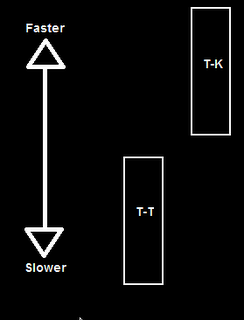
...have an overlap:
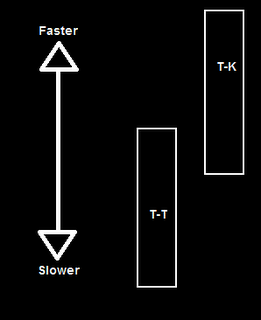
In other words, have a range of tempos where you can comfortably single tongue or double tongue.
Choice is power.
Tino was this talented, charismatic, annoying, endearing trumpet player I once went to school with. We were in a brass quintet together. It seemed like every fast piece we played, Tino would say, "Guys we need to take that faster, it's right on my break." I would joke that Tino had a great double tongue ... at a metronome range of, say, 136-144. Everything else: on the break.
I'm not blessed with a fast single tongue. Thus I had to learn to double tongue at lower speeds than my friends. I think this has become an advantage.
Where am I going with all this? LEARN TO DOUBLE TONGUE SLOWLY
Instead of a gap (too fast for single tongue and too slow for double tongue)...
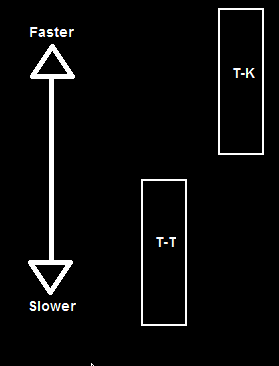
...have an overlap:
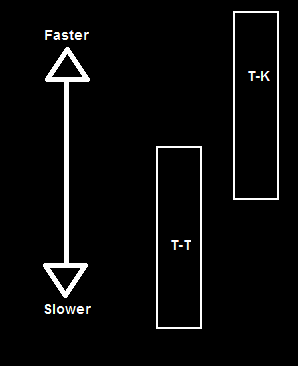
In other words, have a range of tempos where you can comfortably single tongue or double tongue.
Choice is power.
Friday, December 08, 2006
Masterclass with Alessi and Wycliffe
Most of my students have already checked this out but, in case you haven't seen/heard it, here is a video of a Lincoln Center masterclass by Joe Alessi and Wycliffe Gordon.
It's three hours long, beautifully indexed in outline form and, no, I haven't gotten all the way through it yet. Maybe I'll comment more once I've digested it.
Enjoy.
It's three hours long, beautifully indexed in outline form and, no, I haven't gotten all the way through it yet. Maybe I'll comment more once I've digested it.
Enjoy.
Tying Shoes
What's the most important personality trait of a successful brass player?
My vote: PATIENCE
I have kids. I've watched them grow and have to learn little things that adults take for granted like....tying shoes.
My college students sometimes get frustrated when trying to build up a new technique (or polish an old one).
I like this parallel:
Your lips are like little children learning to tie their shoes.
You must be patient with them just as you would be with kids.
You wouldn't yell,
"Come on!
What is wrong with you?
Why can't you just figure this out?"
And yet, how often do we internally voice similar frustrations with our body's slowness to master skills.
James Thompson said it well, "It take as long as it takes."
My vote: PATIENCE
I have kids. I've watched them grow and have to learn little things that adults take for granted like....tying shoes.
My college students sometimes get frustrated when trying to build up a new technique (or polish an old one).
I like this parallel:
Your lips are like little children learning to tie their shoes.
You must be patient with them just as you would be with kids.
You wouldn't yell,
"Come on!
What is wrong with you?
Why can't you just figure this out?"
And yet, how often do we internally voice similar frustrations with our body's slowness to master skills.
James Thompson said it well, "It take as long as it takes."
Tuesday, December 05, 2006
Two Ramps
You probably know the drill. Take the hard lick, slow it down, gradually work it back to speed.
Maybe you've taken a metronome and methodically moved it up one notch at a time.
(A great way to feel virtuous, by the way).
However, it seems that if enough time is spent on the really slow work, the brain "latches on" to the lick and things can take off quickly.
You might get more results by increasing the tempo using more of a "curved ramp."
Something like this...

Maybe you've taken a metronome and methodically moved it up one notch at a time.
(A great way to feel virtuous, by the way).
However, it seems that if enough time is spent on the really slow work, the brain "latches on" to the lick and things can take off quickly.
You might get more results by increasing the tempo using more of a "curved ramp."
Something like this...

Monday, December 04, 2006
Sight Reading : 10+10 with 10 to spare
Here's a technique to help with sight reading.
First 10 seconds:
Scan the "vital statistics" of the whole selection.
Second 10 seconds:
Memorize as much of the opening as possible. Once again, after 10 seconds, look away from the music and try to play it from memory.
Using just these 20 seconds you'd be surprised how much you can accomplish.
The extra 10 seconds? Well, I believe the South Carolina all-state audition gives you 30. You can use those remaining seconds to carefully look over tricky rhythms.
One other sight-reading tip: keep the time steady. Don't stop and re-start. If you're reading with an ensemble, you can't raise your hand and say, "Everybody please stop and go back for me. I was confused about that rhythm."
"OUT OF THE BOX" IDEA:
One problem with sight-reading. You always need lots of material to read.
Somebody should start a website devoted to sight-reading and lot people contribute to it a la wikipedia. Hmmm ... sightreading.org.
I would suggest that material on the sight be broken down by difficulty level and searchable by different categories. For example:
If someone pulls this off (and does it right) it will be a huge contribution! Any takers?
First 10 seconds:
Scan the "vital statistics" of the whole selection.
- What key signature? (Does the key change?)
- What time signature? (Does it change?)
- How fast?
- How loud/soft? (How do they change?)
- Any odd rhythms?
- What accidentals?
Second 10 seconds:
Memorize as much of the opening as possible. Once again, after 10 seconds, look away from the music and try to play it from memory.
Using just these 20 seconds you'd be surprised how much you can accomplish.
The extra 10 seconds? Well, I believe the South Carolina all-state audition gives you 30. You can use those remaining seconds to carefully look over tricky rhythms.
One other sight-reading tip: keep the time steady. Don't stop and re-start. If you're reading with an ensemble, you can't raise your hand and say, "Everybody please stop and go back for me. I was confused about that rhythm."
"OUT OF THE BOX" IDEA:
One problem with sight-reading. You always need lots of material to read.
Somebody should start a website devoted to sight-reading and lot people contribute to it a la wikipedia. Hmmm ... sightreading.org.
I would suggest that material on the sight be broken down by difficulty level and searchable by different categories. For example:
- examples with lots of sharps
- examples with wide leaps
- examples in 5/8 time
- examples exploring the high range
- examples with changing beat subdivisions
If someone pulls this off (and does it right) it will be a huge contribution! Any takers?
Friday, December 01, 2006
Serocki and the Beat
Performers have many options to help them interpret music... dynamics, tone color, note shape, vibrato, etc. But what about meter?
We learned to count and interpret music in which the downbeat note gets greater emphasis.
1 -2 -3 -4 - 1- 2- 3- 4
From what little I understand of music history this hasn't always been the case. I seem to remember a music history lecture in which I heard of an early composer writing the piece and then deciding on the meter. For many of this time period, the bar lines served more as place markers to keep everyone together.
Consider also many many 20th century composers who have implied different meters in their writing. Anyone wanting to argue with me had better look over the trombone part of Stravinsky's Royal March from L'Histoire du Soldat. Obviously he wants the different parts to sound like they are in different meters. I don't think you can read it any other way.
But what about the Serocki Sonatina? A lot of college trombone players are polishing up this piece in preparation for this year's Eastern Trombone Workshop solo competition. Is it possible that one might perform the piece better by sometimes counting in a different meter than the one printed?
This interpretive technique is known as derivative meter: a term coined, as far as I know, by John Swallow of New York Brass Quintet fame. I learned it while studying at Hartt from one of his students, Ron Borror. I don't use it everywhere and, over the years, have had some rather intense discussions with colleagues as to whether or not we performers are "allowed" to count in a different meter than the one printed.
The usual counter-argument goes:
"If so-and-so had wanted it in 3/8, he would have written it that way."
My answer:
"Maybe, maybe not."
(It depends on too many factors to delve into in a blog.)
Anyway, here is a link to an acrobat document I just posted on my website showing 3 examples of derivative meter applied to the Serocki Sonatina. Try it on for size and see what you think.
We learned to count and interpret music in which the downbeat note gets greater emphasis.
1 -2 -3 -4 - 1- 2- 3- 4
From what little I understand of music history this hasn't always been the case. I seem to remember a music history lecture in which I heard of an early composer writing the piece and then deciding on the meter. For many of this time period, the bar lines served more as place markers to keep everyone together.
Consider also many many 20th century composers who have implied different meters in their writing. Anyone wanting to argue with me had better look over the trombone part of Stravinsky's Royal March from L'Histoire du Soldat. Obviously he wants the different parts to sound like they are in different meters. I don't think you can read it any other way.
But what about the Serocki Sonatina? A lot of college trombone players are polishing up this piece in preparation for this year's Eastern Trombone Workshop solo competition. Is it possible that one might perform the piece better by sometimes counting in a different meter than the one printed?
This interpretive technique is known as derivative meter: a term coined, as far as I know, by John Swallow of New York Brass Quintet fame. I learned it while studying at Hartt from one of his students, Ron Borror. I don't use it everywhere and, over the years, have had some rather intense discussions with colleagues as to whether or not we performers are "allowed" to count in a different meter than the one printed.
The usual counter-argument goes:
"If so-and-so had wanted it in 3/8, he would have written it that way."
My answer:
"Maybe, maybe not."
(It depends on too many factors to delve into in a blog.)
Anyway, here is a link to an acrobat document I just posted on my website showing 3 examples of derivative meter applied to the Serocki Sonatina. Try it on for size and see what you think.
Thursday, November 30, 2006
Nyah, nyah, nyah
Recently a student was playing a legato shift from B-flat to G. Lots of tension.
I tried lots of tricks; nothing seemed to work.
Hmm, minor third. What about that little mocking melody kids use.
"Nyah nyah nyah...(etc.)
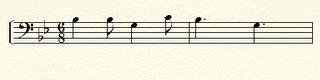
Just like that, tension gone.
Take the new...relate it to the simple, the old.
Something you've done for years.
I tried lots of tricks; nothing seemed to work.
Hmm, minor third. What about that little mocking melody kids use.
"Nyah nyah nyah...(etc.)

Just like that, tension gone.
Take the new...relate it to the simple, the old.
Something you've done for years.
Subscribe to:
Posts (Atom)