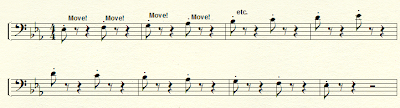
Showing posts with label slide technique. Show all posts

Monday, October 31, 2011

The Evil Fuse


There is an insidious evil that lurks within the hearts of all trombonists.

When we were young and innocent (and beginners), we were lured into that friendliest of scales: B-flat major.

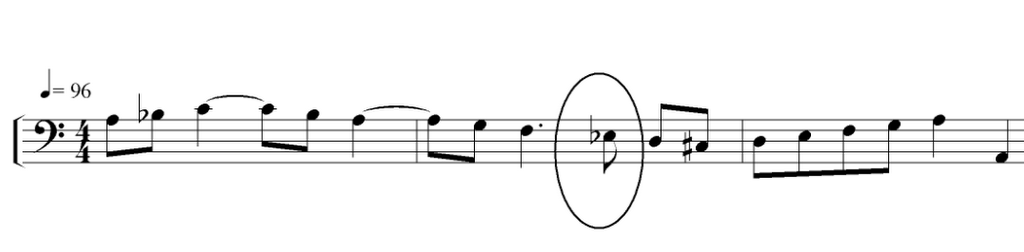
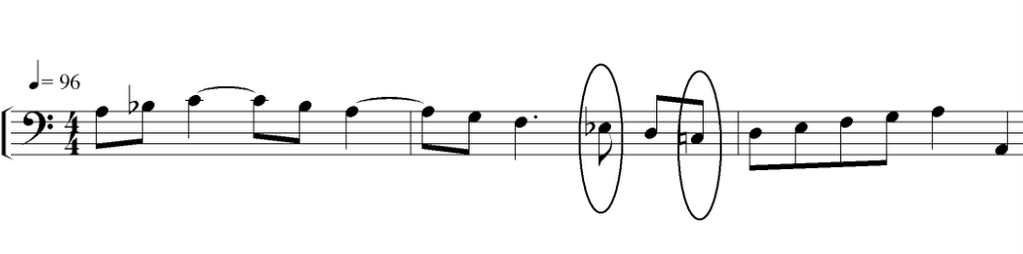
It seemed so simple that we never paused to see the trap lurking within...the A natural in 2nd position and the E-flat in 3rd.

We merrily practiced away allowing the two positions to MORPH into the ....

EVIL FUUUUUUSE!!!

The little voice in our heads may have tried to warn us. The over-worked band director never took the time to catch the problem. Mom and dad just said they were proud (and please use newspaper for the spit).

Nobody warned us of the impending doom.

Instead of a pristine separation of 2nd and 3rd, the evil fuse has practiced its sinister mind control dragging our second positions down and forcing our 3rd positions up.

The result:
a mutant position that was never meant to exist in nature.

Stay safe out there.

Monday, October 03, 2011

YouTube as a practice tool?


I don't think anyone expected YouTube to become as big as it is. All of that video..I just read a 2010 report of an upload rate of 35 hours per minute!

Within that video torrent of kittens and babies quite a few orchestra videos have been posted.

So here's an idea for a handy practice tool:
videos of the big orchestral pieces
that keep the camera focused on the conductor from
the player's vantage point.

Imagine being able to play through a Mahler symphony using the part and following Alan Gilbert on the screen.
Sure lots of people have played along with recordings over the years but one always had to guess the tempo fluctuations because you couldn't see the conductor!
What a training tool!
Now maybe somebody has already done this. I've heard of some older conductor videos for horn excerpts. Does anyone know of such a collection of videos? If it were made into a YouTube channel, it would be great.
One possible problem: sometimes the audio and video aren't well synced. This should have a simple fix.
There are an increasing number of high-quality web broadcasts of orchestra performances. Most of these are multi-camera affairs with at least one camera always trained on the conductor. Wouldn't it be great to get at that original conductor footage? Does it sit in some archive somewhere?
My search of Youtube didn't reveal much. As part of there Youtube symphony project I found this example of the conductor for that Tan Dun piece. You can even find videos targeted to specific instrument groups.
I also found this example by Teodor Currentzis, a conductor I haven't heard of before (and probably won't hear of again). Here's his bio.
Anyway, is there someone out there with the time and know-how could create something of huge value for the rest of us.
Doctoral dissertation, perhaps?


Monday, September 26, 2011

Sad Mickey and slide technique


Here's a common slide technique problem...reaching out towards 6th or 7th but never really reaching the position before you turn around and come back.

Sometimes I compare this to taking a trip in your car. I live in Columbia, South Carolina so, for us, Disney World is only about a 7 1/2 hour drive. We've taken the kids many times.

Imagine we're driving along in the car on that first magical trip to Disney and along about Jacksonville, I stop and announce, "OK, kids we're here!" Then I turn around and head home.
(nothing against Jacksonville, of course)

'Twould not be a happy time in that car.

So, whenever you turn around before truly experiencing the "Disney Magic" of 6th or 7th position, think of the kids.

Don't break their little hearts.


Monday, September 19, 2011

Mac Guy vs PC Guy


I guess this ad campaign has ended. Too bad.
Like most of my posts, I'll use these guys to illustrate a point.

In a recent lesson, I was working on two basic goals with a students. One was to relax, the other was be more accurate with his slide.

  • When I worked with him on relaxing more, we saw nice progress except his slide positions got sloppy.
  • When I worked with him on placing the slide more carefully, we also saw nice progress except his sound lost resonance.
Ahh, to do both...
Mac Guy = relaxed, breathing well, etc.
PC Guy = very picky about precise slide positions.

Sadly my Google image search for a morphed image that was a blend of both guys failed. I though you could find *anything* on the web!

Sunday, February 20, 2011

The Gliss Finder (Ear v. Arm)


OK, I may have blogged this one before but....

Sometimes, when working on intonation with my students, I find that they are unconsciously lipping notes up or down.
Recently, when a student struggled to lock in the high G-flat, I played the chord on the piano and asked him to gliss around before stopping on the note. Essentially, I wanted him to play with a very wide and slow slide vibrato before settling on the note.
Here's my thinking: when we gliss around, we are less likely to lip notes. Instead (hopefully) we focus on getting a full-centered sound. Then, when we try to lock in the correct pitch/position, we are truly tuning with the slide as opposed lipping the notes up and down.
The psychological power of muscle memory is quite amazing. Even in my own playing, I find my ear arguing with my arm.

EAR: Dude, you're sharp. Bring it down.
ARM: No way, man. Second position is never that low!

And thus perhaps the lip begins to take matters into his own hands (don't think about that concept too much, it's just an analogy) and bend the notes.
Maybe they bend into "tune" but they also bend out of resonance.
Hey, we're playing a big tuning slide here...might as well use it.
Maybe if the arm had an ear of its own...


Wednesday, February 02, 2011

Switch to Glide

I think most of us agree on these two things..
  1. At slow tempos, the slide clearly needs to stop on every note. Alessi once said, "I want to see the rhythm in your slide."
  2. At very fast tempos, your slide can't really stop on every note. The classic example of this, I suppose, is the excerpt from William Tell.
I have heard of teachers advising students to practice the William Tell excerpt in an unusual way: even when you play it slowly, don't stop and start with the slide. Instead 'catch' the note as the slide goes by without stopping.

Even though I glide at fast tempos, I find this 'slow glide' practice technique to be awkward. (maybe I'm doing it wrong).

Lately, in my warm-up, I've been playing a lot more chromatic scales. I always start playing slowly over a limited range. Something like this:
Then I extend range and increase speed. I like to end up going full-speed with double tonguing.
Of course, at some point, I switch to the glide approach.

Anybody with a high speed camera? It would be interesting to film top players as they play fast then slow the film down to see what they are really doing with their slides.

Hmm, doctoral dissertation idea?

It will need a lofty title...

"The High-Speed Video Analysis of a Select Group of Professional Trombonists to Ascertain the Transition from the 'Stopped Slide' model of technique to the 'Steady Slide' model at Increasing Tempi"

zzzzzzz


Wednesday, October 13, 2010

Yin and Yang for Slide Technique


Slide technique should be so simple.....right?

Just move the slide to the right place at the right moment...right?

Well knowing it and actually doing it can be two different things. Here are two exercises that may be helpful. Neither one is original.

In legato, we want to stay on each note as long as possible. So, that means move the slide at the last instant (while staying relaxed...I like the verb "flick" as in "flick the slide at the last second")
Another trick I've seen pertains more to speeding up the slide in tongued passages. It involves moving the slide right after the note sounds:
It never occurred to me that these two exercises are so yin and yang. In the first, you move the slide at the last possible second. In the second, you want the slide in the next position at the earliest possible second.


Tuesday, May 18, 2010

Part #2 Slippery Slopes


OK, here's that other blog posting based on a recent coaching of the lyrical trombone solo in Appalachian Spring.

It's the old question of alternate positions. You have the choice of using B-flat in sharp 5th, D-flat in flat 5th, or even F in 6th. So why the 'slippery slope' title? It's the mental train of thought that starts after you've used one alternate position and the little voice in your head says,
"You know if you're going to use alternates,
you could also play that D-flat in 5th.
I'm just sayin'..."

By the way, you face a similar set of choices with the more common excerpt: St Saens 3. And while I'm sliding down that slope, what about starting Bolero in 3rd and using the A and G in 4th? Or how those arpeggios in Tuba Mirum? Or, also in Tuba Mirum, starting that pretty tune on the F in 4th??
(and down the slope I go..)

My undergrad and master's teachers were both great teachers but, when it came to the subject of alternate positions, I could not have chosen two more opposite viewpoints.

Ron's (paraphrased) idea:
You have seven positions; use them.

Tony's (paraphrased) idea, expressed when I used an alternate:
You should stick to the real positions.

Learning from these two opposite viewpoints was good for me. I can honestly say that I tried it both ways.

So where do I end up?
Do what sounds best.

Of course, that answer isn't quite so simple. Perhaps a fictional debate would help here.

Let's call these two schools of thought the "Use All 7" camp (UA7) and the "Closer is Better" camp (CIB).

Please note: This is in no way an attempt to 'quote' my former teachers. This is a fictional discussion representing the viewpoints of lots of people.

Here comes a fictional debate:
CIB: Don't use alternates. They don't sound as good.

UA7: That's because you avoid them. If you practiced them more, they would sound fine.

CIB: I don't think so. Notes farther out on the slide are inherently less stable because, the farther out you go, the the more out-of-proportion your instrument is.

UA7: The difference is too small to be noticeable.

CIB: Well, what about intonation, then? Playing those alternates is always more risky when it comes to pitch.

UA7: Only because you haven't practiced them enough.

CIB: Practice all you want but when you're sitting on the hot seat and pitch is a little funky, I bet you'll go running home to those original positions with your tail tucked between your legs.

(and we'll stop there before it gets nasty).

Alright so where does this leave us?
  1. Practice both ways and strive to make them equally strong. Then, after you've devoted enough time to both: choose the option that sounds best.
  2. Record yourself or play for others to make sure you aren't imagining things. Maybe record a large number of takes where you randomly switch between versions and, after playing the lick, call out to the recorder which version you just did.
I would like to think that, with a superior player, the sound concept is so powerful that it essentially overrides the limitations of either choice of positions.

In other words, be so good that...

...those alternates are in tune with a centered sound
or
...your slide is so fast that you can make the longer shifts sound good.


Friday, November 20, 2009

A Nice Online Music Dictionay

Here's a nice free service from Virginia Tech...

An online music dictionary which includes pronunciations of the terms and, for some examples, sound samples (although I never could get the sound sample page to download...maybe I'm too impatient).

Here's the Link.


Friday, August 28, 2009

Slide Clarity, a Haiku

This is a new term for me: slide clarity.

I hear someone play a legato run and everything blurs together at times. We don't think enough about the clarity in the slide.

Here's my haiku...

quick to the right spot
at the exact right moment
arm is not too tense


Can anyone out there think of their own haiku to add?

Saturday, April 25, 2009

Berlin in the Arm


Good ol' 5th position.
Sooo many pitch problems to be found.

Here's what I find interesting: even when someone KNOWS that they aren't reaching out far enough, their arm just seems strangely reluctant to reach
all.....the......way.....out....into.....the
.....swamps....of.....fifth.....position

Consider this analogy: when Germany reunified, I seem to recall some trouble bringing those East German factories (and factory workers) up to speed with with Western standards.

Brain = new standards (Western manufacturing)
Muscles = old attitudes (Soviet style manufacturing)

The brain keeps saying, "Get out to 5th position, you're sharp" The factory workers keep replying , "Nope, 5th position isn't out there. It's only out to here!"

Somehow, the memos from management don't always get through.

Tuesday, March 24, 2009

Writing Comments - is there a transparent solution?

I just got back from a Virginia/D.C. trip that included judging the two final rounds of the ETW solo competition.

For me, one of the biggest challenges in judging these things is the not-so-simple process of listening attentively while trying to write intelligently. It goes something like this: you listen, you hear something (good or bad) that deserves a written comment. You try to write with decent handwriting, knowing that your comments might impact the person whom you are evaluating. I always want to write something of value to the eventual reader. But, as you write this, the music keeps rolling along and deserves your attention. The challenge is exacerbated when you are dealing with a score you don't know well as was the case with the Schnyder Sonata and the Amis Preludes.

Here's an idea I've thought of but haven't acted on. What if you laid one of those transparency sheets over a copy of the music and wrote comments directly onto the transparency? Then you could quickly refer to specific sections by simply circling them. When the candidate/student receives your comments, in theory they could lay the transparency right over their music and see your comments.

This reminds me of an interesting technique I first saw used by Eugene Corporan when working with conducting students. He had rigged up something that allowed him to hold a microphone and softly make comments that, I believe, were being overlaid directly onto the audio portion of the student's video tape. Clever but a bit cumbersome for a trombone competition.

One last comment on the ETW judging. This is my third time doing it. It seems that every time we end up with a choice between the more "clean, polished" rendition and the more "expressive" rendition. I will say that, usually (with one significant exception this year), the more expressive version wins the day even though it is often clear that the "clean, polished" player is technically stronger.

I have heard stories of parallels in big-time orchestra auditions.

Thursday, April 10, 2008

Keepin' it Smooth

I know I've talked about this before at some point.
As we move our slides quickly (but not too quickly!), we need to keep that air stream very smooth.
It is so easy for the blowing to reflect the slide movement.
Trying playing a passage with silent blowing. Listen to your air stream as you move the slide.
I talk about this in the BoneTips portion of my website.

Here's a simple exercise that should help...

Friday, November 30, 2007

Why is this so hard?

Here's a simple little tuning exercise that's not as easy as it looks...


Some players, once they own that trigger, begin to believe that all positions beyond 4th are alien territory. Thus a simple gliss to 6th seems to give trouble.

After finding 6th, you would think it a simple matter to gliss back to 5th accurately. Nope!

I think there are several reasons for this..
1. When we do our beloved Remington long tones, we are always measuring out from 1st position. Accurately "measuring out" is something we do a lot, but "measuring in" is something we don't practice. Maybe we should do that famous Remington pattern inverted.


2. (disclaimer, this is pretty speculative, I may have it wrong)
Beyond 4th position, the elbow begins to have to extend beyond a right angle and seems to be less accurate.

Anyway, try those glisses out with a tuner (look first, then listen), see what you think.

Tuesday, August 07, 2007

Alessi Seminar Notes, Day 8.."Jaw Droppers"

Please note:

These entries from the Alessi Seminar are not a literal transcript. I took written notes and then typed them up. I have made every effort to be accurate but, as you might expect, each blog entry is a meager substitute for actually being there.

Remember that many of the things Mr. Alessi says in these masterclasses are in the context of addressing the needs of a particular student and should not be seen as universal mandates to be mindlessly followed.

If you are serious about pursuing musical excellence on the trombone, there is no substitute for actually attending one of Mr. Alessi's seminars. You'll be glad you did.

Today began with the usual warm-up sessions (ours was led by Paul Compton) followed by trombone choir rehearsals. After lunch, we boarded buses and traveled to St. Paul's Lutheran Church for our second concert which consisted of soloists, chamber groups and both trombone choirs.

In the evening, Joe gave another masterclass. The performers were:

me - a maestoso etude followed by Mahler's 3rd
Casey Thomas - Castereded Fantasie Concertante
Miguel Rivera - Morales Fantasy for Trombone and Piano
Josh Bynum - excerpts


Once again, I don't have notes to share from my own coaching. Here the notes I wrote down from the remainder:
  • Joe discussed the problem of excessive tension in slide technique. He suggested that, sometimes, you need to just let go. Just play it.
  • He noted that many times he tells his students to do something and they tend to overdo it, going too far with a suggestion.
  • He gave the analogy of great athletes and how they stay so loose.
  • He referred again to the idea of a "dead man's float" (floating in pool, completely relaxed) as he discussed staying relaxed in a performance.
  • He suggested, "Try to wean yourself from the music." Don't be so dependent on the music as you perform. For a demonstration, he moved the music stand farther and farther from the student. "I think that's a good test as you learn a piece. Do you have to be so dependent on the music?"
  • In faster passages, relax the slide more. Don't try to stop the slide in each position. "It becomes more of a glide." He demonstrated, playing a repeating chromatic scale at faster and faster tempos to show how the slide action becomes smoother as you speed up.
  • To free yourself up while tonguing rapidly, let the tongue come back. Don't try to spit out every note. "Start thinking 'dah' "
  • When killing time with colleagues from the NYPO, they chat about everything and sometimes talk shop. His colleague Phil Smith (Principal Trumpet) likes to use the term "the gully" to describe that spot on the roof of the mouth where one should place the tongue when tonguing rapidly.
  • Some passages you should know so well that you can wake up in the middle of the night and play them. While the student was playing a challenging, fast passage, he also suggested that one should make phrases out of the notes.
  • He demonstrated a scale exercise he likes to do, suggesting that we do this every day with the metronome:


  • When a student played a rhythm that wasn't accurate, he said, "You cannot lie about rhythm." He gave the analogy of someone who cheats on their golf score.
  • He praised the UNM Wind Ensemble Conductor, Eric Rombach Kendell, because he makes his students sing their parts. He then gave a short demonstration singing and conducting in strict time.
  • He talked about playing a Bordogni vocalises in 5 ways:
  1. As is
  2. Tenor Clef
  3. An Octave Down
  4. An Octave Up
  5. In Tenor Clef Down Two Octaves
  • He began one vocalise and expected the student to be able to play along with him from memory.
  • He pointed out that, in particular, there were two Bordogni etudes that everyone should have memorized and be be able to play in those five ways without using the music. This, I believe was the one, he was playing with the student:


In a humorous moment, after playing the first etude with the student, he asked audience to sing the other Bordogni every trombone player should know. Sure enough, we all started singing:


  • In talking about high range he said, "The higher you go, the sweeter you play. That's my motto."
  • He suggested that a good way to develop the high range was to get a fake book and start learning some of the standard jazz ballads. Be able to play them in the high range.
  • He observed that, when he goes into the high range, it's easier if he eases off a bit. "Let the note go up there by itself." He also said, "I almost try less."

Although I have been trying not to interject my own opinions into this blog, I do want to point out that, as he was making these comments, he was demonstrating some of the most beautiful, effortless high playing I have ever heard. I think it's fair to say that a lot of jaws were dropping.

  • Concerning long practice sessions, he said, "You can play ten hours a day but I don't think it's going to do you any good." He went on to note that he doesn't get his endurance from playing ten hours a day.
  • As you descend into the low register, be sure to maintain an embouchure. There should be no air escaping.
  • If you rely on single tonguing for too long, the tongue is going to get tired. He sometimes will alternate between single and double tonguing.
  • He gave another demonstration of tonguing while accenting the KAH syllable (tah-KAH). He pointed out that if you really want to develop strong double tonguing, you need to practice it very slowly. He also pointed that you can practice it while walking down the street.
  • He pointed out that, at faster tempos, the syllables "da-da-ga" worked better (than "ta-ta-ka")


Mozart Requiem

  • In the opening figure, he talked about 'air management' suggesting that one option was to go a little faster.
  • Many people have the problem of using a different tempo for half notes and the quarter notes.
  • Concerning intonation, he said that you have to microtune. Every partial is in a different place.
  • On the legato arpeggios (beginning on low B-flat) he advised the student to let the last note of each arpeggio relax a bit. I believe he meant to not clip those notes off.
  • He advised the fourth position D as passing tone in the legato lines to avoid 'sawing.' He demonstrated repeatedly jumping back and forth between first and third positions as a sawing motion.
  • At one point, Joe and the student played through the excerpt together for pitch. This was a common practice with many of the excerpts presented at the seminar. With other students, he would sometimes play along playing from one of the section parts from memory.
  • With this excerpt, the pitch has to be right on. You just have to listen more.


Hungarian March

  • On the ascending quarter notes, he suggested starting with the trigger B instead of 7th position for better intonation.
  • To help with timing, he had the audience sing the opening tuba arpeggio right before the big run. After we did it, he joked, "You guys are late."
  • Since he had already worked on this excerpt with the student in a private lesson, he had the student recall some of the concepts presented in the lesson:
  • Joe had suggested "symmetrical breathing," meaning taking breaths in the same places rhythmically.
  • In the ending of the excerpt, he had suggested using the D in the alternate 4th position.
  • On the opening scale, Joe had noted that most people tend to use too much tongue and not enough air.


The Ride

  • He praised the student for playing the excerpts from memory.
  • He noted that, when playing this excerpt, he hears rhythms from the piece in his head. He sang the rhythm pattern of the accompaniment and one of the singer's lines.
  • He suggested these slide position choices for the opening of the ride (the minor version):


Someone asked if, in a live hall, would he bring down the pitch of the last A-sharp (given that it is effectively the third of a major chord). He said that he would bring it down a bit.

He suggested a sequence for working out this excerpt with respect to intonation.

First, play the long notes (beat 2 and 3 of each measure):


Next, practice the excerpt without the dotted rhythm, using straight eighth notes:


Or, if this is giving you trouble, you could practice it this way:


He suggested also practicing the excerpts using subdivisions:


As a demonstration, he had the student play the original excerpt while he played the subdivided version.

Another practice technique was to isolate portions beginning at each 16th note.


Concerning breathing, he suggested two-bar phrases.


That's all for now.

Saturday, August 04, 2007

Alessi Seminar Notes, Day 6...Beat Boxing

You might be asking, "What happened to day 5?" Well, that was a day off for everyone.

On to Day 6 (which, by the way, was Friday, Aug. 3rd)

Please note:

These entries from the Alessi Seminar are not a literal transcript. I took written notes and then typed them up. I have made every effort to be accurate but, as you might expect, each blog entry is a meager substitute for actually being there.

Remember that many of the things Mr. Alessi says in these masterclasses are in the context of addressing the needs of a particular student and should not be seen as universal mandates to be mindlessly followed.

If you are serious about pursuing musical excellence on the trombone, there is no substitute for actually attending one of Mr. Alessi's seminars. You'll be glad you did.


This morning's performers were:

Joseph Rodriguez - orchestral excerpts
Nathan Dishman - Stojowski Fantasy
Nicole Abissi - orchestral excerpts
Jared Lantzy - Schnyder Concerto mvts. 2 & 3
Ben Perrier - Arrows of Time, mvt. 3

Here are comments from my notes:

Mozart Requiem:
  • Concerning the opening arpeggio, Mr Alessi noted that it was fine to take a breath, if needed, in that passage as long as it was done in time. At one point he demonstrated, snapping the subdivisions and suggested that one should "breathe after the last snap," meaning after the last upbeat before the long B-flat. Later in the coaching, he sang the excerpt, demonstrating a very quick breath before the long B-flat.
  • He spoke about the importance of a smooth legato, commenting that, 30 years ago, the legato that was going around "was very caveman." He warned against getting the "wah-wah" in legato, describing this note-shape as being "like footballs."
  • "When you tense up to play soft, you have two choices: don't tense up or don't play so soft."
  • He described that requiem solo in this way, "It's a beautiful little melody. There's not much we have to add."
  • Someone asked if vibrato should be used in this excerpt. He replied that it wasn't really necessary. If you do use vibrato, don't use it too much..."just a little sprinkle here and there."
  • Concerning excerpts, he said that the hardest thing is to be out there and get scrutinized during an audition.
  • He reminded us to "hit those excerpts constantly." (in the context of someone who is serious about winning an orchestral audition).

Hungarian March

  • He observed that the level of reverberation in Avery Fisher tends to expose bad attacks.
  • In reference to the ascending quarter notes before the big run, he commented, "That scale tells a lot." He reminded the student to get the slide to the next position ahead of the note.
  • He used the phrase, "no-man's land" for the gaps between the separated articulations.
  • As for the big run, he spent time demonstrating triads built from the longer notes in the run: C-A-F, A-F-D, C-E-G. These notes have to be very stable.
  • Of the run he pointed out, "You have to keep reminding yourself what is simple about this."
  • When you do any exercise related to an excerpt, be certain to play the exercise with perfect rhythm.
  • Be sure not to "telegraph" the next note by moving the slide early, causing a small gliss.
  • He sang the run while snapping three big beats:


  • Be certain not to slow down at the end of the excerpt. Stay on top of the beat.

(end of Hungarian March comments)

  • Concerning any changes to the embouchure, he commented, "You have to be like a policeman to yourself." In other words, you will need to be constantly vigilant.
  • He went into a demonstration in which the student lay on his back (keeping the feet relaxed) with one hand laying on the belt buckle. He had the student first fill up the lower part of the lung (closer to the belly), followed by the chest. He then had the student place the finger vertically on the embouchure while breathing in. He suggested that we try this relaxed breathing exercise at any time of the day if we felt we weren't breathing well. Upon returning to the standing position, the breath should just as simple and natural.
  • Concerning the placement of the feet while playing, he suggested that we try lining up the feet as if centered on two perpendicular lines on the floor (like a helicopter landing pad). By lining the feet along these line, the feet are aligned and you are facing directly forward.
  • He suggested that we might try videotaping ourselves to check posture.
  • He recommended that we practice posture and breathing first without the instrument. Then, when the instrument is introduced, be certain that we don't revert to a different posture.
  • He reminded us that, as we extend the slide past 3rd position, to be certain the fingers don't reach out for the bell. This causes many trombonists to play sharp.
  • For descending into the low register with a rich sound, he called to mind the rich warm quality of Bing Crosby singing "I'm Dreaming of a White Christmas"
  • He pointed out that, when the pitch is exactly right, the tone will sound more rich.

Mahler 3

  • When playing the opening notes, count 1-2-3-4 (the quarters) rather than 1-2-3 (the half notes). Later he added that he likes to let the sound bleed a little into the next beat.
  • When you get to the low A's, think 'dah.' "Let the air do more work than the tongue."
  • As you descend into the low range, make the air go slower.
  • When articulating in the low range, watch out for a chewing motion in the jaw.
  • At the end of the first excerpt he suggested that we should "try not to smash these notes. Play them in a singing manner."
  • He reminded us that many other musical elements have to be in place along with a big sound.
Ein Heldenleben
  • He observed that this is one of the hardest excerpts to play, rhythmically.
  • With respect to the occasional out-of-tune notes, he pointed out, "Those few notes start to add up in an audition."
  • He observed that, in practicing, he's happy to just focus in on a single measure and really polish it (to apply what has been learned)
  • As you play, be careful not to look so "student-like." (meaning with a frantic, tense expression in the face, eyes wide-open)
  • It is important to memorize those excerpts that are important to you.
  • Concerning the long low F he said, "If you have to take a breath, that's not the end of the world."
  • He built on this idea be describing the notion of gaining and losing "points" in an audition. If you play something really well, you gain points and this gives you some license. Of auditions he said, "I want to give these players points." (as they begin their audition). He went to note that some players play with a poor tone or faulty rhythm and they don't get those points.
  • If you memorize something and you're able to play well from memory, that means you really know it.
  • Concerning tempo choices in excerpts: choose tempos that are "good averages." Don't choose an odd tempo just because one recording goes at that speed.
  • For any excerpt, you should know the piece as whole well enough to be able to sing some of the themes. Thinking of these themes can relax you. "You have to put yourself in the piece."
(end of the Heldenleben comments)

  • It is important to be able to tape yourself at half speed, especially to study legato and attacks. In discussing the various technologies available to accomplish this, a member of the audience mentioned a website called The Amazing Slow Downer
  • He went into a demonstration of correct hand position when holding the slide. He stressed the important of keeping the thumb straight (like holding car keys as you're about the unlock the door) for better control.
"Beat Box" Demo

Mr. Alessi invited Anthony Barfield to the stage. Anthony composed one of the pieces Joe performed on his recital earlier in the week. Using a microphone, Anthony put on a very impressive display which he referred to as "beat boxing." If you closed your eyes, you would swear you were listening to a drum synthesizer. Joe told us this was a great example of internal rhythm. Joe then got up on stage and played Hungarian March while Anthony provided a "beat box" accompaniment. Everybody loved it! Joe pointed out how it is so much easier to play when you have a beat like this.

Moving on...
  • If we are trying out an adjustment in technique, it might feel strange. In this context, he observed, "Alien doesn't mean bad." In other words, just because a new way of doing things feels strange doesn't mean it's wrong. He recommended that sometimes it is good to explore new things, even if they are alien.
  • While the student was playing a fast, technical passage, Joe suggested that he pretend he was just playing a nice F (the note, note the dynamic)
  • As you descend into the lower register, don't allow that embouchure to collapse.
  • If you are playing a fast, technical passage filled with awkward intervals and tricky rhythms, be careful you aren't "slicing up your air like mincemeat." He also referred to this kind of playing as "hacking and slashing."
  • When you see a difficult passage, don't freak out. When approaching such a passage, Joe observed, "I'm just pretending I'm playing a chorale."
Mini-Lecture on Slide Technique
  • Joe observed that people have to have more "respect for the slide."
  • He placed two water bottles on the stage, each bottle representing (I believe) the exact point in time when a new note begins. He asked us to consider the question, "When should you move your slide in legato?"
  • He used the phrase "within the technique, stay relaxed in your own environment" for the avoidance of tension.
  • He demonstrated a passage of slow, widely-spaced staccato notes with a quick slide motion in between so that the slide was well-placed before each new note.
(end of lecture)
  • When you practice double-tonguing, try emphasizing the "kah" syllable...
    tah-KAH-tah-KAH-tah-KAH
  • When multiple tonguing a fast passage, be sure to maintain the right pitches. Later he reminded us to practice technical passages slowly enough to maintain a good tone.
  • You have to respect a difficult passage and take enough time to learn it at a slow speed
  • If a highly technical passage in a solo is marked 'forte' consider not trying to play it so loudly. Don't try to "muscle it out," especially if you are playing alone at the point in the solo.
  • With respect to demeanor during auditions, he recalled a recent audition in which Lisa Albrecht was given the one-year position to replace Jim Markey. He observed that is was amazing to see the difference in demeanor of someone who has been there before.
  • In terms of playing difficult material, he wants his approach to be "like taking a stroll in the park."
  • He demonstrated transposing a difficult passage into the middle range to work on tone quality.
  • He observed that, in a lot of the lessons he teaches, they simply devote time to getting the first note of something.
That's all for now...

Wednesday, August 01, 2007

Alessi Seminar Notes, Day 4 (part 1) ... Rhythm is King

Please note:

These entries from the Alessi Seminar are not a literal transcript. I took written notes and then typed them up. I have made every effort to be accurate but, as you might expect, each blog entry is a meager substitute for actually being there.

Remember that many of the things Mr. Alessi says in these masterclasses are in the context of addressing the needs of a particular student and should not be seen as universal mandates to be mindlessly followed.

If you are serious about pursuing musical excellence on the trombone, there is no substitute for actually attending one of Mr. Alessi's seminars. You'll be glad you did.


This morning's master class featured the following performers:
Casey Thomas - Wilder Sonata (starting with the last movement and working back)
Miguel Rivera - Sulek Sonata
Josh Bynum - Salzedo Piece Concertante
Quartet (Compton, Rivera, Lange, Bremer) - Spaniola AMS
Orchestra Section - Passages from Wagner's Die Walkure

Here are some comments (I took a lot of notes!):

  • He pointed out that all is not lost when you feel nervous. When you feel nerves kick in, don't panic.
  • "When I go on stage, I like to put myself in a little box." I believe he was referring to a technique for screening out distractions while performing.
  • He recommended that aspiring performers should get on stage more often and get used to dealing with nerves. Don't just do one recital a year, do six a year.
  • For a rhythmic passage in which a long note was followed by triplets he used the phrase: "pre-authorize the triplets." (in other words, think triplets during the long note).
  • For phrasing, he suggested one might a circle a note in the music and then aim at it.
  • "Sometimes you just have to tear licks apart." If a passage is giving you trouble, extract a segment of it and see if you can play it ten times in a row perfectly. If you miss on the tenth time, start over. Then take the next fragment and do the same. Then, put the fragments together.
  • Concerning slide grip, he suggested a very natural grip of just 2 fingers and the thumb.
  • Concerning about slide grip he suggested that, in softer legato passages, you should hold the slide more gently. Later, he said, "When you play the Rhenish (Schumann Symphony No. 3 the soft trombone chorale) you're going to hold the slide like you have a little bird in your hand."
  • At other times (especially during moving passages requiring accuracy he suggested you might want to grip the slide a little harder while staying relaxed. He demonstrated how one can firmly grip a pencil and still stay relaxed. "A firm slide grip improves the connection between brain and slide."
  • He recommended that any trombonist serious about auditions should have the main excerpts memorized.
  • "Everything is coordinated by rhythm." (for example, breathing, embouchure, slide, etc.)
  • Don't just practice short phrases. Play something like a Bordogni etude all the way through to promote air flow.
  • As a suggestion to a student whose sound he wanted more projected, he used the phrases "Don't be gun shy" and "Warm up the room."
  • Musically, he warned that we shouldn't go into a state of "suspended animation," a place where we are floating but nothing is happening musically.
Here was one funny exchange:

Joe: "You're not playing for the president of the United States. You're just playing for trombone players."

Student: "I'd rather play for the president."

  • Focus on accurate rhythm. He had a student sing along with the piano part to ensure the rhythm was accurate.
  • It's one thing to guess at something. It's another thing to know it.
  • There's no point in trying to play it if you can't sing it.
  • He re-emphasized this simple saying, "Rhythm is King!"
  • If your rhythm isn't solid, how are you going to know when to move the slide, when to breathe?
  • He also pointed out that a better slide grip will improve rhythm.
  • He warned against breaking the wrist in slide technique because it leads to uncoordinated playing.
  • "There's bad health and good health on the instrument." Elements of brass health include such things as posture, slide grip, how you inhale, etc.
  • Before you perform a piece, you have to know the score.
  • "I'm writing all kinds of cues" (in his music) He even invited us to take a look at the solos he performed Monday night to see how many cues he had written.
  • He used the phrase "ear marks" to describe points in the score he listens for in order to not get lost.
  • He described his preparation for the Rouse concerto which doesn't have a piano reduction. To get ready for this complex piece he even hired Jim Pugh to create a midi file of the score so he could practice it. He pointed out, "I like to have everything prepared a month before."
  • He expressed admiration for Christian Lindberg. "He's way beyond me in terms of the amount of information that is thrown at him."
  • He stressed the importance of listening to great singers. At one point, he asked a student, "How many Frank Sinatra recordings do you have?"
  • In a very impressive demonstration of the power of listening, he began sight-reading Salzedo's Piece Concertante. It quickly became clear how closely he was listening to the chords in the piano part. Once or twice, when the pianist played a wrong note, he stopped and looked over at her. Even while sight-reading, he knew that the chord couldn't be right.
  • For one particular chord he said, "See, I put a little vibrato there because I like that chord. Listen to that chord, that really turns me on!"
  • He pointed out that, although he had never played the piece before, he knew what to do because he was listening carefully to the piano part.
  • Keep the embouchure corners consistent. Look in a mirror every day. "You have to create a more stable environment."
  • For high, soft playing: "The key is the higher you go, the less energy you use." He suggested that we listen to "high-floaters" like Bill Watrous and emulate their style.
  • He enjoys going through a piece and finding alternate positions to facilitate the music.
  • He demonstrated a segment of Bolero (the ascending B-flat, C, D-flat) and played the C in third position instead of first. With regard to getting up into that partial he joked, "You either pay now or pay later."
  • He said that we don't talk enough about diminuendo and playing softer.
  • "When you play softer, relax." He told a story about an old episode of the original Star Trek in which they were trapped in a force field until Spock suggested that perhaps they could escape by relaxing. "I remember that being a very pivotal time for me."
  • When you want to play soft, breathe more slowly. He recalled a childhood memory of floating in the pool, a "dead man's float."
  • Breathe in slowly and trust that the soft note will come out.
  • "It took me a long time to realize that you have to respect the melody." Melody is king (...along with rhythm).
  • Joe talked to us about his new trombone. He is trying out a new Edwards design that uses a traditional rotor valve. He added that he was trying to get away from a giant, wide sound. He stressed that we should make sure our sound doesn't get too wide.
  • He commented on the recent bass trombone auditions for both the New York Philharmonic and the Metropolitan Opera Orchestra. Upon comparing notes with the Met audition committee, they found that they had both heard a lot of players with giant sounds they couldn't control. He also noted that Paul Pollard, the winner of the Met audition, was the runner-up to Jim Markey in the NYPO audition.
  • "Keep you sound contained where you can handle it"
  • For the famous dotted Ride rhythm, he likes to use the word "Tympani." The main thing is that you don't get to the 16th too soon.
  • He reminded us to to visit our soft playing every day.

That's all for now...

Tuesday, July 31, 2007

Alessi Seminar Notes, Day 2 (part 2).. Masterclass No. 1

Please note:

These entries from the Alessi Seminar are not a literal transcript. I took written notes and then typed them up. I have made every effort to be accurate but, as you might expect, each blog entry is a meager substitute for actually being there.

Remember that many of the things Mr. Alessi says in these masterclasses are in the context of addressing the needs of a particular student and should not be seen as universal mandates to be mindlessly followed.

If you are serious about pursuing musical excellence on the trombone, there is no substitute for actually attending one of Mr. Alessi's seminars. You'll be glad you did.


In this master class, 5 participants played:
Paul Compton - The Pugh Concerto (mvts. 1 &2)
Weston Sprott - The Grondahl Concerto (mvts. 1&2)
Joseph Rodriquez - Gershwin Medley
Louis Bremer - Sagittarius 2
Nicole Abissi - Martin Ballade

Here are some of my notes:


  • Joe quoted Wycliffe Gordon, "You have to be able to sing what you're going to play."
  • Make sure your phrase lead to the last note. When you get to the end, don't give up. Finish the phrase. He gave the analogy of a racehorse slowing down before the finish line.
  • He pointed out that the hardest thing about music sometimes is that we play with blinders on. Take the blinders off and see the whole phrase. He gave the analogy of bad drivers who don't see the whole road around them.
  • Be sure your technique is clean. He pointed out that his teacher harped on him all the time about his slide.
  • When working with an accompanist, lead don't follow. He observed that this is what messes a lot of people up when they audition for Juilliard. "They don't drive the car."
  • One possible cause for playing sharp is a too-fast air stream. "Personally, I like low and slow" Lower pitch, slower air stream.
  • He suggested that the student should try to make the sound reach to the corners of the hall. He then demonstrate and said that, as he he plays, "I'm hearing the hall ring"
  • For the tendency to play sharp he suggested that one should let the sound settle down into the pitch. He also phrased it this way, "Let the notes sit down where they want to go."
  • Joe said in his own practicing he was thinking of incorporating some pitch bending (with the embouchure) to explore the center and find the sweet spot.
  • At one point he advised a student to sing more and take more risks.
  • Regarding phrase groupings and the comparison between the small phrases and the larger phrases: he pointed out that the overall phrase mark is the most important one.
  • At one point he observed "You have to think, 'I have nothing to lose.' "
  • If you want to learn about phrasing, listen to the great singers: Frank Sinatra, Barbara Streisand, Nat King Cole.
  • "I think when you're having fun, you don't get as tired."
  • For high notes, don't use a downward pointing body position. Think of lifting your body (and bell) as you play higher. This gives you a little more leverage. Joe talked about Maynard Ferguson's trumpet players and how they would lean back while playing high notes. He suggest doing a tiny bit of that same gesture.
  • One of the keys to phrasing, never do the same thing twice.
  • A recital of trombone music can become very boring if a player plays in only one style.
  • A common musical problem is that we sometimes crescendo too soon. Often you should wait to start the crescendo.
  • Be more aware of the thematic material in the piano part. Know when to back off and let the piano lines come out.
  • Avoid the "car horn" sound where the tone has no musical shape. On many long notes, you can let the sound relax.
  • With respect to loud playing he observed that it's good to show off your stuff but that it should lead somewhere.
  • Regarding slide technique, he observed, "I'm not a "wrist-ey" player. {meaning not so much flexing of the wrist} I like to index with the slide. When I go to a position, I like to have a connection straight from the tone in my brain to my slide."
  • Avoid "panic breathing" in your performance. He described breathing as a chance to replenish yourself. Do this every chance you get.
  • "Be true to the music, not convenient to yourself."
  • Try rehearsing a piece from the ending and work towards the beginning. This way, you have a clear idea of how you want it to end.
  • Bad breathing often comes from trying to frantically rush through everything.
  • For rapid tonguing, he suggested pulling the tongue back a little (in other words, tongue farther back in the mouth.).
  • Have a consistent breath and breathe this one way whenever possible. He demonstrated by playing Bolero and then then Mozart Requiem, pointing out that he takes the same breath in either situation.
  • If you open your mouth wide to breathe, you end up closing the throat.


Wow, all this from one masterclass. I don't know if I'll be able to provide this much detail about every class (especially the ones I'm playing in), but I'll do what I can.


Oh yes, the recital. Well, what can you say......


he's the man


Thursday, April 26, 2007

John Hancock's Knuckles

In the spring semester, I teach a class in secondary trombone for music ed. majors. As I go over the basics, I find myself double-checking my trombone majors for those little basic details.

Here's one that comes up at times: slide grip. Some of my students end up holding the slide in some odd way other than at the pads of the finger tips. Of course I point this out and some of them ask, "What does it matter? This way is comfortable."

Here's a new explanation to consider: when you write with a pen, don't you use the tips of your fingers for fine control?

Try signing your name by holding the pen closer to your knuckles instead. How does it look?

How would John Hancock's signature have looked had he been holding the pen close to his knuckles.
Perhaps this....


Instead of this....

Sunday, February 04, 2007

Accurate Hungarians

Here's a good trick for improving slide accuracy. Take this example from Hungarian March by Berlioz...


Sometimes the slide placement/accuracy isn't so hot. To improve your accuracy (and your ear), try changing some of the notes in the run, like this....


Or this....


In other words: wrong notes on purpose BUT hear them as you play the run.