Tuesday, August 29, 2006

Two Types of People

Here's a favorite saying. I use it often...

There are two types of people..

Those who pursue success
and
Those who avoid failure.

Monday, August 28, 2006

UBOT!!

After a summer of being able to blissfully ignore my "to-do" list, classes have begun and the maelstrom of details and deadlines has started.

Alas, we have come to rely on our electronic.computer.software.helpers to accomplish our deeds.

Lately it seems some of my helpers are out to get me...

  • I'm about to post my syllabus on the website when Adobe Acrobat (which has worked faithfully for years) suddenly locks up my computer.
  • iCal dropped a bunch of of recital hall reservations creating double bookings
  • MS Word crashes about once each work session (I've learned to hit Ctrl-S after about every sentence)
  • I get 20 - 30 spams a day (Boy, no matter how many times I give them my my social security number they still say my credit union account needs updating).
  • Just as I'm about to really get something done on the computer, Windows announces everything must stop for an update, (or McAfee).
  • When I plug in my iPod for an update it takes about 5 minutes for iTunes to open and begin the update
  • Even my login to blogger.com got messed up for a while.
It amazes me how much time is spent just trying to help our "helpers" to help us.

And thus, I have a new term:
UBOT

Unproductive Because Of Technology

(a.k.a. "Where did that last hour go???")

I do have some "star" programs that have chugged away reliably and thus deserve credit:

The PBOT list:
  • Finale 2006. Just got it and love it. Never crashes.
  • Dreamweaver MX. I use it for BoneZone. Fantastic. So good I can't see why I need to ever update the software.
  • Eudora. Trusty, simple, it does the gig although I don't venture into spam filtering (yet).
  • Palm Desktop. Synchs beautifully with the Palm Pilot. The desktop app. is missing some features I'd love to see but, hey, it works day in day out. However, thumbs down to the "Documents to Go" app that synchs MS Word docs with the PDA.
  • CGoban (from Java). My addiction is playing the game of GO online. The applet from the Kiseido Go Server is a faithful friend. http://kgs.kiseido.com/
Hmm, look at that list. Anything from Microsoft? Nope.

Not really a trombone posting but, regardless of our specialty, we all increasingly rely on these machines to achieve our goals.

Saturday, August 26, 2006

And Away WE Go!

Happy New Year!

No, it's not January but in the academic world everything is beginning so this may as well be the new year.

I've caught grief from some of my students for not keeping active with this blog over the summer. Sorry. Summer is a time not only to recharge my batteries a bit but to work on those projects that end up gobbling up a lot of time.

The two big projects: continuing to transcribe and edit my own collection of selected etudes ( currently 200 - 300 pages of material), and working on another book, Pattern Building, to accompany my book of Lip Slurs.

Ultimately I plan for these books to be a 3-part (or possibly 4-part) collection of books. Here's the plan:


Underlying everything are the fundamentals (Bone Basics): warm-up patterns, simple tunes, basic articulation exercises, maybe some specialized exercises (like building the high register).
These are exercises which are not progressive. They will be basic "bread and butter" stuff. Many sketches for this book are already done.

The Lip Slurs are pretty much self-explanatory. I'm mostly happy with the book and other people seem to like them. If you're curious, here's a link.

Pattern Building is the latest (and hopefully the final) incarnation in my search for a way to teach scales and arpeggios (Ouch, so many previous tries that just haven't worked). Yes, I know a lot these kinds books are already available but I haven't seen anything that really does what I'm looking for. This book is basically the mixture of scale/arp patterns and rhythm patterns. Any given section of the book, for example, presents a melodic pattern (scale or arp based) to be played from memory in all keys and a collection of related rhythms (almost like flashcards). What follows are 24 "mini etudes," most 8-12 measures long , which are connected to the given melodic and rhythmic patterns.

Why do we learn scales? Not only to develop general technique but to develop instincts that let us rapidly read/learn music. Thus, a complete scale/arp plan needs to have both memory work and reading work. Rhythm patterns aren't really different, the goal is a kind of "instant recognition" ... see the rhythm and instinctively know what it is supposed to sound like.

All this is very similar to learning to read words. One starts sounding out words and eventually moves on to instant recognition.

If the book succeeds, I hope my students will develop much stronger reading skills.

We'll see how it goes.

Wednesday, June 21, 2006

Grunts and Moans

I'm doing less teaching over the summer but I do see a few private students.

So often, freshman students arrive with bad habits so deeply ingrained that it takes months or years to turn things around. That's why I like to work with younger students and try to instill good habits earlier in the process.

Here's the big one I'm noticing this summer (not that I haven't seen it before!):

THROAT TENSION

Especially when students go to attack notes, I so often hear a little grunting sound as the throat tenses (often for the attack). In more severe cases, you can actually hear a soft humming or moaning sound along with the playing.

I've even held up a recorder microphone close to a student's throat to help them hear these sounds. Sometimes the effect is kind of spooky, like the ghost of someone's grandfather is humming along with the music.

Remember, the vocal chords help to keep food out of the lungs. But, as they close, this also prevents air from coming out of the lungs.

Some things to think about it:
  1. Higher notes seem to cause more trouble.
  2. Tricky music makes things worse.
  3. You need to notice it in order to fix it. Have a friend stand nearby and listen for those throat sounds.
  4. As your throat relaxes, you might notice your sound getting bigger and notes speaking more easily.
  5. When notes don't speak, I often hear a very significant grunt (makes sense, really..less air going to the lips makes "air balls" much easier)
You can't hold your throat open.

A relaxed throat is an open throat.


Sunday, May 28, 2006

Ahh, summer...time to reflect on balance

Summer's here and I can just feel my brain going soft. Well, not soft but certainly down-shifting the gears (a momentary escape from the to-do list that threatens to become my identity during the school year).

Being on a 9-month contract at USC, I am effectively unemployed for three months in the summer. I gotta admit, I love it!

This gives me time to reflect on the past year and plan for the next. I'm quite happy with how the year has gone but, of course, it can always go better. Many of the big questions can be reduced down to balancing acts.

Balancing Act #1: Leading or Following/Guiding

In my syllabus I ask my students to do three basic things: show up, prepare and show initiative. It's that third element that is the most interesting. Although asking students to show initiative may lead to unexpected results, it also leads to moments of great satisfaction. I am still seeking that optimal balance between stepping to the fore and saying, "This is the way it's going to go," or hanging back and seeing what will transpire. I am supposed to be the big expert but what little expertise I have acquired tells me that self-motivation is the most powerful force around.
Of course, it is different with each student and from year to year, even week to week sometimes. Some students want me to provide a clear structure. Others insist on finding their own path.
I need to remember a few basic ideas:
I am teaching students to teach themselves.
In essence my job is to make myself unnecessary.

Balancing Act #2: Work vs. Family
As the studio gets stronger, my students naturally want more growth still. Part of me would love to run with them as far as they are willing to go:
Trombone ensemble twice a week with concert tours? ... sure
Daily group warm-up sessions? .. absolutely
Orchestral excerpt coaching sessions? ... great idea

It may seem like a cop-out to my students, but I simply can't offer that level of commitment without short-changing my kids. So, I strike the best balance I can and try not to get down about not being there enough for either constituency.

Balancing Act #3: Technique vs. Music
As a student prepares a piece, so I often I can see aspects of their fundamentals that are holding them back. (The usual culprit: tension.)
Yet I can also see that, quite naturally, they would rather play music than exercises. So, I continue to seek ways to improve technique through good musical selection and to make technical material more musically satisfying. If I'm not careful, I can easily fill an entire lesson with technical material and drive most everyone nuts.

Balancing Act #4: Rising to the Point of Defection
You've heard the saying, "Rising to the level of one's incompetence." Here's an interesting parallel: I work to recruit better students. But as the studio gets stronger, it is natural to enroll students who are eyeing better schools. I have an increasing number of trombone players disappointed that they couldn't get into Juilliard, Eastman or Curtis. When a (usually highly motivated) student tells me they want to audition to transfer to a big-name school or are taking lessons with a prominent teacher/performer, I have to remember not to feel threatened. Ultimately I am here for them and not the other way around. I suppose it is natural that, as students here get stronger, they're going to look around at this music school and wonder if perhaps they could do better. Don't get me wrong, this is a good (and growing) program but I can't deny the significance of that first question asked by almost every top prospect during auditions, "Am I going to have to do marching band?" (Hmmm, maybe if Juilliard had a big-time football team...)

Anyway, a last themes which come to mind about this last year:

Playing is an extension of breathing

Sing it/Say it and you can play it

Play with others frequently

90% of success is showing up

Maintain a teachable spirit

Experience is still the best teacher

Yes, getting enough sleep really does make a difference

Stress lowers the I.Q.

When all else fails, play a pretty tune.

Have a great summer. I'll post from time to time.

Wednesday, April 19, 2006

Support from the Diaphragm? It depends on the black box.

Sometimes teachers tell students to support a note from the diaphragm. This isn't technically correct since, when you breathe out, the diaphragm simply relaxes back to a dome shape. The diaphragm only "works" ("contracts") when you breathe in.

All fine and good but ....

Remember Self 1 and Self 2 from the Inner Game of Tennis? Self 1 thinks, Self 2 does. Try as you might you'll have very poor control of your body if you try to consciously control each muscle.
Instead, your Self 1 thinks of of an external goal which Self 2 interprets into a series of coordinated muscle movements.

Self 2 is a black box, really. We send instructions into the black box and some sequence of muscle actions comes out of it.

What instructions should we send? Well, ideally, it should be the sound we want .... the sound we hear in our heads.
But when you get right down to it, any instruction can work IF if it results in the right outcome.

In theory, you could train yourself to think of a chocolate milkshake and, when sent into the black box, this might result in a warm, smooth legato sound in the low register.


You could think of anything..
ping pong balls,
waves on the ocean,
wind blowing through a spooky cave,
blowing out a candle..

If the thought gets a nice result out of the black box, keep it.

Soooo...
suppose you tell a student to support from the diaphragm and they, in fact, are supporting from the *region* of the diaphragm but actually are using abdominal and intercostal muscles.

What really matters is that the thought of supporting from the diaphragm produces a successful result. No, they aren't actually doing it but, thinking of it this way might cause them to play well.

If so, keep it and move on.

So, while I don't tell my students to support from the diaphragm, I'm not quite ready to blast teachers who say this. Thinking of it this way may, in fact, help.

Of course, it could also hurt.

So be prepared to conjure up some other image in the hopes that the black box will do what we want it to do.

Wednesday, April 12, 2006

The Other 99% of the Note

A simple post on a simple concept.
We get so focused on the beginnings of notes that I believe we tend to view the rest of the note as some kind of "placeholder" until the next attack.

In essence, we focus all our attention on the first 1% of each note rather than on the body of the whole.

The attack is not a separate event but merely the beginning of the tone.

When I listen to Alessi play, I'm drawn to how many of his notes have presence but without the attack as a discernable separate entity. When I listen to him, I don't think about the attacks, just the notes as a whole.

I also find it interesting how many of my students can so clearly hear how well the notes begin but struggle to hear subtle variations in how notes end.

Don't ignore the other 99% of the note.

That's where the music is.

Tuesday, March 28, 2006

Hearing with Your Eyes

Back in my Air Force Band days, we were reminded to look sharp when on stage. This not only meant keeping our uniforms in order but also meant no slouching or crossing legs while on stage. That's when I first heard it:

"Remember, people hear with their eyes."

At first I took this to mean that our audiences were not always the most cultured group and thus relied on appearances. I haven't stopped thinking about it. There's more to consider here.

I'm a pretty casual person but I can't deny the importance of stage presence. Recently, I adjudicated a student recital by listening to the CD. My voting was more positive than that of other faculty who attended the recital. They saw a number of nervous mannerisms that I couldn't hear on the tape.

It's hard to separate what we see from what we hear. Should we?

When I watch a performer walk on stage, their manner creates an expectation of what I'm going to hear. I'm not sure of the validity of this, but I do believe it's true.

Here's a weird thought. If you adopt the posture and mannerisms of a poised, relaxed, confident performer is there a chance that you'll create a positive expectation for your own performance?

In essence, do you hear your own performance with your eyes?

As an experiment, try playing the same passage twice, first adopting the manner of confident, relaxed virtuoso with every expectation of success. The second time through, adopt the manner of a nervous player with serious self doubts.

I wonder which rendition will be better?

Sunday, March 19, 2006

ETW (part 2)

It's Sunday night, the smoke has settled, and I'm back reflecting on the Saturday session of ETW.

As with so many of these conventions, I seem more keenly aware of what I missed. My two main regrets:
missing the Chicago trombone quartet
seeing only the trombone concerto portion of the US Army Brass Dectet (which many observers described as possibly the highlight of the workshop).

But I do have one big highlight to share...

Brandt Attema first on the contrabass in the morning (especially the final piece, a work composed for solo contrabassoon) then on the Saturday night concert. His performance, Etoile des Profondeurs, was possibly the best live bass trombone performance I've ever heard in my life. It ranks right up there with Matt Guilford's rendition of the Vaughn Williams' Tuba Concerto.

Oh yes, a lowlight of sorts...
The PowerLung display in the vending area. This is possibly the stupidest product I have ever seen in my life!!
In order to achieve this honor, it must be stupid on more than one level. Here's the first level: I used this thing one time and immediately felt a very uncomfortable pressure on my inner ears. If this doesn't bother you, hey go ahead and take your chances.

Next level of stupidity: does the diaphragm muscle need to be strengthened like the biceps? I've never heard of this before.

Next level of stupidity (I'm saving the best for last here): this thing costs around $88!!! Hey, if you want to do resistance training for your lungs, here's a way to save a lot of money. Go to your hardware store and buy a ball valve.


Last time I checked, less than a buck.

Maybe someone can correct me here but until that glorious time comes, I'm calling this powerlung an overhyped, stupid product for fitness losers with too much money to spend.

Whew, it felt good to vent.

Oh yeah, ETW. Here's a great new feature. The army band plans to post archives of all the performances at this year's ETW. Wow!

Click here for a link.

Friday, March 17, 2006

ETW Reflections (part 1?)

I type this entry from the (legendary?) Days Inn just across from Fort Myer, home of the Eastern Trombone Workshop.
I thought I'd share some random reflections, hopefully without offending anyone.
I judged the national solo competition along with..Paul Compton, Jimmy Clark, Phil Jameson, Pete Ellefson, J. Mark Thompson, James McNair, Henry Charles Smith and John Swallow. Lofty company. I hope my comments were worthy.
Some choices were easy, some much harder. Often I was faced with the choice: candidate A is more solid technically, candidate B is more musically interesting. This was particularly true in the finals. Generally I (and the committee) ended up going with the more musical player.
I often found myself wanting to extract the positive qualities from two players and combine them into one "super" player. Not necessary with Marques and Jeremy, though. They both had that great combination of technique and expression.

Each time I hear these great young players I keep thinking, "Thank heavens I have a job. These guys are good!"

As for the rest of the workshop, some personal highlights/observations thus far:

The UT Austin Trombone Choir: such a beautiful blend of sound. Very inspiring.

Very interesting, two trombone trios: Trio Hidas with Nitzan Haroz, Haim Avitsur and Dave Taylor and Tres Bone with Chris Dudley, Ken Wolfe and Matt Guilford. Both groups want to perform regularly and thus are immediately confronted with a shortage of rep. Time to get creative. Makes me want to try my hand at writing a trio this summer (add to the impossible list).

Vibrato lives on: many fine players in a variety of classical genres playing with generous vibrato.

Many ways to play: at some time we are all reminded of the "textbook" approach to playing. It is refreshing to see musical success along with so many quirks: lots of moving around, sometimes unusual embouchures, hunched shoulders. Though, this leaves me with a dilemma: when I see a student doing something off the beaten path at what point should I step in and suggest changes?

Highlight: Jim Pugh's beautiful melodic lines in the second movement of his concerto played so well by Doug Wright. Doug plays brilliantly on a closed-wrap horn with a standard valve, once again proving it isn't the horn, it's the player.

Highlight: enjoying the company of a batch of my students who travelled up for this event. And many thanks to the teachers and conductors who let them go! Though I must say, I see so much of the sure-footed confidence of youthful opinions. How will these certainties stand the test of time?

Highlight: having my new lip slurs book on display at the Hickey's booth. Hey, I worked for years on this project. I don't want to turn into a big-time self promoter but I shouldn't keep my light under a bushel, either.

A frustration: my students asking me to listen to them play with this horn or that mouthpiece in a room crowded with other trombone players all honking away. So frustrating to try to give any meaningful opinion in such an environment. That's the irony of these things: it's your one golden chance to have all these different mouthpiece and horns all in one place at one time but the room is so crowded and so noisy that the opportunity is nearly spoiled.
I've advised my students: if you really want to try out equipment, come over to the displays when a popular event takes place back at Brucker hall.

Time to vent: ETW has a 90-minute open public recital. I don't believe anything of this sort shows up at ITF and I disagree with that. Many other conventions make use of open recitals giving lesser-known players a chance to show off some new pieces. Hello, ITF, could you open the doors of opportunity just a bit more, please? On the bad side, ETW used to have a standard deadline date for applications for this open recital. Not this year. I emailed about it last Fall to be told the the program was already full. I like the old system better.

Bravo to ETW for featuring winning quartets and jazz ensembles, too. Especially bravo to the US Army band for going through all this work to set up a *free* event which regularly rivals the ITF. What a great service to the community.

Yes, there are things I heard that were disappointments but I see no need to go negative on other people. I like my glass house just fine.

Perhaps, after Saturday's festivities (during which I'll once again feel as if I need to be in two places at one time) I'll post up another blog.

Enough for now. G'night

Monday, February 27, 2006

Themes Bubbling to the Surface

What? Two blog entries in a single day? Astounding.
Each semester I teach, it seems that I find myself repeating ideas in different lessons. Enough repetitions and the idea takes on the aura of a theme.
Starting the semester is always interesting because I don't know what themes will bubble to the surface.
We're about at our halfway point in the semester and I believe two themes have arisen:

Play the Hand You're Dealt
This of course is a poker term. Hey, we all want to be in ideal situations. At least some of my students would love have full scholarships to Juilliard with plenty of time to practice every day, good meals to eat, a great circle of friends, inspiring conductors, 8 hours of sleep each night, etc.
Just like in poker, it's hard to lose if you keep getting royal flushes and full houses.
The real question is: how do you respond to a situation that is less than ideal?

I think this is especially relevant in professional orchestras where a young, highly motivated player joins the group and discovers that some of the people around him/her have, shall we say, "lost that spark."

Playing is a Natural Extension of Breathing
So often I need to deal with tension issues in people's playing. I find it interesting that, when someone puts down the horn and just takes a natural, full breath, most of the tension disappears. What is it about the act of picking the horn and looking at music that causes the body to tense up so much? Rhetorical question, really. Obviously these are learned responses that have to be replaced with more effective learned responses.
I like exercises that reinforce the notion that playing the horn isn't so radically different from full breathing.
Here's one idea: try "blowing through" a difficult pattern. In other words, pick up the horn and pretend to play (moving your slide and everything) but simply blow air through the instrument. Make it "musical air" that reflects the phrases you want. I'm guessing you'll find a lot of the tension is gone.

Me and Sasha

As a musician, I love the Olympics. Things have been pretty busy but I managed to watch as much of the games as I could. Having taken auditions, I can begin to relate to the pressure the athletes must feel as they train for so long only to have everything crystalize into one "live or die" moment.
As I watched Sasha Cohan skate her first program, an interesting parallel occured to me, an audition I'd rather forget.
SASHA: Skating a clean first program. Nice jumps. Good confidence.
ME: Good first round. Stuck to my game plan. Played well. (I found out later they almost decided to stop the audition right there).
SASHA: Here comes the press. "Sasha is the leader. Sasha has trouble skating two clean programs in a row. Will Sasha choke?"
ME: The conventional wisdom: he already won a one-year position with the orchestra before. He's the professor at USC. Of course he'll easily win this audition right? In other words, everything to lose, nothing to gain. [Not quite the same as Sasha, I'll admit. Maybe this post should be titled "Me and Irena"]
SASHA: Second program, first jump...she falls. Stumbles on the second jump. Finishes well but it's too late. Now the press hounds will be all over her.
ME: Second round, first note (Mahler 3). I butcher the first note. I have some idea why: I tried to play too loud, I had been messing with lead pipes and a new valve, I was nervous, I didn't warm-up or get focused for the second round. Still, same result: I sent that note to Baghdad with no return address. They should have called in the janitors to mop it up as it lay quivering on the floor. A colleague on the other side of the screen said the conductor's body just went rigid as if some electric shock had been delivered. This was followed by some furious scribbling in his notes. Not a good sign, I believe.
SASHA: Ends up with a silver medal.
ME: I end up losing the audition and having to tell everyone I blew it when I was supposed to coast to victory.

OK, Sasha's a lot prettier and more famous. But, on some level, I can really relate. When the smoke clears, life goes on and we are all older and (hopefully) wiser.

Wednesday, February 22, 2006

Weblog Backlog: Data Dump Needed

Too busy! Many weblog ideas waiting to be posted!
Reaching critical mass! Must dump ideas!

-------DATA DUMP COMMENCING-----

Analogy: rubato like stretching chewing gum. You know, kids stretching chewing gum outside their mouths. How far can you stretch without breaking the gum? Rubato 16th notes: how far can you stretch until they really aren't recognizable as 16th notes any more?

Visual Aids: music has tension and release. How about making a copy of your solo. Use colored highlighting pens to indicate points of tension and release. How about red for the notes of greatest musical tension and green or blue for points of release?

Trombone Placemat: Remember those laminated placemats with things like a map of the U.S. and diagrams of the planets? To get around those bumps on the Manhassett stand (hard to write on), I have an unfolded file folder on the stand to provide a smooth writing surface. It was only a matter of time until I started writing quick notes/illustrations on it. But wait..a lot of the same ideas come up in different lessons. Maybe I should jot down some of my favorites in advance and then have sitting there ready to go. OK, maybe laminating it would be serious overkill.

Renotating: Some licks become strangely easier to play through simple renotation. Take Elegy for Mippy 2. That swing section in the middle would probably be a lot easier to play if it were notated differently. Once I wrote out the second page of the Creston middle movement using flats instead of sharps. Not only was it easier to read, it seemed much easier to play all those high notes.
Time permitting, I'd like to post some of these renotations on the website.

The Trauma of Sharps: Why wait to introduce sharps to beginners? Waiting only makes the experience more traumatic later. I think it might be better to jump right in with sharps at the beginning when everything is new anyway.

-----DATA DUMP COMPLETE.------

System pressure returning to normal.

Wednesday, February 08, 2006

Hey Cupid (a.k.a. Hey Santa part 2)

OK, so Christmas is over and I never made my second request.
Here's one:
Maybe a special mouthpiece with a little valve at the stem. If you start to use too much pressure, the valve closes.
Actually, hasn't there been an invention like this before (ah, searching through the land of my vague memories)?
Other ways to reduce mouthpiece pressure (the "high blood pressure" of brass playing).
  • While playing a medium-high note, slowly take the trombone off the face. Eventually, the note will break up. How much can you lower the pressure before losing the note?
  • While holding that same note (or higher?) have a friend stand behind you and, unannounced, gently push the trombone off your face.
  • Stand with your back to the wall and play ascending lip slurs. The wall should prevent you from pushing in.
Another Bonetalk? Hopefully this weekend.

Tuesday, January 24, 2006

Professing, Middle Fingers and Taoism

Students from the music school sometimes see me out in public (like in Sam's club as I'm getting socks). This one student walked by, smiled and said, "Hi, Professor."

It's my seventh year at USC and 10th year teaching college full time and, still, it is disconcerting when someone calls me "professor."

I guess it's nice for my ego. Certainly I've learned a lot and I think I share it well. Still, I've never been comfortable as a big authority figure.

Sometimes my students are surprised when they mention a piece of music I don't know.

I learn from my students. I think that makes me a stronger teacher, not a weaker one.
Here are two new things my students have mentioned:

One of my students shared with me some comments about slide technique from an Alessi master class. As I understood it, Alessi was suggesting that the thumb shouldn't be too flexible. Instead it should be like an extension of the arm.

Another student just visited the Edwards trombone factory to buy a new horn. The factory rep talked about gripping the slide between the thumb and the middle finger (as opposed to the second finger). Apparently there is a tendon that leads through the arm directly to that middle finger. Therefore, one's slide placement should be more consistent.

I never thought much about how to hold the slide. I've always taught: a light grip and keep it comfortable. I even have a section on my bonezone website where I talk about all the "spring hinges" from the shoulder to the tips of the fingers. Hmm, I may have to revise that.

I hope I never stop learning from my students (or from any other source). As soon as I stop growing and learning, I need to get out of this business.

I need to reopen that copy of the Tao te Ching...

Here's one:

Knowing you don't know is wholeness.
Thinking you know is a disease.
Only by recognizing that you have an illness
can you move to seek a cure.

Monday, January 09, 2006

Droning Away

After years of struggle, it appears victory is at hand.
OK, maybe a little too dramatic but it has been years and it has been something of a struggle.

To the point..
Ever since I bought and started using the Bootcamp CD from Tune-Up Systems (http://www.tuneupsystems.com/) I have wanted to make a basic drone CD. Over the years I've tried many solutions with varying degrees of success.
Now, thanks to some freeware on the web, I'm close to a viable tuning CD. (Boring for you, maybe, but satisfying for me).
Here are the links for the freeware..
Wavepad Audio Editor: http://www.nch.com.au/wavepad/
NCH Tone Generator: http://www.nch.com.au/tonegen/index.html

I think they've even updated this software over the stuff I've downloaded and am using. Since you can set the tone generator to any frequency, it only takes some patience (well, a lot of patience) and a pocket calculator.
2:1 octave
3:2 perfect fifth (or multiply the root frequency by 1.5)
5:4 major third (or multiply the root frequency by 1.25)
10:4 major tenth (root times 2.5)
I haven't done the minor chords yet but the following math should work.
6:5 minor third (root times 1.2)
12:5 minor tenth (root times 2.4)

Basically, I set up the frequencies I want, record them in wave pad and then mix them together (an option listed under "edit" in wavepad).
A few other comments:
I preferred triangle waves.
On major chords, I mixed the higher voices in at less then 100% so they wouldn't dominate.
In wavepad, I ultimately decided to include multiple octaves of one tone in a single file.
Also, save the files as .wav format, not .mp3. Much higher quality (sadly, much larger file sizes too).

The end result: something to play along with to ensure you are in tune. In other words, tuning with the ears, not the eyes. A little thing, maybe, but worth it's weight in gold. Here's a brief ten-second example of a major chord:
http://www.bonezone.org/downloads/sound/drones/CMaj.WAV

Soon, I'll at least have a CD for my students to practice with. I'm still not sure what else to do with this project. The files are too large to post on the web. Commercial product? Free zip files?

I do think this is a valuable tool everyone should be using.

Sunday, December 11, 2005

Scales? Why? How?

A short post tonight...
Scales: love 'em, hate 'em ..can't live without 'em.
But why, exactly, do we do them?

I think it boils down to two main things..
  1. Develop the ability to "get around" the horn quickly and well (relaxed, in-tune, good sound...)
  2. Develop the ability to learn new music more quickly by quickly spotting familiar patterns.
Most people stick with a limited number of patterns.
How well does this translate to new material?

I like to think of a scale as a template.
Instead of one specific pattern, apply a wide variety of patterns to the same set of notes.
Something like this..


So, by mastering a variety all based on the same scale, you learn the template instead of one pattern.

Thus, when you encounter a new pattern, you can more quickly spot the template and master the new pattern.

Thursday, December 01, 2005

Hey Santa! (part 1)

My kids are starting on their Christmas lists. Once again a pony will not appear under the tree.

Here's something I'd like for Christmas, a sort of magic box. It should have:
  1. A tuner with an easy to read display
  2. A metronome
  3. A digital recorder that records directly to a digital memory (mp3?). This recorder should be able to directly upload to a computer through a USB connection.
  4. Good speakers.
  5. A set of oscillators which can send drone pitches through those speakers. Also the oscillators should be able to play intervals and chords in just intonation (similar to the Tune-Up system but programmable to your needs).
  6. A remote control so you can tape yourself without many trips back and forth to hit the record and playback buttons.
Wait, there can be more... add some new features to that tuner. Have it sit silently as long as your notes are in tune. If you stray by more than x number of cents, the tuner plays the correct note. Thus, you learn to play in tune using your ears, not your eyes.

I suppose you could throw in Smart Music studio with lots more useful accompaniments, too.

Here's the kicker: all this has either been done or is easily do-able. I think , if well -marketed, it would sell. But alas, performers are increasingly a niche market. The big sales bucks aren't there to justify the cost. Or are they?

Doubt I'll have see such a box, but maybe Santa has a soft spot in his heart for musicians.

I welcome comments on this one.

Maybe we can start a movement (hey, I can dream can't I?)

Monday, November 21, 2005

Speaking of Concerts and Auditions

Tonight was Fall Trombone Night. I was very happy with the outcome. When things go this well, I feel as if I'm riding a wave.

Congratulations, everyone!

I've also been spending a lot of time going over the ensemble placement audition recordings. Here at USC, auditions are recorded and I receive a CD to review. I go through the whole CD once and then, with the luxury of each selection having its own track, I started at the highest scored lyrical selection (or technical, or sight-reading) and then jump around hearing them not in audition order but in the order I initially scored them.

In other words, I start with the track I scored highest and work my way down. This allows me to hear to selections side by side and make sure the scores are consistent. True, this is time-consuming but I know my students have a lot at stake and I want to make sure I get it right.

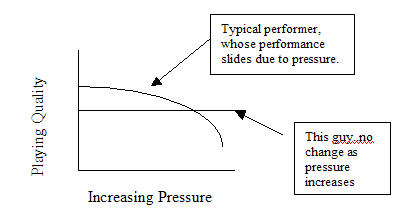
All this reminds me of experiences I had auditioning when I was a student. There was one guy in the studio who, as far as we could tell, was mildly autistic (or at least had some kind of developmental disorder). He wasn't the best player in the studio, but when auditions came around, he didn't became even slightly nervous. Thus, he played pretty much exactly the same way whether in the practice room or in the audition.

Other players would have to deal with nerves and sometimes end up not playing us well under pressure as they had practiced.

I think it drove some people nuts to be "stronger" players but unable to prove it in auditions while this guy simply continued on his even keel.
Here's this idea in graph form:

Of course, I have included a third curve which goes up as pressure increases. This kind of player is sometime referred to as a "money player."

Another way to think of it..

There are two skills in music:
  1. Instrumental skill
  2. Performing skill
A weaker player who is a very strong "money player" can surpass an otherwise stronger player whose auditioning/performing skills are lacking. Nobody can judge you on how hard you worked to prepare. You are only judged on the results coming out of the bell.

The conclusion: you need to have both skills in order to succeed.

Saturday, November 12, 2005

Koussevitsky, RAM and Perlman

Here's a first. I'm posting this from a public wifi hot spot in Augusta, GA. Very 21st century.
I'm in town doing a concert with the Augusta Symphony. One piece on the program: the Koussevitsky Double Bass Concerto.

Now apparently, the only copies of this concerto are bad manuscript. So our soloist has prepared a Finale edition of score and parts. One problem: mistakes.

For example, trombone parts without any rehearsal letters. (and of course no cues!). So there we are trying to count 66 measures and then come in on one chord.

Mildly annoying.

Wait, I'm going somewhere with this. At one point, a woodwind principal asks the conductor if he's conducting in 2 or in 4. He expresses mild irritation because it should be obvious. He's right, BUT, that poor musician is already dealing with a mistake-ridden part. I get the impression that dealing with the bad part is occupying so much attention that less is left for other issues.

Come to think of it, uncertainty doesn't exactly help tone quality.

I also bought a laser printer today. I'm looking over the memory specs and decide to pass on the 2 mb model and pay more for the 8 mb model. I'm figuring, more memory, better hendling of print jobs.

Wait, our attention is like that RAM on the printer. Although flexible, we have some kind of limit. If we use up RAM on bad parts, we have less left for other issues.

Years ago, 60 minutes interviewed Itzhak Perlman. He said he practiced scales while watching sports on TV. At the time I was stunned, shocked, horrified (well not really).

But think about it, if the scales is automatic, that frees up memory to focus on phrasing, balance, and other higher level stuff.

I'm not leading up to some grand moral of the story. Draw your own conclusions.

(I hope you liked the hand-dandy color coding. free of charge.)